The United Nations' maritime agency said on Friday that it had successfully evacuated about 2,500 stranded seafarers from the Persian Gulf before suspending the operation, after an attack on a commercial vessel exposed uncertainty over who can guarantee safe passage through the Strait of Hormuz.
The International Maritime Organization (IMO) said that 115 ships carrying roughly 2,500 crew members had left the Gulf during the first three and a half days of the operation. The figures offered the first concrete measure of an evacuation launched this week to rescue some 11,000 mariners stranded aboard 600 vessels since the war pitting Israel and the United States against Iran erupted in late February.
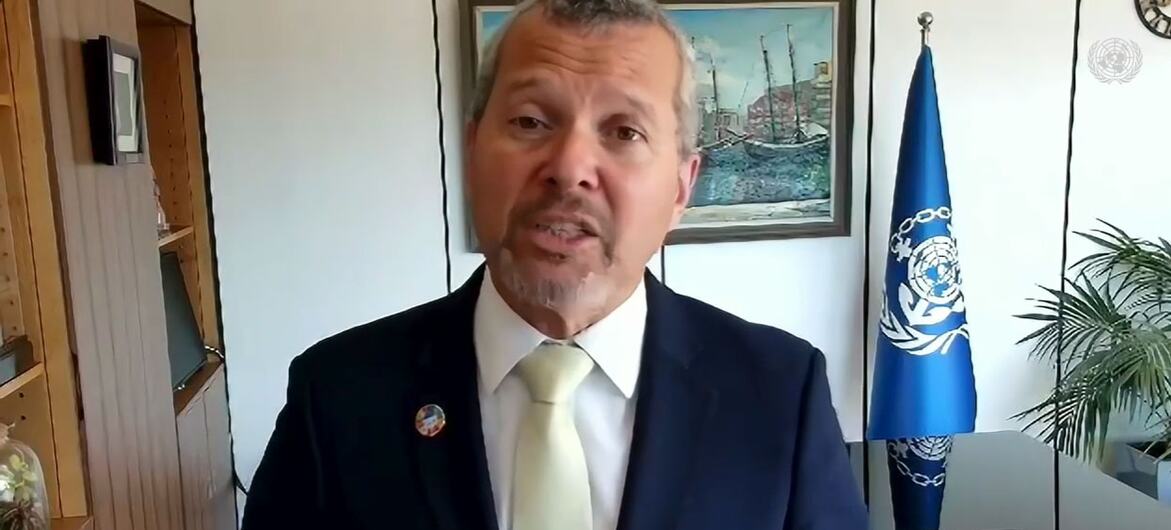
The evacuation was paused on Thursday after a container ship, the Ever Lovely, was struck while transiting the strait near Oman's coast. The vessel was not participating in the IMO-led operation, Arsenio Dominguez, the head of the UN agency, said during a press conference on Friday.
"We're still on the investigation of exactly what happened to the vessel," Mr. Dominguez told reporters from his office in London. But, he added, "what I can confirm to you is [the ship] was not contacting the authorities in Oman in order to transit, following the evacuation framework."
His remarks offered the clearest picture yet of a rescue effort that has become entangled in the fragile diplomacy surrounding one of the world's most strategically important waterways.
A rescue mission meets geopolitics
The Strait of Hormuz, through which roughly a fifth of the world's oil supply passes in peacetime, has become one of the central tests of the preliminary peace agreement reached last week between Washington and Tehran.
Although the memorandum of understanding signed by the two countries ended hostilities and reopened the waterway in principle, it left unresolved a fundamental question: who ultimately controls navigation through the narrow channel linking the Persian Gulf to the Indian Ocean.
Thursday's attack exposed the practical consequences of that ambiguity.
Iran had already warned that only routes authorized by Tehran should be used, while many commercial vessels had been sailing along a southern corridor close to Oman's coastline under arrangements coordinated by Oman, the United States and the IMO.
On Friday, Iranian authorities again asserted their right to regulate traffic through the Strait, underscoring the uncertainty that now hangs over the maritime provisions of the broader peace process.
Two corridors, no guarantees
Mr. Dominguez said his immediate concern was not interpreting the diplomatic agreement but restoring confidence that ships would not come under attack regardless of which route they followed.
"The guarantees that I'm looking to reinstate," he said, are "the safety of the vessels and the seafarers - that there will be no action like the one that took place yesterday in relation to the possibilities of threatening a vessel or attacking a vessel for using one or another corridor."
The agency is now in active discussions with Iran, Oman and the United States to secure renewed assurances before restarting the evacuations.
Despite the pause, maritime traffic has not come to a complete halt.
Mr. Dominguez said preliminary figures showed that four vessels had crossed Friday through the northern corridor administered by Iran, while another 11 had used the southern route with assistance from Oman and the United States. He cautioned that those figures were still being verified.
He also disclosed another obstacle: ships are currently unable to use the internationally recognized traffic separation scheme that has governed navigation through the Strait of Hormuz since 1968, because the central shipping lanes remain contaminated by naval mines.
Instead, vessels are being funneled through two temporary corridors established after negotiations among the parties - one coordinated by Iran to the north and another supported by Oman and the United States to the south.
Asked whether Thursday's attack violated the U.S.-Iran memorandum of understanding, Mr. Dominguez declined to offer a legal interpretation. Instead, he described a step-by-step approach.
"My first priority is the evacuation of the seafarers," he said. "The next priority is, of course, the demining of the Strait of Hormuz."
"Seafarers feel forgotten"
For Mr. Dominguez, however, the crisis remains above all a humanitarian one.
At least 14 seafarers have been killed and more than 40 commercial vessels attacked during the conflict, according to the IMO. Many crews have spent more than three months trapped aboard ships unable to leave the Gulf, relying on outside assistance for fuel, food, medical supplies and even communications with their families.
"Seafarers feel forgotten," Mr. Dominguez said. "Whenever they turn on the news, they listen to how this conflict is really a big negative for the countries, for the global economy, the fuel price, et cetera, and not so much attention on the innocent seafarers."
His appeal reflected the unusual position the IMO now occupies: attempting to keep one of the world's busiest maritime chokepoints functioning while navigating negotiations that extend well beyond its technical mandate.
Only after the seafarers have been brought to safety, he said, can attention turn to the longer-term question that Thursday's attack has thrown into sharper focus: who will ultimately govern passage through one of the world's most consequential waterways.