
The Apprenticeship in Shellfish Aquaculture Program, a collaboration involving Rutgers and industry partners, trains high school students in farming waters
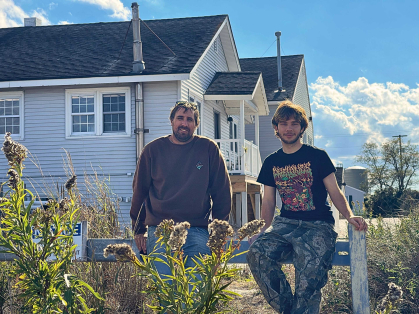
Ryan Myers became interested in New Jersey's oyster farming industry two years ago when a Rutgers aquaculture expert spoke at his high school.
Myers, now 18, heard about Apprenticeship in Shellfish Aquaculture Program (ASAP), a workforce development program offered through Rutgers and its partners connecting students with businesses to learn about New Jersey's oyster farming and receive on-the-job training.
The program starts with a one-week boot camp of intensified training followed by eight weeks of apprenticeship at a business. Students learn about shellfish hatchery operations in parallel with small business skills such as marketing, balancing finances and aquaculture regulations.
"The boot camp is the heart of the program," said Michael Acquafredda, assistant extension specialist in aquaculture at Rutgers-New Brunswick, who spoke at Myers' school. "It ensures that each apprentice receives basic training and can operate safely on a farm. But the apprentices really develop their skills during their farm-based work placements, and they learn those skills directly from our partner farmers."
The program appealed to Myers.
Everything you do here goes to food production - the most basic need.
Ryan Myers
That summer he began working under the guidance of Matt Williams, who owns South Bay Shellfish Company, a wholesale oyster farming and shucking company in Cape May. The operation is fairly local - most, but not all, of his oysters are sold in Cape May County. It's also a small operating team, consisting only of him, his wife, his brother and now Myers.
The timing of Myers' arrival was right. The business was being housed in a new building with new machinery and Williams said he "wanted another set of hands to see the optimal rate of hands needed to work this machinery."
By learning to cultivate oysters and other shellfish, Myers and students like him walk a path deeply rooted in New Jersey history. Rutgers has been involved in shellfishery research since the late 1800s and the Haskin Shellfish Research Laboratory is now situated in Port Norris, N.J., which is a historic oyster village with a rich history of harvesting and shucking.

Oyster production in New Jersey reached its heyday in the late 19th and early 20th centuries, but, after years of overharvesting and two devastating diseases (MSX in the 1950s and Dermo around the 1980s and 1990s), the oyster populations dwindled. In response, Rutgers committed to breeding disease-resistant oyster lines. Today, the seeds from those lines are can be licensed by local farmers.
New Jersey oysters have been making a comeback since the 2010s - and the Rutgers Coastal Campus has spent the past 100-plus years supporting this resurgence.
ASAP was designed by the Haskin Shellfish Research Laboratory (part of the Rutgers Coastal Campus), the New Jersey Sea Grant Consortium, and local industry partners.
"Oyster farming is a restorative practice," Acquafredda said. "ASAP supports our greater mission at the Haskin lab to make our science usable and used."
As of 2023, the New Jersey shellfish industry accounted for about 90% of New Jersey's total aquaculture sales. Direct sales of mollusks, namely oysters and clams, had an estimated value of $11.78 million, according to the National Agricultural Statistics Service. With ASAP, students have the opportunity to engage in this blue economy.
Since its inception in 2022 to now, ASAP has worked within the Atlantic, Cape May, Cumberland, Monmouth, Ocean and Salem counties to promote aquaculture literacy. Through in-classroom lessons, the ASAP team has engaged more than 1,500 high school students in an effort to educate and recruit. Of those that apply, less than 15 students are selected for the program each year.
ASAP was envisioned to hook young people into an industry they might not have even heard of and fill a need for seasonal and full-time workers. The program has trained 33 students, with 64% of the latest cohort continuing to work with their partner farmers in some capacity in the summer after the program ended.
"I don't think there is a program like this elsewhere in the state," said Jenny Shinn, a Rutgers field researcher who works with Acquafredda. She specializes in oyster restoration and community education.
The program was designed from the start to include members of the local industry as much as possible. One of the original collaborators is Lisa Calvo, a former Rutgers marine scientist and celebrated oyster farmer whose restaurant, Sweet Amalia Market & Kitchen, was named in the New York Times' 2024 Restaurant List.

"ASAP was her brainchild," Acquafredda said. "Because of her uniquely keen insight into the skills the oyster industry needs "[Lisa] keeps us real and realistic."
Acquafredda also collaborates with Diana Burich, the New Jersey Sea Grant Consortium's director of education, to design this out-of-school educational experience. Together, they run a part of the program out of the Cape Shore Laboratory and the New Jersey Aquaculture Innovation Center, both part of the Rutgers Coastal Campus.
ASAP has been renewed until 2027 by the National Oceanic and Atmospheric Administration's National Sea Grant Program and organizers of the program hope to eventually turn ASAP into a sustainable long-term partnership with its industry partners.
Farmers believe in this program.
Michael Acquafredda
During the apprenticeship, Myers and Williams were working full-time, often spending around half the day in the water and half the day sorting the catch. Along the way, Williams found himself teaching Myers other crucial skills that popped up when running an oyster farm, such as welding.
Myers chose to stay with the company after the program. These days he is simultaneously working with Williams and earning a data science degree online. Myers said he plans to continue working on the farm after he graduates and starts looking for a job in his field of study.
"If AI takes tech away from me, at least oyster farming works out," he said jokingly.
Williams said Myers "came with a good work ethic. And if you learn how to work hard as a teenager, it sets you up for life."
Williams credits ASAP for selecting hard-working candidates who are keen to listen, learn and work. He added students "don't have to want to work here their whole life, but it does teach them hard work and responsibility."
The program is recruiting for its 2026 cohort. High school students interested in participating in ASAP are encouraged to review the program's website.
Applications are due on Friday, March 27, 2026 by 5:00 p.m.
Mitaali Taskar is a research project assistant in the Rutgers Department of Marine and Coastal Sciences.


