
A new international survey reveals clear differences in how veterinarians and animal welfare scientists in Japan and the UK perceive animal welfare, particularly animal behaviour.

Animal welfare is gaining increasing global attention, but what it means to ensure a "good life" for animals can vary across cultures. The World Organisation for Animal Health defines animal welfare not only as 'the physical and mental state of an animal in relation to the conditions in which it lives and dies' but also as a 'complex and multi-faceted subject with scientific, ethical, economic, cultural, social, religious, and political dimensions,' suggesting the potential for cultural diversity in its understanding.
Indeed, Japan is grappling with the challenge of improving animal welfare while still respecting long-standing cultural values. To address this challenge, a research group led by Assistant Professor Yuki Otani at the One Health Research Center in Hokkaido University surveyed veterinarians and animal welfare scientists in Japan and the United Kingdom (UK), the country that pioneered the modern animal welfare movement.
The survey was based on the widely used Five Freedoms framework, which outlines key conditions necessary for animal welfare. Respondents in both countries rated survival-related freedoms, such as the freedom from hunger and thirst, fear and distress, pain, injury, and disease, to be highly important. In contrast, situation-related freedoms, such as the freedom from discomfort and the freedom to express normal behaviour, were generally rated as less important. In particular, fewer respondents in Japan recognized the importance of the freedom to express normal behaviour for domesticated animals compared with their UK counterparts.
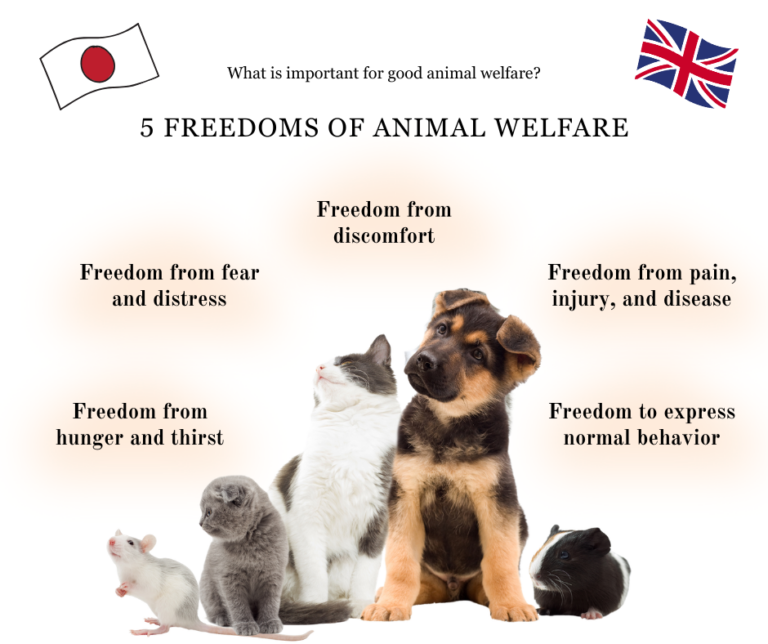
These differences were reflected in real-life scenarios. In Japan, cats are commonly kept strictly indoors, while outdoor access is viewed as beneficial for their welfare in the UK. Veterinary professionals in Japan tended to focus more on the risks of outdoor access, such as getting injured, becoming lost, or causing conflict with neighbours, rather than the potential benefits of allowing cats to enjoy the outdoor environment.
Differences were also seen in making end-of-life decisions for dogs. When presented with a case involving a dog suffering from an incurable tumour, most respondents in both countries would opt for euthanasia to alleviate intractable pain or mental stress. However, responses diverged significantly in scenarios concerning the loss of normal behaviour, such as a dog's inability to walk. In these situations, euthanasia was more commonly chosen by respondents from the UK, whereas Japanese respondents largely favoured continuing care.
This gap suggests that, in Japan, an animal's inability to express normal behaviour may not be closely associated with mental suffering. This could reflect cultural differences in how "normal behaviour" is perceived for animals, or even for humans perhaps, the researchers suggest.
The study shows that efforts to improve animal welfare can sometimes conflict with cultural traditions. "Achieving improved welfare for animals is undeniably a priority," says Otani. "At the same time, preserving valuable cultural traditions for future generations is also vital. More international and domestic research and dialogue are needed".
The researchers note that the human-animal bond often mirrors human-human relationships. Differences between Japan's interdependence-oriented culture and the UK's more individualistic society appeared to shape attitudes toward animals in this study. Further research with a broader perspective could explore how societal values influence the evolving relationship between humans and animals.
Original article:
Yuki Otani et al., Cross-cultural variation in understanding of animal welfare principles and animal management practices among veterinary and animal welfare professionals in the UK and Japan. Animal Welfare. August 6, 2025. DOI: 10.1017/awf.2025.10026.
Funding:
This study was supported by the JSPS Overseas Challenge Programme for Young Researchers, JSPS Overseas Research Fellowships programme, JSPS post-doctoral fellowship, and JSPS KAKENHI grant.


