Sleeping rough for a single night is an inadequate simulation of homelessness, but it can still leave a mark, writes ACU's Vice-Chancellor and President, Professor Zlatko Skrbis.
It's still dark at the Roma Street Parkland in Brisbane, a dry winter's night in mid-June. At about four in the morning, the city begins to wake, and you hear it before you see it. A train, a bus, a siren in the distance, the commotion of the place emerging quite suddenly.
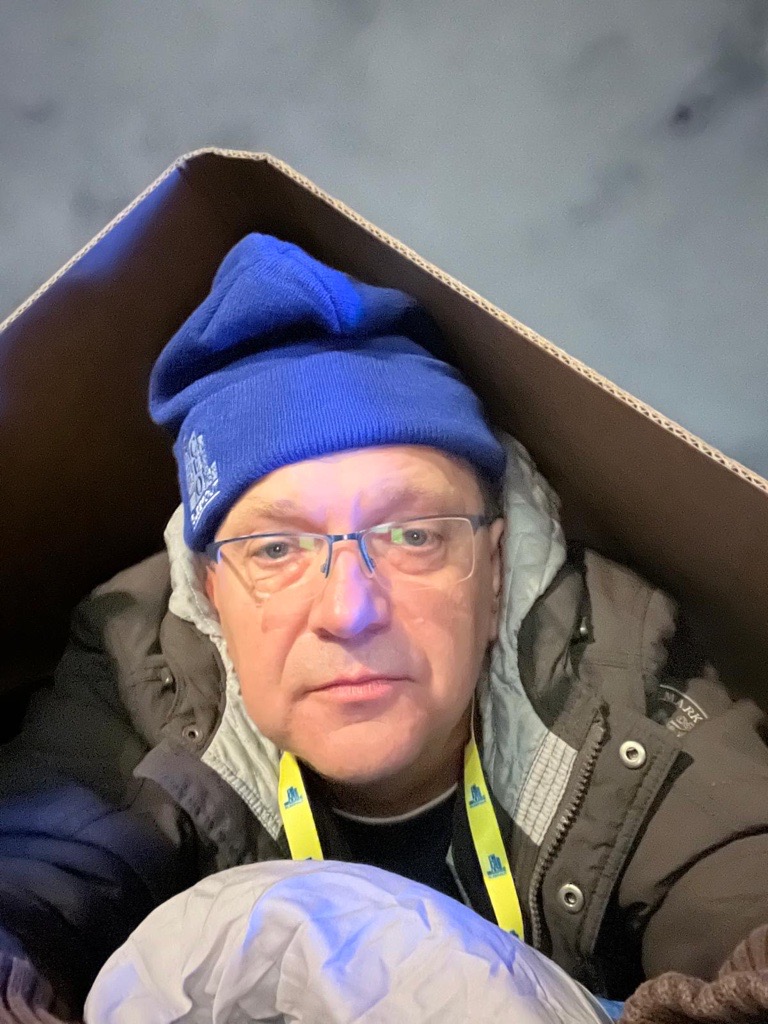
Around me, CEOs are disassembling their shelters made of cardboard, wrestling out of sleeping bags as they yawn and raise their heads. I do the same. By 5am, most of us have folded our makeshift dwellings into flat sheets of carton.
The switch flips quickly. In a moment, we are once again busy people, checking our watches and phones, working out where we need to be at the beginning of another day of meetings and decision-making. I spot some familiar faces from the night before, say my goodbyes, and then walk down the path towards the main road to order an Uber.
That's where I see him. A lone gentleman, rugged up and sleeping under the light of the bus station. A real version of the type of person that I and other participants in the Vinnies CEO Sleepout had spent one night trying to understand and imitate.
This juxtaposition was really quite stark to me. I had an Uber coming, a hot coffee and a warm bed waiting for me, as well as the comfort and security of home and work. He would soon wake to the same morning he had likely woken to the day before, and the one before that, without much comfort or a safety net, without the certainty that most of us take for granted.
This was my first CEO Sleepout, and I want to be honest about what the night was. My one night of sleeping relatively rough (and the word 'relatively' is doing a lot of work here) was nothing like real homelessness. It had an entry point and an exit, both built into the experience before it began.
There is a word for a thing that takes on the likeness of another thing without its substance: a simulacrum. This was made famous by the French sociologist Jean Baudrillard, and when I saw the man at the bus station, I understood that the night I'd just spent in central Brisbane was exactly this. The thought sat with me uncomfortably as I jumped into my Uber and slipped back into my life.
And yet the night was not nothing. The St Vincent de Paul Society, the Catholic lay organisation that runs the CEO Sleepout, recently announced that this year's event raised more than $10 million nationally – a record, at a time when the demand for homelessness services continues to climb.
The not-for-profit organisation, which has long had a close connection with ACU, is clear that the annual sleepout doesn't aim to replicate homelessness. Rather, it hopes to "build understanding and turn that into real action" for the people it supports.
This is where I think the real power of such an event lies.
In Brisbane that evening, we were met by a group of student volunteers from the Ozanam Leadership Program. They asked us to imagine we were a woman named Clara, a 29-year-old Gold Coast mother with four kids and a life coming apart. Clara is desperate and urgently needs to find safety. She is recovering from an abusive relationship and drug addiction, with only her car to house her young family.
The students handed us cards naming 20 or so items that one might need in a situation like this: a phone, a charger, a birth certificate, toiletries, medication and a blanket. Imagine you're Clara, they said, and choose 12. We did, and we were rather pleased with ourselves, practical and reasonable. Now choose six. And now three.
This was where something tightened in my chest, because suddenly I was transported to a situation where Clara is trying to escape her abusive partner with her four kids, and as she hurriedly grabs some things and stuffs them in the car as she races away, she's a woman with seconds to decide.
In that crisis, that heightened anxiety and cold anger, she's bound to choose wrongly, because nobody can choose well in these conditions. It occurred to me that this is precisely what we then judge people for – decisions made in circumstances that make good decisions impossible.
Homelessness frequently evokes judgment. Despite the evidence, a stigma persists that those who fall on hard times have only themselves to blame. The true causes, however, are structural rather than personal: a mental illness, a family breakdown, a housing market that's closed its doors. For many people, these are everyday realities that leave them with choices that are never easy to make.
I have thought often, since that morning, about people like Clara. About the man asleep at the bus station. I know nothing about his circumstances, and I never will. So, who am I to judge?
One night on cardboard cannot replicate homelessness, but it can do other things. It can redirect much-needed funds from those who have them to those who need them. And it can do something smaller that's also valuable. It can interrupt the habit of not seeing.
I am not suggesting we stop for every person we pass. Only that we never pass without a thought, because that thought is where it starts. That small refusal to look away might make doing something feel necessary.
And there's a great deal to be done. We can give to organisations, the St Vincent de Paul Society among them, that provide the crisis accommodation and practical support this problem demands. We can pressure governments to treat housing as the essential infrastructure it is, and to act at the scale the crisis requires.
This work is easier when more of us notice. And that, to put it simply, is why events like the CEO Sleepout are worth doing.
Donate to the St Vincent de Paul Society's winter appeal