
The early morning of 8 December offered a reminder that, in accelerator operations, not everything always goes according to plan. During the final weekend of the 2025 LHC run, the machine had been running almost like a Swiss clock, with short turnaround times (i.e. the interval between dumping one fill and declaring stable beams for the next) and with most fills being dumped by the LHC Engineer in Charge.
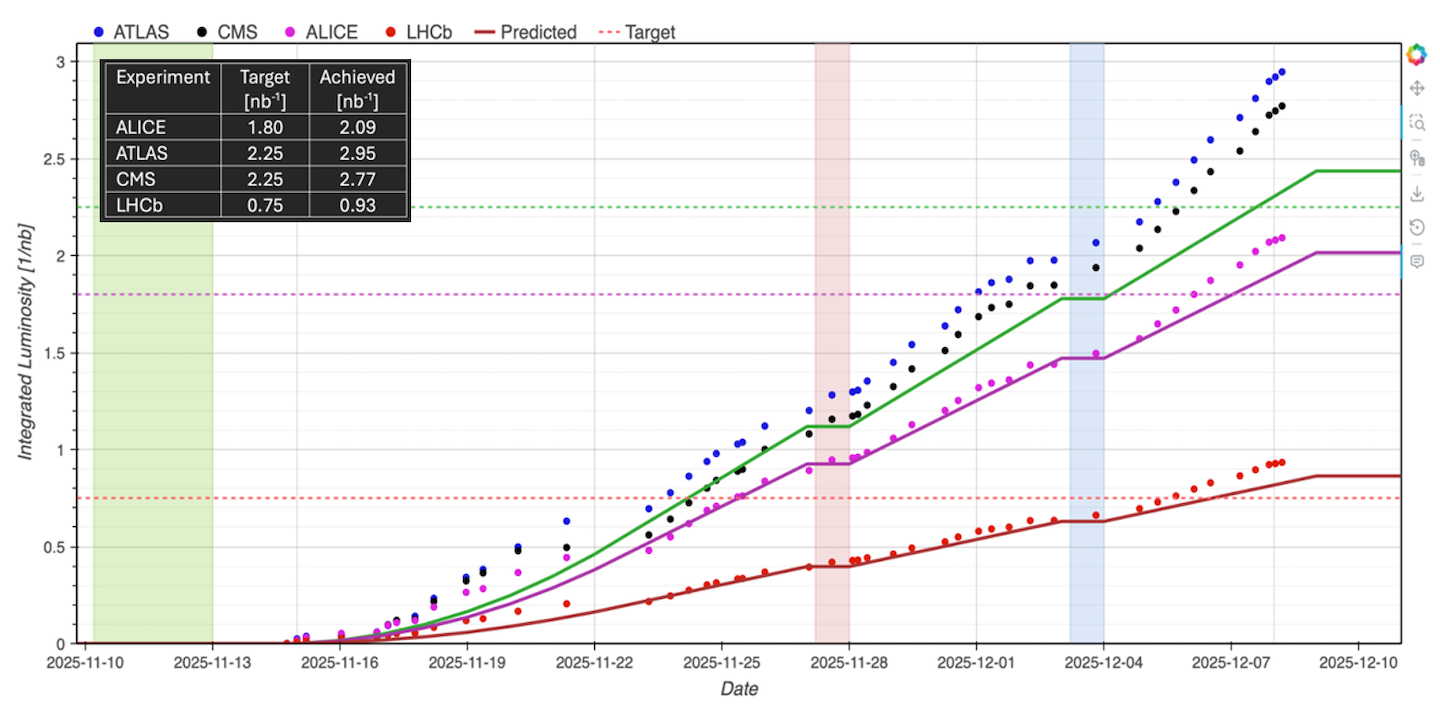
At 2.50 a.m. on 6 December, ALICE was the last of the four experiments to reach its integrated luminosity goal for 2025. With more than 50 hours remaining before the scheduled end of the run, it looked like there was ample time to exceed the year's targets. The LHC continued to perform well, but early on 8 December, some end-of-run equipment tiredness seemed to creep in. The final two fills of 2025 were dumped by the machine protection system due to faults in one of the radiofrequency power transmission lines. The first at 1.33 a.m. on 8 December, and the second at 4.34 a.m., which turned out to be the last beam dump of 2025. Only 1.5 hours remained until the planned end of the run.
Once again, this end-of-run episode highlights a familiar truth: we can plan meticulously, but reality always has the final say.
While the LHC run had come to an end, the injectors continued to deliver beams to the fixed-target experiments until the very last moment. At 6.00 a.m. on 8 December, the operators in the injector chain stopped all beam production, inserted the beam stoppers and began powering down the machines. This precise shutdown time may seem surprisingly early. What could possibly happen so soon in the day other than beam operation? The answer is straightforward: access to the accelerator tunnels begins around 8.00 a.m. The two-hour window is needed for radiation cooldown, ensuring that the teams eager to start their tightly scheduled work in the tunnels can do so safely.
The LHC equipment was also powered down immediately after the final beam dump. Because the LHC is a superconducting machine, one additional critical step must be completed before CERN's annual closure: securing the helium inventory at the surface. During operation, the helium circulating in the magnets is liquid at 1.9 K (-271 °C). During the year-end technical stop (YETS), however, this liquid helium is extracted from the machine and the magnets are warmed up to around 20 K (-250 °C), leaving only gaseous helium in the system. This procedure greatly reduces the risk of losing a substantial amount of helium in the event of an unexpected leak in the underground cryogenic circuits. It also significantly lowers the power consumption of the cryogenic system, resulting in both energy and cost savings.
With the entire accelerator complex now stopped and many people working on machine equipment, preparations for the 2026 run are already under way. For the first injectors in the chain, most of the work will need to be completed before the two-week annual closure, because the Linac4 source is scheduled to restart on 5 January. The remaining machines will follow during the four weeks after the source restart. This timing is 3.5 weeks earlier than the 2025 start. Activities planned during the YETS have been reduced to what is strictly necessary in order to make the most of the available time until the start of Long Shutdown 3 (LS3), planned for 29 June for the LHC and 31 August for the injector complex.
On 19 December 2025, all tools will be set down, or at least most of them, for a well-deserved break during the festive period. Nevertheless, a small team will remain on site. Among them, the Technical Infrastructure (TI) operators in the CERN Control Centre (CCC) will continue to monitor CERN's technical infrastructure and coordinate interventions in case issues arise. For everyone else, a two-week period of "battery charging" begins, in preparation for what promises to be another busy year leading up to LS3.
This is my final Accelerator Report, not only for 2025, but also as leader of the Operations group (BE-OP). As of January, Bettina Mikulec will take the helm, while I move on to the Technology (TE) department for new adventures.
It has been a pleasure and a privilege to share news about the running of the accelerator complex with you over these past years. I am confident that Bettina and her team will continue to keep you well informed about the LHC and its injector complex throughout 2026 and beyond.
In the meantime, I wish you all a wonderful Christmas break and a happy, healthy and successful 2026.


