Journaling about one's identities from childhood through early adulthood may offer an accessible, low-cost way to help young adults struggling with depression, according to new Cornell psychology research.
In a study involving more than 100 people aged 18 to 29 experiencing moderate to severe depression, participants who reflected on their life story reported significantly reduced symptoms two months later, compared to a control group.
As a possible complement to therapy, the researchers said, the two-week journaling exercise could be a promising strategy for adults open to reflecting on their past, present and future identities - but perhaps less so for those prone to ruminating about negative experiences.
"Something about journaling based on your identities and connecting them through time - throughout your life story - appears to be psychologically beneficial," said Christopher Davis, a doctoral candidate in the field of developmental psychology affiliated with the Purpose and Identity Processes Lab. "Connecting yourself back to yourself in such an explicit manner, and thinking about how you can take that forward, seems to be therapeutic."
Davis is the first author of "Strengthening Self-Continuity to Reduce Depressive Symptoms and Derailment: A Multiphasic Mixed-Methods Randomized Controlled Trial," published in the Journal of Consulting and Clinical Psychology. Co-authors are Emma Levinbook '26; Sydnie Spearman, a therapist with LifeStance Health; Cassondra Lyman, a doctoral candidate in the field of social psychology and member of the Better Outcomes Laboratory; and Anthony Burrow, the Ferris Family Associate Professor of Life Course Studies in the Department of Psychology and College of Human Ecology, and director of the Purpose and Identity Processes Lab.
The new research advances prior work finding that people who can form a thematically coherent narrative about their lives may be psychologically stronger, compared to people whose life stories feel more fragmented.
Focusing on young adults - the fastest-growing group among the 29% of U.S. adults reporting they'd been diagnosed with depression in 2023 - the study tested whether bolstering a sense of identity and continuity could reduce depression and "derailment," a perceived mismatch between current and past identities.
A first study phase measured depression, derailment and self-continuity among nearly 260 participants recruited online. From that group, 111 qualified to participate in the journaling project because they had at least moderate depression symptoms, based on a commonly used scale. Half were randomly assigned to a control group that wrote about everyday activities, like a trip to the grocery store, and the other half to the experimental group.
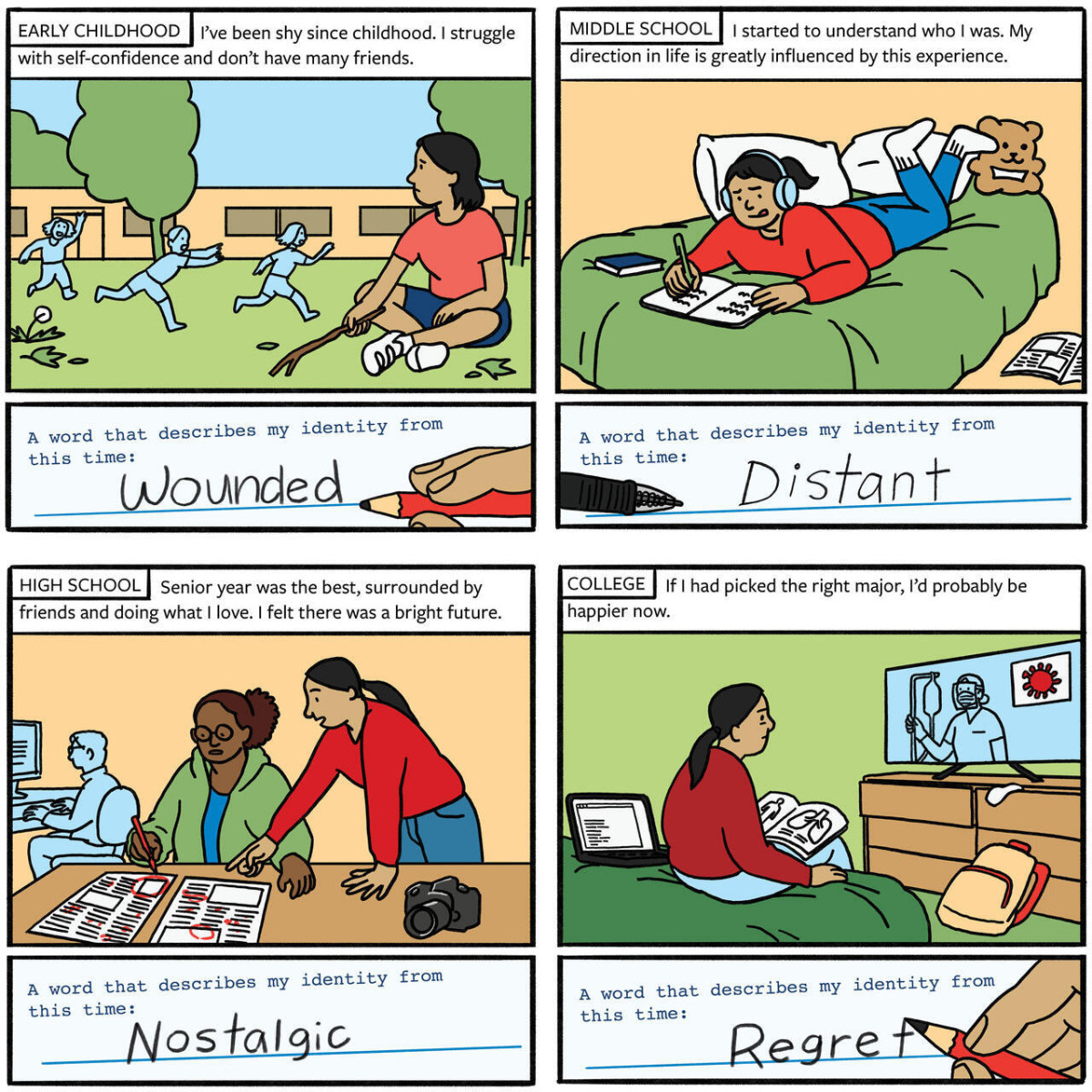
Over two weeks, the latter group responded to five prompts asking about their motivations, passions or goals at different life stages - early childhood, middle school, high school, college and their desired future - and how those experiences affected their current direction. Participants summarized their identity during each period in a word - examples included "sapling," "determined" and "inquisitive" - and reviewing those words later appeared to be a powerful experience for many, Davis said. Symptoms were measured during the program and both two weeks and two months after completion.
Results showed that two months later, the group that reflected on their identities at different points in time on average reported feeling significantly less depressed, less derailed and more connected to their past selves than the control group, which returned to baseline levels. That suggested the reported improvement was related not just to the act of journaling but to its content.
In a final phase, the researchers investigated why many participants experienced fewer depressive symptoms, but about a quarter saw no change. Their analysis of journal entries showed that those making the biggest gains had engaged in "reflective self-evaluation," responding more introspectively, including recalling some positive aspects of their past, like a college semester of self-discovery. Those who benefitted least displayed "ruminative brooding," with minimalist journal entries emphasizing more negative experiences - a high school audition that heightened feelings of isolation.
"More introspective respondents did something we don't typically do in daily life that is more, 'Go, go, go, what's the next step,' rather than, 'Where did I come from, and what parts of that story do I want to bring with me into the future,'" Davis said. "Taking a step back and looking through your life may help you realize, 'I'm actually not that far off track.'"
The team said additional research could fine-tune the journaling methods and address limits to their study. But they said the intervention as is could give clinicians a useful tool alongside structured care.
"This work demonstrates an accessible, actionable way to address this growing issue that we see in emerging adults of simultaneous increases in depression and loss of identity," Davis said. "If someone is willing to do this, these journaling prompts could offer a promising avenue for symptom relief for a vast number of people."