A new study using Explainable Artificial Intelligence (XAI) has revealed land-use change - particularly deforestation and unplanned agricultural expansion - is dramatically intensifying heatwaves across Africa, with findings that carry direct implications for Australia's warm climate.
While the research focused on Africa, the physical mechanisms behind this amplification were universal.
"The way land use interacts with heat is not regional - it's fundamental physics," said co-lead researcher Dr Chris Ndehedehe, from Griffith University's Australian Rivers Institute.
"Although our case study is Africa, the patterns we uncovered are highly relevant to Australia, especially given recent extreme heat in Queensland."
The study, published in Earth Communications and Environment warned heatwaves were shifting from short-lived events to a "near-perennial state" in some regions.
Under high-emissions scenarios, parts of Southern Africa could experience more than 100 days of extreme heat per year.
In certain locations, heatwaves were projected to become 12 times longer and more frequent by the end of the century if current emissions and land degradation continued.
"Heatwaves are no longer just weather events; in many regions, they are becoming the climate itself," said Dr Oluwafemi Adeyeri, a Research Fellow at the Australian National University.
"This study highlights that this is not just about temperature. In regions with dense vegetation or high soil moisture, high humidity combines with heat to create dangerous physiological stress conditions, which are often underestimated by temperature readings alone."
By analysing climate drivers using XAI, researchers found land-use changes significantly reduced the land's ability to cool itself.
When forests were cleared for crops or pasture, evaporation dropped, breaking down natural climatic buffers and creating a dangerous local warming feedback loop.
"We found land-use change doesn't just alter the landscape; it effectively turns up the volume on heatwave intensity," Dr Adeyeri said.
"Converting forests to cropland or pasture reduces the land's ability to cool itself through evaporation."
The study also highlighted the often-overlooked danger of heat and humidity in areas with high vegetation or moist soils, where humidity could combine with heat to produce life-threatening physiological stress not captured by temperature readings alone.
Dr Ndehedehe noted strong parallels between the study's findings and recent climate extremes in Queensland. Rapid urbanisation and land clearing in South-East Queensland limited natural cooling in the same way observed in African regions.
"The physics identified in this paper apply globally," Dr Ndehedehe said.
"This research shows that managing land use and protecting green infrastructure is just as critical as reducing emissions. It provides evidence that planning green infrastructure and managing land use is just as critical as reducing carbon emissions for protecting communities from extreme heat."
Dr Chris Ndehedehe
The researchers suggested Brisbane's recent combination of oppressive humidity, intense heat, and sudden storms mirrored the compound events identified in the study - heat interacting with high atmospheric moisture to create volatile, high-impact conditions.
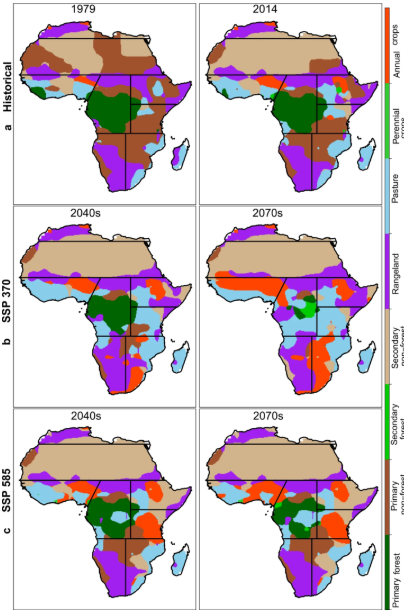
Importantly, the study findings highlighted that following a moderate emissions pathway (SSP370) could dramatically reduce the duration and severity of future mega-heatwaves.
"Adaptation cannot stop at the thermometer," Dr Adeyeri said.
"To build resilience, we must integrate climate policy with smart land management."
The study 'Coupled climate-land-use interactions modulate projected heatwave intensification across Africa' has been published in Earth Communications and Environment.