
'As students face an increasingly complex world, these conversations help prepare them to engage thoughtfully with questions that have no easy answers'
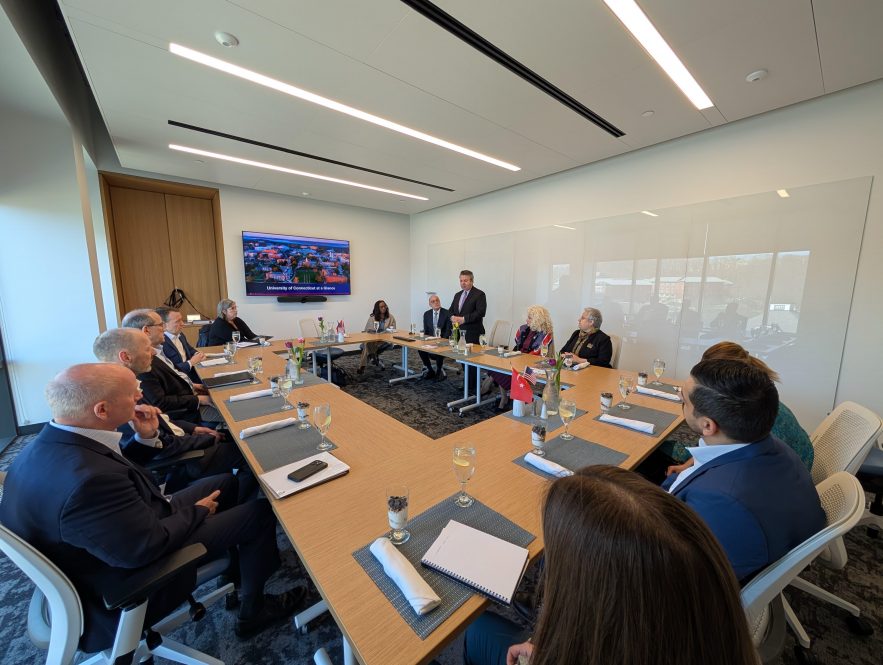
Sedat Önal, Ambassador of the Republic of Türkiye to the United States, meets with UConn and private sector leaders at Science 1 during a visit to Storrs (UConn Photo).
As part of his first-ever visit to Connecticut, Sedat Önal, Ambassador of the Republic of Türkiye to the United States, visited UConn Storrs for a discussion on international relations and Türkiye's evolving role in global affairs and met with industry leaders to discuss economic connection between the two countries.
The discussion event, titled "Türkiye at the Crossroads: Türkiye's Role from the Middle East to Ukraine," drew students and faculty for an afternoon of thoughtful dialogue on some of the world's most pressing geopolitical questions. Hosted by the Provost's Office in collaboration with the Department of Political Science, the discussion highlighted UConn's commitment to bringing world leaders and global outlooks directly to students.
"This visit marks an important moment for Connecticut, as we were honored to welcome Ambassador Önal for his first official trip to our state. It is especially meaningful that he chose to visit UConn," said Interim Provost and Executive Vice President for Academic Affairs Pamir Alpay. "Our discussions highlighted the strong and growing ties between Türkiye, Connecticut, and the United States, particularly in areas of research, innovation, and industry collaboration. UConn is proud to serve as a bridge between academic excellence and global partnership. We look forward to building on this momentum with our colleagues in government and the business community."
Professor Oksan Bayülgen moderated the conversation, engaging Önal on topics ranging from regional diplomacy to the future of international institutions. The relaxed, conversational format allowed for genuine exchange, with the ambassador responding to student questions with candor and depth drawn from his extensive career in Turkish foreign service and at the United Nations.
Understanding Complex Neighbors
A significant portion of the discussion centered on Iran, a neighboring country that, as Önal noted, shares a border with Türkiye that "has remained the same since before the foundation of America." He offered students a nuanced framework for thinking about the relationship between the Iranian state and the Iranian people, emphasizing that progressive movements within Iranian society, particularly among women, often go unrecognized in Western discourse.

The ambassador traced the historical roots of current tensions, helping students understand how events like the 1953 coup that overthrew Iran's democratically elected Prime Minister Mohammad Mossadegh continue to shape Iranian perspectives today. From the American side, he acknowledged the lasting impact of the 1979 hostage crisis, describing these as "psychological and emotional" factors that remain part of the story.
His message to students was one of patience and understanding: meaningful change in complex societies must be evolutionary rather than imposed, driven by people themselves through reflection and self-determination.
The View from Türkiye
Önal painted a picture of Türkiye's unique position at the intersection of multiple regions and conflicts. The country's relationship with neighboring Iran, he explained, has always balanced "cooperation and rivalry" a dynamic shaped by centuries of shared history, geographic proximity, and cultural connections that include nearly 30% of Iran's population being of Turkish origin.
He spoke candidly about Türkiye's broader regional engagement, from Ukraine to the Middle East, from the Caucasus to the Balkans. "This is a country with the capacity to generate stability," he said, describing Türkiye's active role in pursuing diplomatic solutions across flashpoints.
Defending Institutions, Embracing Dialogue
When students engaged him on the future of international institutions like the United Nations and NATO, Önal offered a thoughtful reflection. While acknowledging their limitations, he emphasized that these organizations provide essential platforms for dialogue, even when they cannot resolve every conflict.
"Even at minimum, this is very important," he said of the UN's role in giving countries under pressure a platform to express themselves to international public opinion. He noted that beyond conflict resolution, these institutions do vital work on economic development, human rights, and humanitarian assistance that often goes unrecognized.
The conversation touched on leadership styles in foreign policy, with the ambassador advocating for balance between decisive action and inclusive consultation. "Nobody can be in a position to know everything in each and every case to make the correct decisions," he reflected. "To the extent this is coordinated, it is better."
Career Advice and Community Connections
The discussion took a practical turn when students asked about careers in diplomacy. Önal's advice was concrete: learn a second language early, and choose it strategically based on the region where you want to build expertise. "The earlier you decide about your career, the more comfortable you can be over time," he told students. "When you reach positions of decision-making, you will be more equipped because of this focus."
He also spent time discussing the Turkish community in the United States, sharing observations about the challenges of maintaining cultural connections across generations and social groups. The conversation revealed his genuine interest in supporting student organizations and fostering connections between different parts of the community.
Members of UConn's Turkish Student Association were present, and the ambassador engaged warmly with them about their upcoming events and the challenges of bringing students together across busy academic schedules.
As the formal discussion wrapped up, students gathered around to continue conversations in a more informal setting. The ambassador's willingness to stay and engage one-on-one reflected the collaborative spirit that defined the afternoon.
"We continue to offer these visits and programs as a pathway for helping students see beyond their own borders and broaden their global perspectives - a skill they will rely on to navigate an increasingly interconnected world," said Ngozi Taffe.
Global Connections in Academia and Industry
As part of his visit, Önal met with a group of representatives from major Connecticut companies to discuss economic and academic collaboration involving Türkiye, the U.S., and UConn.
"Ambassador Önal's visit reminded the UConn community that the most complex global challenges require not just expertise, but empathy, historical understanding, and a willingness to see multiple perspectives," said President Radenka Maric, who met with Önal during his visit to Storrs. "As students face an increasingly complex world, these conversations help prepare them to engage thoughtfully with questions that have no easy answers."


