

Car insurers are leaving many Australians guessing about the factors driving sharp and repeated premium increases, an ASIC review has found.
Motor vehicle insurance premiums rose by 8% in the 12 months to July 2025, outpacing inflation and adding pressure to household budgets. This followed growth of more than 42% between 2019 and 2024.
The findings, released today in ASIC Report 838 Road testing transparency in car insurance premiums (REP 838), examined eight insurance brands across five insurers, representing around 72% of the market, and included consumer research involving more than 2,000 Australians.
ASIC Commissioner Alan Kirkland said: 'With many households already facing cost-of-living pressures, consumers deserve to know why premiums are going up so they can decide whether to stay with their current insurer or shop around.'
Yet ASIC identified that none of the insurers reviewed explained the key factors that affected how premiums were calculated in quote and renewal documents, or why they had changed from the previous year.
'Most insurers gave only generic explanations in supplementary documents, with some providing no explanations at all. This fails to meet the needs of customers trying to understand the reasons for significant price increases,' Mr Kirkland said.
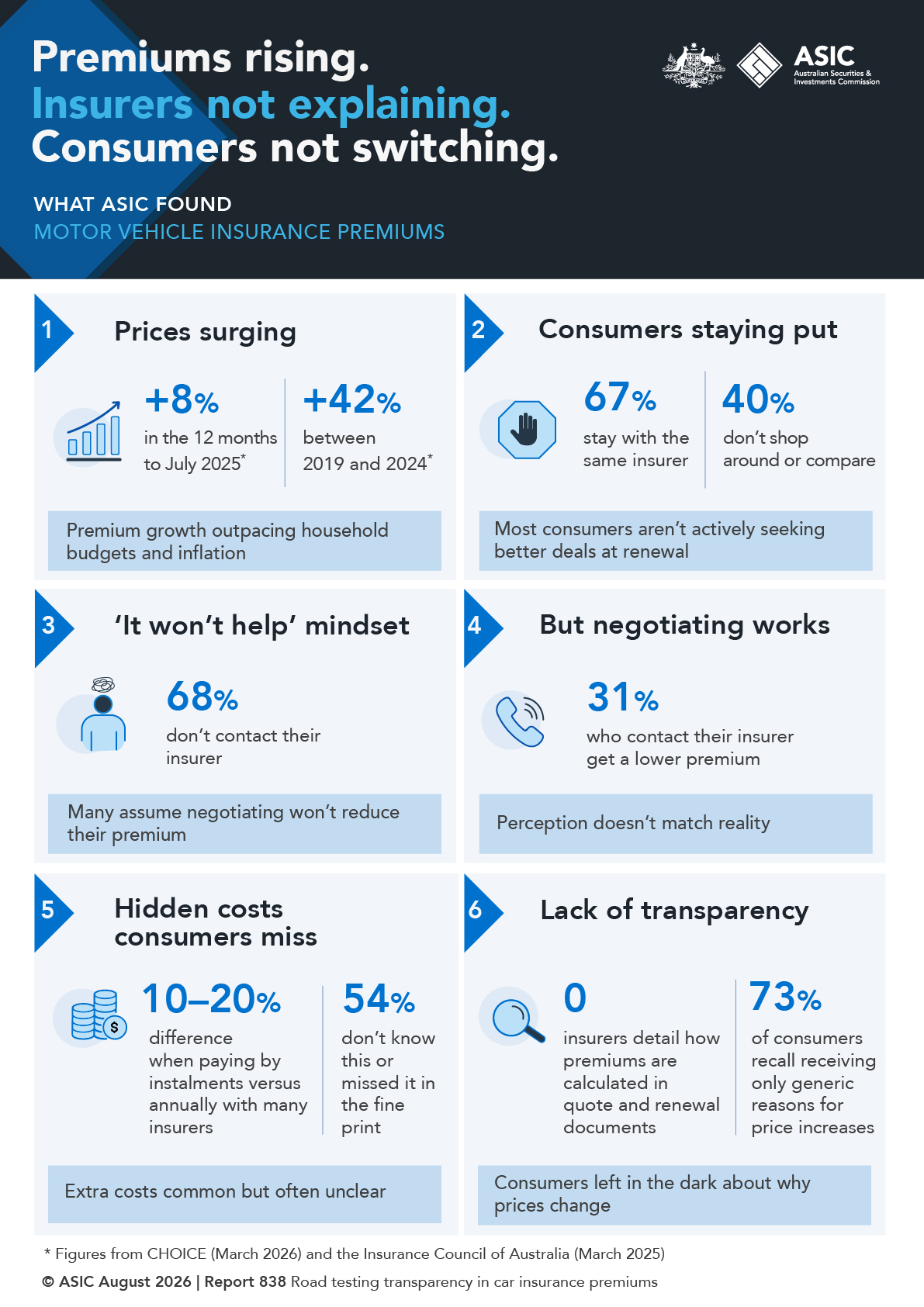
Infographic - Premiums rising. Insurers not explaining. Consumers not switching. (text version)
What ASIC found
Motor vehicle insurance premiums
Prices surging
+8% in the 12 months to July 2025*
+42% between 2019 and 2024*
Premium growth outpacing household budgets and inflation
Consumers staying put
67% stay with the same insurer
40% don't shop around or compare
Most consumers aren't actively seeking better deals at renewal
'It won't help' mindset
68% don't contact their insurer
Many assume negotiating won't reduce their premium
But negotiating works
31% who contact their insurer get a lower premium
Perception doesn't match reality
Hidden costs consumers miss
10-20% difference when paying by instalments versus annually with many insurers
54% don't know this or missed it in the fine print
Extra costs common but often unclear
Lack of transparency
0 insurers detail how premiums are calculated in quote and renewal documents
73% of consumers recall receiving only generic reasons for price increases
Consumers left in the dark about why prices change
*Figures from CHOICE (March 2026) and the Insurance Council of Australia (March 2025)
© ASIC August 2026 | Report 838 Road testing transparency in car insurance premiums
ASIC found that where insurers charged more for paying in instalments, they did not clearly explain in renewal notices that consumers could save up to 20% by paying annually.
'A cost saving of 20% can go a long way. There is no excuse why some insurers cannot communicate such a basic benefit to customers,' Commissioner Kirkland added.
Price was the main consideration for many Australians. ASIC's research showed 37% of consumers nominated price as the most important factor in deciding whether to purchase or renew a policy.
Mr Kirkland said unclear information however made it harder for consumers to compare products, question price increases or take steps to reduce premiums.
'Consumers should not have to guess why premiums have changed. If an insurer has increased a premium, consumers should be able to understand what is different,' he said.
ASIC's review found 67% of consumers renewed the same type of policy with the same insurer and of these, 40% chose not to contact their insurer or compare quotes before renewing their policy. Many said they did not think it would be worthwhile or lead to a lower premium.
However, research confirmed that many consumers who challenged their renewal notice were able to secure a lower price. Of consumers who contacted their insurer before renewing, 31% had their premium reduced without changes to their cover.
'That finding shows it pays to ask, with some consumers who challenged their premium increase ending up with a better deal' Mr Kirkland said.
'The problem is that not everyone has the time, confidence or capability to negotiate with their insurer, and many may not even know that this is possible. Sadly, these findings indicate that sometimes loyalty is not repaid.
'Clearer disclosure will help all consumers, not just those who know how to push back.'
ASIC is calling on insurers to improve renewal and quote documents so premium information is clearer, more useful and easier to compare.
This includes:
- clearly explaining the key factors that affect how a customer's premium is calculated and why it has changed
- showing how factors such as excess, cover options and payment method affect price
- clearly setting out the total cost of paying by instalments and the dollar difference compared to paying annually
- comparing key policy changes, such as excess or insured value, from year to year
- making important information prominent and easy to find at renewal.
'Insurers must ensure that the information they provide as part of a quote or renewal is accurate. ASIC will take enforcement action where disclosures about insurance premiums are inaccurate or misleading,' Mr Kirkland said.
ASIC will provide individualised feedback to participating insurers and will continue to monitor industry practices.
Background
ASIC's review of the motor vehicle insurance sector looked at the disclosure practices of five general insurers across eight insurance brands between 1 September 2024 and 1 September 2025, in addition to consumer research undertaken in January 2026.
Insurers involved in the review included:
- AAI Limited through its brands AAMI and Suncorp Insurance
- Allianz Australia Insurance Limited through its brands Allianz and Territory Insurance Office (TIO)
- Insurance Australia Group Limited (IAG) through its brands NRMA Insurance (issued by Insurance Australia Limited) and RACV Insurance (issued by Insurance Manufacturers of Australia Pty Limited)
- RAC Insurance Pty Limited (self-branded)
- Youi Pty Ltd (self-branded)
Outside of this review, ASIC has taken court action against one of Queensland's largest insurers, RACQ Insurance, alleging that over more than five years, it sent out at least 475,000 renewal documents with misleading premium comparison information, despite customer complaints. The matter is still proceeding in the court (25-211MR).


