
Growing up camping and running amok under the beating sun of the Northern Territory, Ben Johnson-Strike was born for a career in nature.
Now a dedicated marine ranger, Ben spends days helping keep our waterways safe – sometimes with a camera in his hand! In celebration of World Ranger Day 2026, we managed to get him out of his wetsuit and chatting to us about his role with Parks Victoria and his love for Wilsons Promontory.
What inspired you to become a ranger?
'Being born and raised in outback Australia, in the "red centre" of the Northern Territory (Mparntwe/Alice Springs), instilled a love for nature and the bush from a young age. Growing up camping in a swag under millions of stars, and exploring the beautiful desert landscape, chasing bearded dragons and scrambling up rockfaces of the local waterholes, I knew I was never going to be stuck in an office when I was older.
I also grew up with a camera in my hand, and so I've always had an eye for landscapes and wildlife. I was lucky that Alice Springs had amazing opportunities for young people to be exposed to conservation and science, with many school trips to the Alice Springs Desert Park and programs run by the Commonwealth Scientific and Industrial Research Organisation (CSIRO).
I followed my passion for science and moved to the "big smoke", completing my undergrad at La Trobe in Melbourne. I then went onto get my occupational diving ticket and Master of Marine and Antarctic Science at Institute for Marine and Antarctic Studies in Hobart. After working in the marine industry as an Animal Health Technician and Coxswain, I knew that I needed to do something that was more rewarding and fulfilling. And what is more rewarding then being a ranger and getting to look after the land?
I was very lucky to get a short-term contract with Parks Victoria (PV) as a marine ranger, and then finally apply to become on-going in that role in the restructure.'
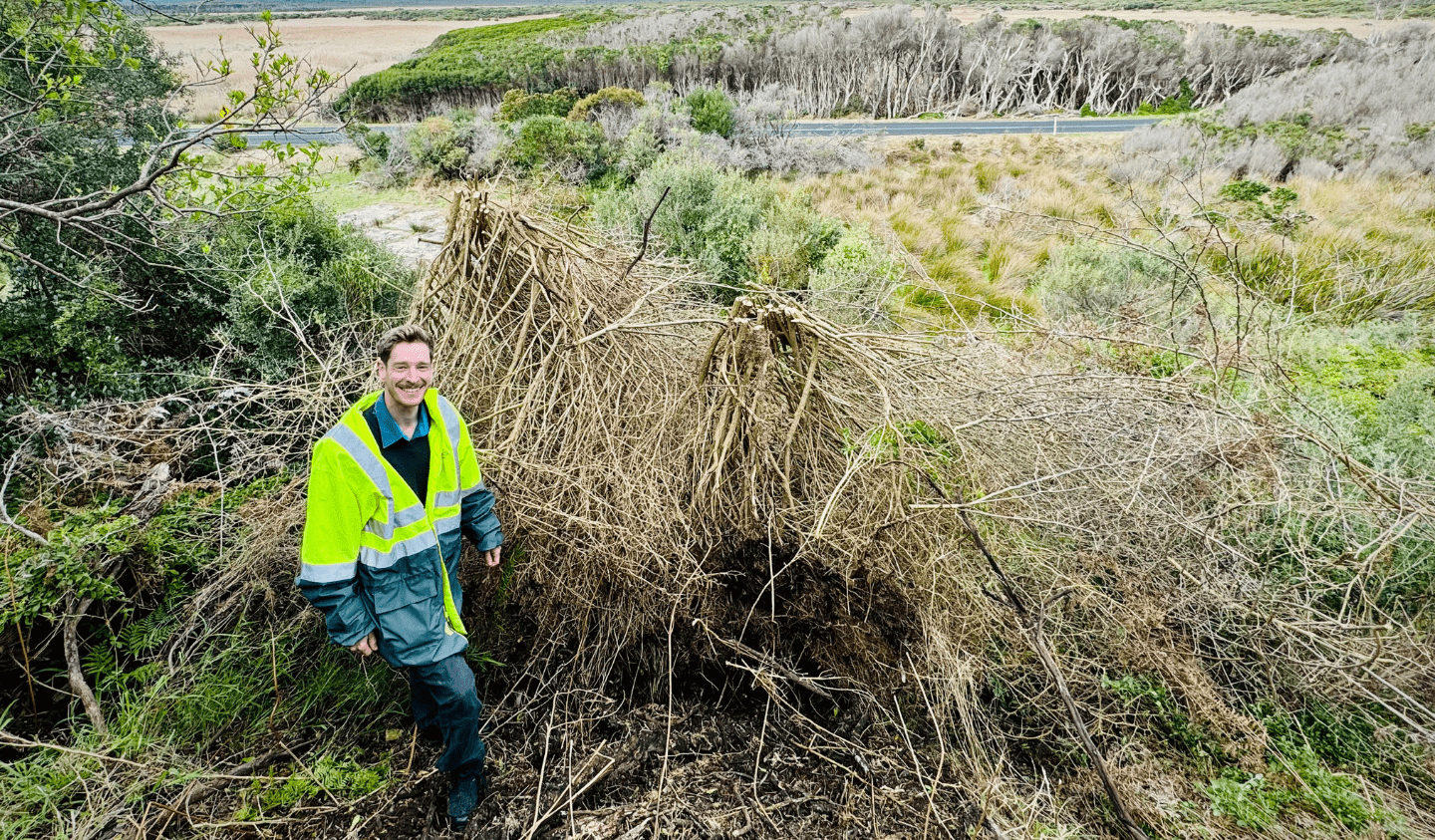
Ben amongst the weeds on the job. Credit: Parks Victoria
Can you describe your role and what a typical day looks like?
'As every ranger knows, no two days are the same. My role is extremely varied and consists of conducting vessel operations, maintenance and ensuring survey compliance. I work with an amazing team on conservation and monitoring programs in our Marine Protected Areas (MPAs). This can insist of:
- compliance and enforcement inside of our MPAs
- auditing and maintaining our MPA assets, such as in-water special mark piles and regulatory signage.
- supporting the many volunteer groups and citizen science programs, including the PV Junior Ranger program
- documenting and photographing our amazing MPAs for comms and engagement as well as for the scientific data.
- we also work closely the local terrestrial teams to help each other out with whatever needs to be done
For example, the other week I woke very early to hit the road, driving from my Foster to Portsea Pier, where I was picked up by the "Seadragon" vessel. We skippered over to Popes Eye – an amazing horseshoe-shaped historical artificial reef made from the foundations of an unfinished fort – in Port Phillip Heads Marine National Park. There we completed a safety briefing and geared up in our SCUBA, looking like Christmas trees.
Surrounded by young seals frolicking and diving sea birds, we dove to 12 metres and with a trusty pair of kitchen scissors we went to work weeding the park of the invasive Wakame (Undaria pinnatifida). We are limited by only a short period of slack tide, so we worked quickly to cover as much ground as possible. By removing the reproductive part of the seaweed, the substrate remains undisturbed which allows the native seaweed – Golden Kelp (Ecklonia Radiata) – to reestablish and form crucial habitat for reef life.'
What is your favourite park, waterway or place that you help manage, and why?
'I started out in Wilsons Promontory so it will always be my favourite, above or below the water! It's a photographer's dream, the diving is world class, the hikes are incredible, home to a myriad of flora and fauna species, the worlds southernmost mangroves and a whale superhighway!
A climate refuge, it's an extremely special place, and you only need to look at what's happening elsewhere to know how precious that is and how hard we have to work to keep it that way.
Not only is the locale amazing, but the people are too, I'm extremely privileged to work with such dedicated, hardworking and likeminded individuals.'


