
A supermassive black hole with a case of cosmic indigestion has been burping out the remains of a shredded star for four years - and it's still going strong, new research led by a University of Oregon astrophysicist shows.
Already, the jet shooting out of the black hole is a contender for one of the brightest, most energetic things ever detected in the universe. Scientists have now collected enough data on the unusual occurrence to predict that the stream of radio waves belching from the black hole will keep increasing exponentially before peaking in 2027.
"This is really unusual," said Yvette Cendes, an astrophysicist at the UO who led the work. "I'd be hard-pressed to think of anything rising like this over such a long period of time."
Cendes and her team reported their findings Feb. 5 in the Astrophysical Journal.Astrophysicists have documented plenty of incidents where a star gets a little too close to a black hole and gets shredded by its gravitational field without going all the way across the event horizon, or the point of no return. It's called a "tidal disruption event" because it's caused by the same gravitational dynamics that create ocean tides on Earth.
In this case, though, the gravitational tug shreds a star in a process descriptively named "spaghettification."

But a black hole emitting this much energy so many years after chewing up a star is unprecedented, Cendes said.
In 2018, when Cendes was a postdoctoral researcher at Harvard University, one of her lab mates noticed the tidal disruption event using an optical telescope. At the time, it was "the most boring, garden-variety event," she said, so no one paid much attention.
But then, a few years later, Cendes caught something strange: Although the black hole hadn't done much immediately after shredding a star, it was now emitting quite a lot of energy in radio waves.
Her curiosity piqued, Cendes and her colleagues began scrutinizing the black hole more closely. They initially reported the discovery in a 2022 paper in the Astrophysical Journal. Since then, they've kept monitoring it, and it's continued to surprise them.
The object's official scientific name is AT2018hyz, though Cendes prefers the nickname "Jetty McJetface," a nod to the internet-famous British research vessel Boaty McBoatface.
In the latest paper, Cendes and her colleagues show that the energy emitted from the black hole has continued to rise sharply over the last few years. It's now 50 times brighter than it was when originally detected in 2019.
Their calculations also suggest that the radiation from the star has been shooting out in one direction as a single jet. That could explain why it wasn't initially detected, if the jet wasn't aimed towards Earth, Cendes said. But they won't know for sure until the energy peaks in a few years.
Cendes is a radio astronomer, so the strong energy she's measuring from the black hole is in the form of radio waves. (The region around the black hole is also emitting visible light, but it's very faint.) Her team uses data collected at big radio telescopes in New Mexico and South Africa that measure radiation from around the universe at very high sensitivities.
Image captions
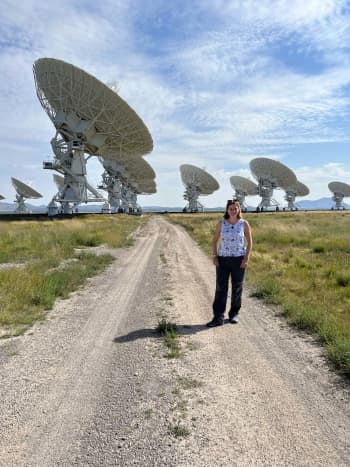 Image 1
Cendes used data from the Very Large Array radio telescope site in New Mexico. (Photo courtesy of Yvette Cendes)
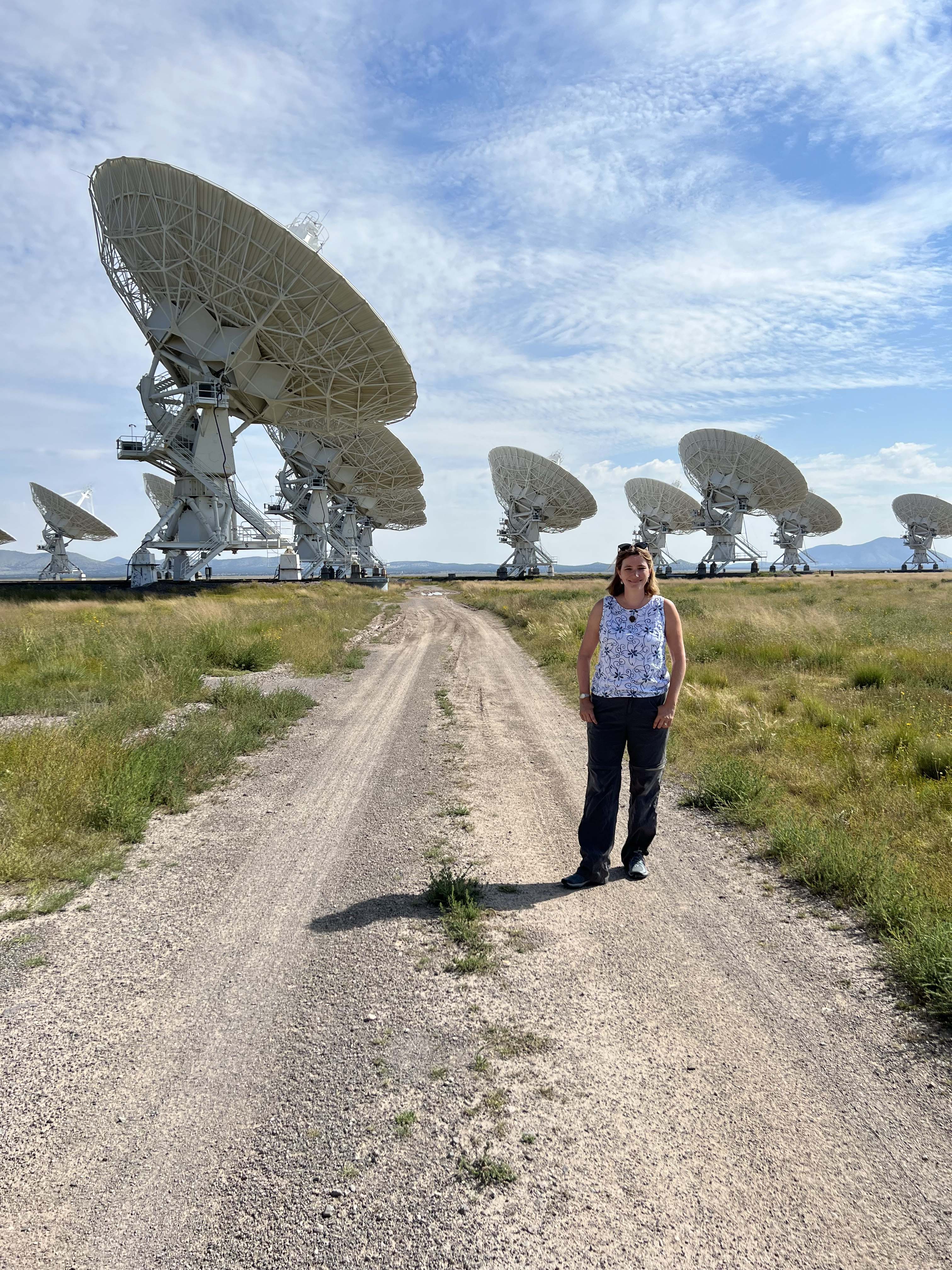
Cendes used data from the Very Large Array radio telescope site in New Mexico. (Photo courtesy of Yvette Cendes)
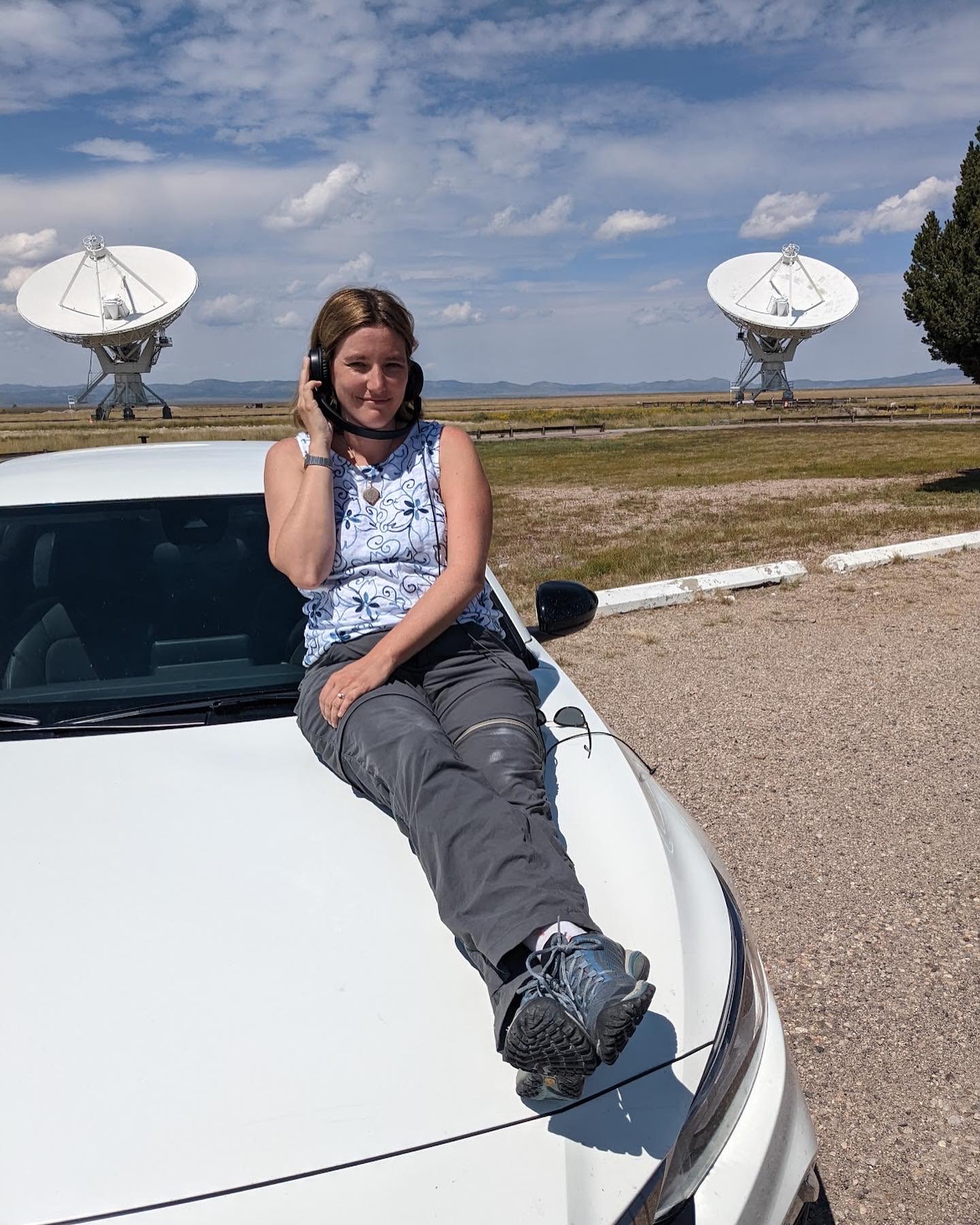
Cendes used data from the Very Large Array radio telescope site in New Mexico. (Photo courtesy of Yvette Cendes)
They calculated the current energy outflow of the black hole and came up with an astounding number, putting it on a par with a gamma ray burst and potentially placing it among the most powerful single events ever detected in the universe.
To put it in other terms: Avid Star Wars fans have done calculations of how much energy the infamous super-powerful Death Star would emit. This black hole is emitting at least a trillion times that, and possibly closer to 100 trillion times.
Of course, only time will tell how high it will go. Her team is continuing to track the object to see whether their predictions play out.
Meanwhile, Cendes is on the hunt for other black holes that might also be exhibiting the phenomenon. No one has ever seen anything like this before, but that could be in part because nobody has really looked, she noted.
Securing time to gather data on international telescopes is competitive, Cendes said, and "if you have an explosion, why would you expect there to be something years after the explosion happened when you didn't see something before?"
But now they know to look.
More stories about space
UO particle physicist Tien-Tien Yu is investigating one of the most puzzling questions in science
UO scientists are on a team using gravitational waves to better understand the universe
Planetologist Carol Paty helped develop tools to look for an ocean on a Jovian moon


