
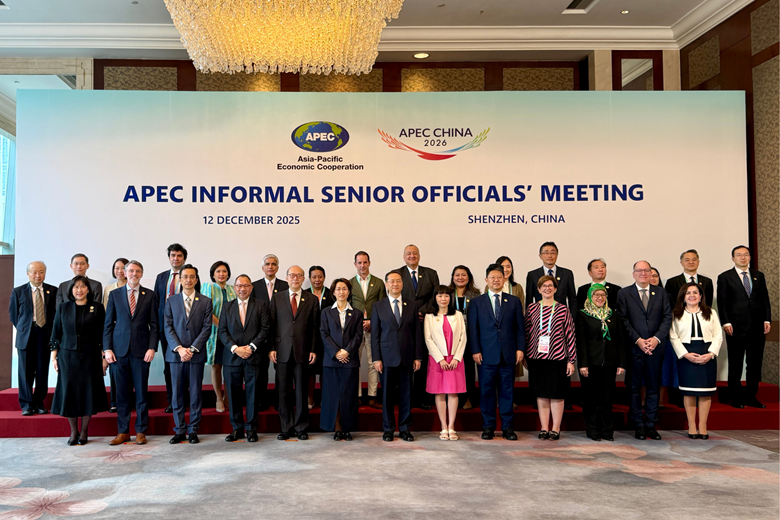
Senior officials from APEC economies convened in Shenzhen, a modern southern coastal city of China, to lay the groundwork for the forum's agenda for next year. China, the host of APEC 2026, introduced its theme, Building an Asia-Pacific Community to Prosper Together.
Opening the meeting, Deputy Foreign Minister of China Ma Zhaoxu underscored the urgent need for unity and coordinated action as the region confronts rising protectionism, anti-globalization pressures and sluggish economic growth.
"Rising protectionism and anti-globalization trends have created many uncertainties and challenges, placing pressure on economic growth and leaving difficult issues that are hard to address," Ma said. "How to strengthen policy coordination and sustain Asia-Pacific economic growth has become an urgent and serious test before all APEC economies."
Ma recalled President Xi Jinping's remarks in Gyeongju during the 2025 APEC Economic Leaders' Meeting, quoting: " China stands ready to take this as an opportunity to bring all parties together to advance the goal of an Asia-Pacific community, promote growth and prosperity in the region, energize practical cooperation on priorities including the Free Trade Area of the Asia-Pacific (FTAAP), connectivity, digital economy and AI, so as to inject greater vitality and impetus to development in the Asia-Pacific and deliver more benefits to the people of the region."
Ma emphasized that Asia-Pacific community is not only an aspiration but also a set of practical actions, outlining China's three priorities for APEC 2026 - openness, innovation, cooperation - as the means to translate this vision into concrete work.
Openness, he noted, has long been the lifeblood of the region as the average tariffs across APEC have fallen from 17 percent to 5 percent. With 2026 marking the 20th anniversary of FTAAP, he called for continued support for the multilateral trading system, a stable and open regional economic environment, strengthened industrial and supply chain resilience, and deeper connectivity.
On innovation, Ma pointed to rapid technological change, particularly in artificial intelligence, as the driver of new engines of growth. He called on APEC to deepen collaboration on frontier technologies, expand digital public services, promote interoperability of standards, and ensure that technological benefits are shared equitably across the region.
"China has accumulated significant experience in technological innovation and long-term development. Shenzhen is widely recognized as a global innovation hub, and we are ready to share our experience with all partners and contribute to the region's innovative growth," he added.
Cooperation remains foundational to Asia-Pacific prosperity. Ma underscored APEC's role as the region's premier economic cooperation forum and called for deeper coordination and capacity building in fiscal policy, food security, energy, SMEs, transportation, tourism, human resources, and public health to ensure that "no member or community is left behind."
Shenzhen provides an apt backdrop for this meeting. One of China's first special economic zones and now the economy's top foreign trade hub, the city has grown from a GDP of just 270 million yuan in 1980 to 3.68 trillion yuan in 2024, with total trade reaching about 4.5 trillion yuan last year. Shenzhen will also host the APEC Economic Leaders' Week in November 2026.
Ambassador Chen Xu, Chair of the APEC 2026 Senior Officials' Meeting, introduced the logo for APEC 2026, drawing inspiration from Shenzhen, also known as the City of Peng, named after the legendary creature that transforms from a giant fish into a soaring bird. The logo features 21 interwoven feathers, each distinct yet seamlessly connected, forming the shape of the bird Peng. The design represents the 21 APEC member economies, diverse but connected, harnessing momentum and rising together toward shared prosperity.
"In spite of the unprecedented changes in the world, the APEC region remains the major engine of global economic growth," Ambassador Chen said. "And APEC, as a modern, efficient and effective incubator of ideas, continues to be the premier forum for regional economic cooperation."
"As we move into 2026, China will strive to advance our collaboration to promote economic cooperation in our region," he concluded.
APEC 2026 will also mark a key milestone including the first five-year review of the Aotearoa Plan of Action, which provides a timely opportunity to assess progress and recalibrate efforts toward achieving the 2040 vision of an open, dynamic, resilient and peaceful Asia-Pacific community.
Senior officials will meet for the first set of technical meetings from 1 to 10 February 2026 in Guangzhou.


