
Key points
- Countries that align investment signals with electricity system build-out will convert spending into delivered capacity faster and at lower cost.
- CSIRO's role is to reduce technical and cost risks so industry can adopt lower-emissions solutions with confidence.
- The scale of our current and historic greenhouse gas emissions means carbon capture and storage is imperative.
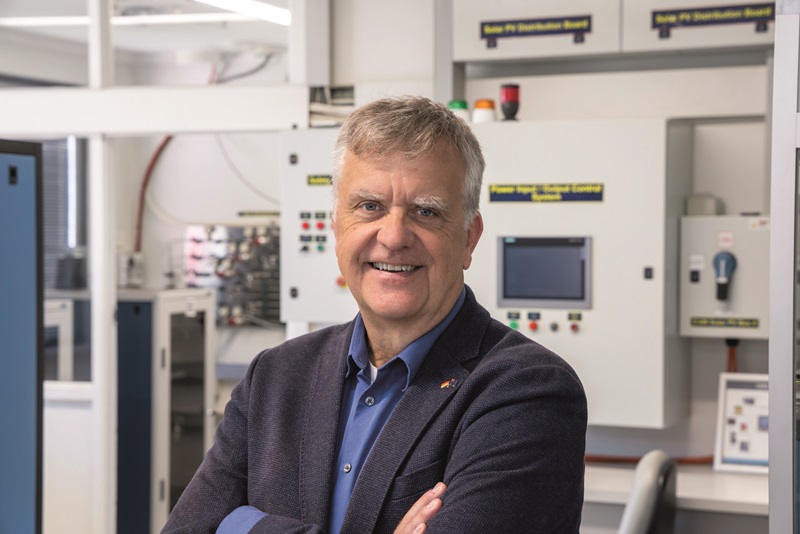
CSIRO director of energy, Dr Dietmar Tourbier, is often asked about 2050 – Australia's long-term net-zero destination. But as 2026 begins, his focus is drawn to a much closer horizon.
"It's often easy to focus on 2050 as that all-important target," Dr Tourbier said. "But there's a nearer-term deadline posing more questions."
According to data from the Australian Energy Market Operator (AEMO), renewables made up 51 per cent of the National Electricity Market (NEM) in the fourth quarter of 2025. This is a significant achievement but brings Australia's goal of reaching 82 per cent renewable electricity by 2030 firmly under the microscope.

Growing renewable capacity comes as global investment in energy systems accelerates at an unprecedented pace. According to the International Energy Agency , global energy investment was slated to reach a record $3.3 trillion in 2025 , with clean energy technologies attracting more than twice the investment flowing to fossil fuels.
Yet even as spending on renewable generation surges, investment in grids and system integration continues to lag, and system constraints are emerging as a shared challenge across advanced economies. Renewables are becoming the default source of new supply, so the decisive question is no longer whether clean energy can be built cheaply, but who has the capability, coordination and institutional leverage to navigate system bottlenecks?
"Internationally, capital investment in clean energy is becoming more selective not because clean energy is unproven, but because the risks now sit in grid integration, approvals, execution and operation rather than the generation technology itself," Dr Tourbier said.
"Countries that can align investment signals with system build-out – rather than generation alone – will convert spending into delivered capacity faster and at lower cost.
What will determine success by 2030, Dr Tourbier argued, is whether Australia can successfully engage with communities, develop and reskill workforces and ultimately build the necessary infrastructure.
The electricity transition
While Australia's electricity sector remains the fastest-moving part of the transition, Dr Tourbier is clear that scaling renewables is no longer just about building more generation.
"We need to move from where we are now – around 50 per cent renewables – to more than 80 per cent by 2030 while rapidly expanding capacity and doubling or even tripling energy throughput by 2050," he said. "And we have to do that while keeping the grid stable and reliable."
That systems-level challenge sits at the heart of the Australian Research in Power Systems Transition ( AR-PST ) initiative, a collaboration between CSIRO, AEMO, universities and international research partners. The work focuses on how a highly distributed, renewables-dominated grid can operate securely at scale.
"In industries such as aerospace, people understand that distributed systems are often more reliable than centralised ones," Dr Tourbier said. "In energy, there's still a perception that moving away from centralised generation makes the system less stable. From a systems perspective, that's not true – if you do it right."
Australia's long, geographically stretched grid means it is encountering challenges earlier than many other countries – making the next five years even more decisive.
"By 2030, Australia needs to make distributed generation work, supporting the grid services that currently depend on large scale synchronous generators," Dr Tourbier said. "The technologies around grid-forming inverters, demand response, and time-shifting consumption need to be in place as large scale coal retires."
Industry and transport
Beyond electricity, Dr Tourbier sees significant opportunities for near-term gains in industry and transport, particularly where emissions are tied to heat. CSIRO's role, he said, is to reduce technical and cost risks so industry can adopt lower-emissions solutions with confidence.
"For Australia's energy-intense industries, lower-temperature processes can be electrified or served by solar thermal, and higher-temperature processes can also be addressed using direct renewable heat," Dr Tourbier said.
Concentrated solar thermal technologies, which directly convert sunlight into heat, offer promise for industrial applications where high temperatures – not electrons – are the primary requirement. Dr Tourbier points to concentrated solar thermal approaches capable of reaching temperatures above 1000°C, with the potential to deliver industrial heat at a lower cost than gas.
"If heat is what you need, solar thermal can make a lot of sense as converting heat directly can be much more efficient," he said.
In transport, the most immediate gains remain in electrification.
"Electric vehicles are on a good trajectory, but it's critical charging infrastructure keeps pace," Dr Tourbier said.
Other parts of the transport system are more complex. Sectors such as aviation , shipping and rail face harder-to-solve challenges, with fewer near-term alternatives. But progress wherever possible still matters.
"Every gain we make now buys us time," Dr Tourbier said, "and creates space for the more difficult parts of the system to catch up."

Carbon management: An unavoidable reality
Even with rapid electrification, Dr Tourbier was unequivocal that carbon management technologies will be essential to meeting Australia's climate goals.
While acknowledging the valid concerns around cost and corporate accountability, the scientific consensus is clear: carbon capture and storage is a proven and necessary solution to achieve deep emissions reductions.
"Reaching net zero will require carbon capture," Dr Tourbier said. "The scale of our current and historic greenhouse gas emissions means there's no way around that."
Hydrocarbons represent the majority of Australia's energy flows , providing a significant contribution to the national economy with more than three quarters of Australia's coal, gas and oil production exported.
Australia's geology offers significant potential for long-term carbon storage – for domestic purposes and potentially as a future foreign investment revenue stream. The challenge is cost, scale and social licence.
"Our target is to get carbon capture from air (direct air capture) below $100 per tonne," Dr Tourbier said, comparing this to current costs of closer to $1000 per tonne. "By 2030, I'd like to see a demonstrated project achieving a much lower cost.
" Augmenting global industry knowledge on how CO2 reacts when stored in geological formations over time is another driver, helping to build confidence in the long-term integrity of storage sites."
The real challenge
Across all three pillars, Dr Tourbier returns to a consistent theme: technology is not the limiting factor.
"We need to bring the public along with this – not just to accept infrastructure, but to participate in the transition," he said.
CSIRO's social science research, including a 2024 national survey of over 6700 Australians, shows support for renewables alongside clear priorities around affordability, energy security and emissions reduction.
Combined with CSIRO's applied science, such research informs the agency's residential energy efficiency work. Australia's ~12 million homes account for a quarter of our nation's electricity use and 10 per cent of our total carbon emissions. CSIRO's housing research continues to drive energy efficiency, comfort and sustainability across 90 per cent of new Australian homes. This work is being extended to existing homes through collaboration with the banking and real estate sectors, and government.
Looking to 2030, CSIRO's new National Energy Analysis Centre (NEAC) combines whole-of-system modelling with a "living lab" concept, allowing households and businesses to share energy data and receive insights into how they use, manage and reduce their energy costs.
"At the end of the day, what matters most to people is cost," Dr Tourbier said. "CSIRO's role is to keep innovating and drive down the cost of the transition – for industry, for households, and for government."
While much of CSIRO's focus is domestic, Dr Tourbier sees the next five years as a critical window for Australia to step into a stronger regional leadership role, particularly in Southeast Asia and the South Pacific .
"Rather than doing everything ourselves, the bigger impact comes from working with other countries, multinational companies and supply chains to align research capability, international investment and industrial demand," he said.
"This is something we must accelerate now – not in another decade."
A marathon, not a sprint
Dr Tourbier is conscious that the transition risks public momentum if it feels endless.
"This is a marathon, not a sprint," he said. "Don't think about the whole run; think about smaller milestones instead."
For him, 2030 is one of those milestones.
CSIRO's flagship GenCost report highlights the challenges and opportunities of reaching 2030 targets just in the electricity sector, and recent government programs show that progress there can be both rapid and unpredictable. Home battery installations, for example, have surged since July 2025, when systems became eligible for the Small-scale Renewable Energy Scheme . In just one year, the scale of battery capacity being installed is set to match the storage capacity of the Snowy Hydro scheme.
This rapid uptake demonstrates the fluidity of Australia's energy transition and the ability for Australia's households to collectively drive major change.
"The technologies and the drive to innovate is there," Dr Tourbier said. "That gives me confidence that the energy transition can evolve, sometimes faster than we expect and in areas that are challenging or complex."
The question now is whether Australia can align investment, policy, and community trust quickly enough to turn potential into reality – within the next five years.
This article was originally published by Energy Magazine .


