
- Global turbulence is becoming the new norm, amplified by constant noise that forces a sharper focus on delivery and implementation.
- As global pressures intensify, the resilience of local economies and communities will be tested.
- Yet, amid a global crisis of trust, these communities are emerging as the frontline for renewed collaboration and collective action.
One of the key takeaways from Davos this year probably isn't something you'll see in the headlines or the daily news cycle.
It is not the high-stakes political rhetoric or deal-making, nor is it about the corporate announcements or commitments. While Canadian Prime Minister Mark Carney's remarks offer a glimpse of the shift underway, this moment goes beyond government policy.
We're experiencing a fundamental change in how governments and businesses advance progress. At the core of this change is a turbulent new world order shaped by two compounding forces.
First, there is growing, high-volume competition for attention from political leaders, media, influencers and the public itself - what CEOs in Davos frequently referred to as "the noise." Throughout the week, that noise radiated across Main Street in Davos, the Promenade.
Second, that noise is coupled with increasing distrust in institutions, information, and one another, alongside a sharpening polarization of views. The 2026 Edelman Trust Barometer puts numbers to this reality: nearly 70% of people say they are hesitant to trust someone with different values or viewpoints. In this climate, even talking publicly about progress can become a liability rather than an asset.
Together, these forces create a challenging operating environment - one where it is increasingly difficult for governments and companies to stay focused and deliver consistent outcomes for customers, constituents and communities alike.
This is not an anomaly; it is rapidly becoming the new norm. And while these pressures are global, their consequences - and the work required to address them - are increasingly local.
Communities and local economies will be tested
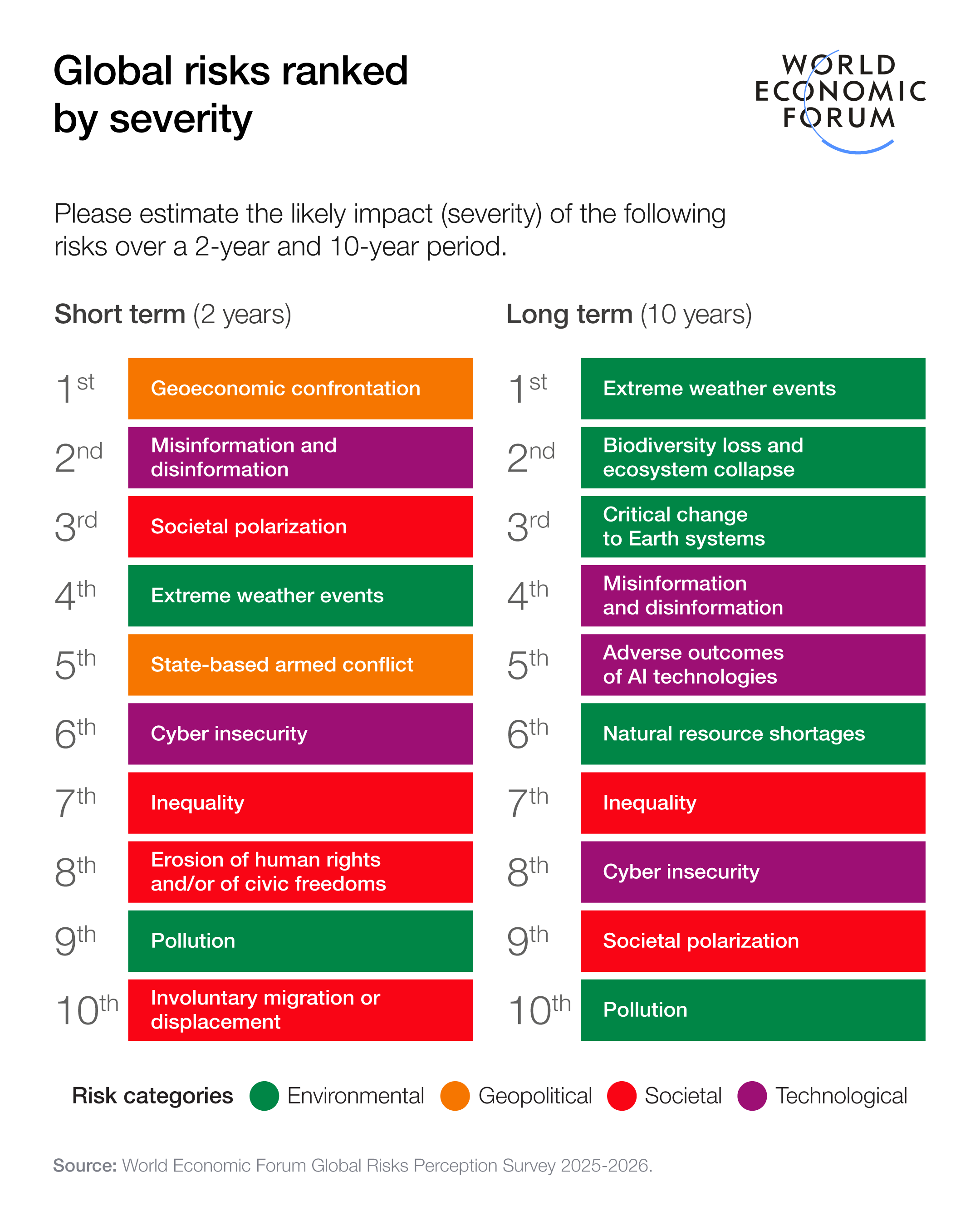
At the Annual Meeting in Davos, the World Economic Forum released its Global Risks Report 2026 . For the first time, geoeconomic confrontation ranks as the top global risk, surpassing both climate change and conflict. Roughly half of the leaders surveyed expect this turbulence to intensify worldwide over the next two years.
That turbulence, however, will not be felt evenly. Businesses and economies operate like airplanes or boats navigating a storm. Larger vessels can absorb shocks more easily; smaller craft can be knocked off course.
Communities and local economies will be on the frontline as tariffs, immigration policies, competition for materials, and other market interventions reshape trade, supply chains, workforces, and the cost of doing business. In this volatile environment, resilience and durability take on heightened importance.
Outcomes reflecting this shift included:
- The World Economic Forum launched the Yes/Cities Global Network , bringing together 17 leading city-based innovation ecosystems across North America, Latin America, Europe and Asia to act as launch pads and landing pads for innovators and investors expanding across markets.
- Members of the Davos Baukultur Alliance launched Investing in Quality , a new initiative focused on unlocking long-term economic value in the built environment by embedding quality, sustainability and human-centred design into planning, development and investment decisions.
- The World Economic Forum released the Global Value Chains Outlook 2026 , alongside reports on Building Geopolitical Muscle and Resilient Firms and Economies , outlining practical pathways for governments and industry to navigate reconfigured value chains, strengthen operational resilience and unlock growth, particularly in emerging markets.
- Government and business leaders established a new cross-sector Leadership Group on Workforce Transformation and Tourism Tech , recognizing travel and tourism as a critical driver of growth, accounting for roughly 10% of global GDP.
- Leaders at the Annual Meeting also outlined practical steps to advance the 24-hour economy , identifying focused workstreams to support governance, infrastructure, data, small and medium-sized enterprises and night-time workers.
Trust will be rebuilt in communities
If economic stability is about staying on course, legitimacy is about securing the trust and license to operate.
Throughout the private sessions in Davos, business leaders across industries and geographies described a shift away from broad, global commitments on social and environmental issues toward more focused, place-based engagement - concentrated in the communities where their customers, clients, and employees live and work.
This reflects a growing recognition that trust is not built through press releases or global pledges, but through a visible, sustained presence on the ground. Leaders also underscored the business value of these efforts in strengthening workforces, attracting talent, and reinforcing local resilience.
Outcomes reflecting this shift included:
- Leaders from major consumer-facing companies directed new resources to empower frontline workers as ambassadors for their organizations, deepen volunteer efforts and increase investment in priority markets .
- Public- and private-sector partners launched a new global initiative on Growing the Wellbeing Economy , aligning private-sector investment with public-sector goals across healthcare, nutrition and sustainable food systems, with Boston serving as the first place-based hub through Yes/Boston.
- The World Economic Forum and the Municipality of Davos announced a partnership to support the city's evolution into a year-round hub for innovation, culture and community life, beginning with engagement around the Davos Tech Summit in July 2026.
Cities are becoming the frontline of preparedness
Environmental pressure has evolved from an abstract concern into an immediate, financial, and deeply local reality. The Global Risks Report 2026 highlights that while geoeconomic confrontation currently leads the short-term list, extreme weather remains the dominant risk for the next decade.
In Davos, conversations shifted toward preparedness. The focus is no longer just on response, but on equipping cities with the tools, capital, and coordination required to manage risk before it escalates.
Outcomes reflecting this shift included:
- Leaders from the insurance, finance and public sectors launched a new global initiative on Building the Marketplace for Urban Risk and Resilience, focused on mobilizing capital and risk solutions to strengthen the resilience and insurability of urban assets.
- The First Movers Coalition released Board Leadership for Growth and Resilience , providing guidance to help boards lead decisively on climate and nature governance.
- New publications outlined pathways to translate long-term risk into actionable investment, including work on shared energy infrastructure , climate-resilient utilities and bridging the €6.5 trillion global water infrastructure gap .
Explore more
- Watch livestreamed sessions from the World Economic Forum Annual Meeting 2026.
- Learn more about the World Economic Forum's year-round initiatives supporting local communities and economies at weforum.org/cities .


