
Some 78 miles on the south coast and 75 miles on the north coast is now open. Works have seen upgraded walkways, landscaping and habitat improvements
Two new sections of the King Charles III England Coast Path (KCIIIECP), together covering more than 150 miles along the north and south coasts of Devon, have been opened today (17 December).
These works form part of a national programme to create a coastal footpath around the whole of England and establish coastal access rights between the trail and mean low water. Once completed the KCIIIECP will be the longest managed coastal walking route in the world and the UK's longest National Trail. In Devon, the paths adopt and in places improve the existing South West Coast Path.
On the north coast, the new section of KCIIIECP stretches from Combe Martin to Marsland Mouth on the Devon-Cornwall border, whilst on the south coast the new section is from Cremyll at the Tamar estuary, to Kingswear.
These two sections join other open sections around the south west peninsula and create an amazing 600 miles of continuous open trail, with an accessible coastal margin to the water's edge taking in typical coastal land types such as cliffs, dunes, beaches and foreshore, from Brean Down to Lyme Regis around the south west peninsula. This not only also takes the total of open KCIIIECP nationally to over 2000 miles, but also significantly improves the existing South West Coast Path.
The north coast stretches from Combe Martin to Marsland Mouth
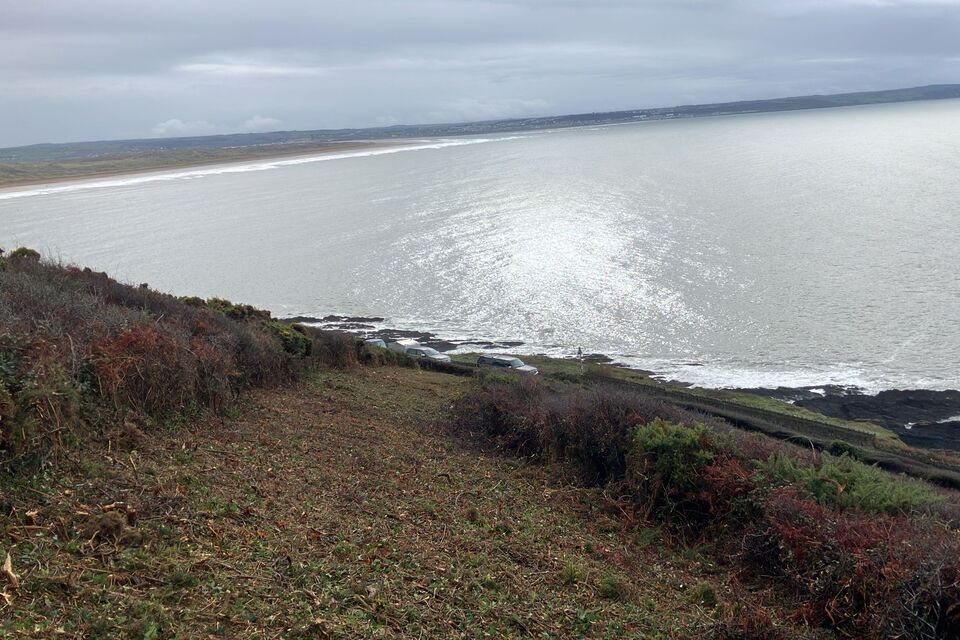
Route clearance for the new path at Downend Croyde. Photo: Devon County Council
The 75 miles north coast stretch is set against the backdrop of Lundy Island. It passes through the Taw Torridge estuaries, a haven for wildfowl, waders and gulls, the sand dunes of Braunton Burrows, home to over 470 species of plants and wildflowers and also a training beach for the D-Day landings in 1944 and the undulating Hartland Peninsular. Part of this stretch, between Hartland Point and Marsland Mouth, around 10 miles in length, is seen as one of the toughest sections to walk in the southwest. The route passes through the holiday centres of Ilfracombe, Woolacombe, Croyde, Saunton Sands, Appledore and Westward Ho!
Access to the saltmarsh in the coastal margin of the Taw-Torridge estuary is to be excluded all year-round as it is unsuitable for public access.
As the South West Coast Path, becomes part of the KCIIIECP improvement works have included restoring a concrete causeway across the southern part of Croyde beach and at Watertown in Appledore a new short section of off-road, traffic free path, above the high tide line, has improved connectivity between Appledore and Northam Burrows.
The south coast stretches from Cremyll at the Tamar estuary, to Kingswear

Mothecombe Beach. Photo: Devon County Council
The 78 miles south coast stretch runs along the clifftops between the historic ports of Plymouth and Dartmouth/Kingswear. The trail crosses seven estuaries, six by ferry and one that can only be crossed on foot at low tide. The route includes the iconic coastal bar of Slapton Sands from Torcross and Strete Gate which has its own historic links to the preparations for the Normandy landings in 1944. The trail passes a number of other notable historic sites including the Iron Age promontory fort of Bolt Tail camp, Fort Charles, Salcombe, the village of Hallsands and Dartmouth Castle.
Opportunities for spotting wildlife are plenty with several protected wildlife sites along the route, such as the intertidal habitats at the Erme and Kingsbridge Estuaries and at Slapton Ley where cirl bunting and shore dock can be found.
Improvements to these sections have been completed by Devon County Council and with the support of the South West Coast Path Association. These include a new, short section of path above an existing coastal defence feature to improve access at high tide at Mothecombe beach; reinstating a section of path previously lost to erosion at Blackpool Sands and at Stoke Fleming building a new path to improve and increase provision of off-road, traffic free walking to the east of the village and gives impressive coastal views over Blackpool Sands.
Andrea Ayres of Natural England said:
Natural England wants to make it easier for everyone to connect with nature, and the new sections of the King Charles III England Coast Path will give people the chance to explore amazing landscapes on both the north and south coasts of Devon.
By joining up the places where people live, work and enjoy, the improved coast path will benefit the local economy and local communities and makes it easier for everyone to enjoy.
Councillor Jacqi Hodgson, Devon County Council cabinet member for climate change and biodiversity said:
The King Charles III England Coast Path is a wonderful addition to the National Trails family.
In addition to the significant contribution to health and wellbeing, the Coast Path provides for and supports green infrastructure within and between Devon's Protected Landscapes, enabling our communities and visitors to sensitively enjoy our amazing coastline.
Lorna Sherriff, National Trail Officer, South West Coast Path Association said:
It's wonderful to see the investment along the Coast Path around Devon.
These works have enhanced the trail, and the new crossing of the B3231 at Down End near Croyde is an improvement, which the charity has been championing to ensure the safety of walkers in this area.
It's great to have this opened before the Christmas period so people can get out, connect with nature, and enjoy the improved Coast Path route.
You can plan your walk on the KCIIIECP by visiting the National Trails website. Up-to-date information on the South West Coast Path National Trail and KCIIIECP


