
Haitian security forces and private contractors working with them have conducted extensive and apparently unlawful lethal drone strikes, Human Rights Watch said today. The strikes, at least some of which appear to be deliberate extrajudicial killings, have been carried out with quadcopter drones armed with explosives in densely populated urban areas, in some cases killing and injuring dozens of people, including children and other residents who are not members of criminal groups.
According to data from multiple sources reviewed by Human Rights Watch, at least 1,243 people were killed by drone strikes in 141 operations between March 1, 2025, and January 21, 2026, including at least 43 adults who were reportedly not members of criminal groups, and 17 children. The data also shows that the drone strikes injured 738 people, at least 49 of whom were reportedly not members of criminal groups.
"Dozens of ordinary people, including many children, have been killed and injured in these lethal drone operations," said Juanita Goebertus, Americas director at Human Rights Watch. "Haitian authorities should urgently rein in the security forces and private contractors working for them before more children die."
The United Nations Integrated Office in Haiti has attributed the drone attacks in Haiti to a specialized "Task Force" established by Prime Minister Alix Didier Fils-Aimé that is operated with support from the private military company Vectus Global. The US ambassador to Haiti has confirmed that the US State Department issued a license to Vectus Global to export defense services to Haiti.
Human Rights Watch interviewed five relatives of people killed or injured in a September 20, 2025, attack, as well as six community leaders, doctors, and others who either visited the site, or spoke to or treated victims afterward. Researchers also interviewed the relative of a woman killed in a different drone strike on January 1, 2026. The National Human Rights Defense Network (RNDDH) and the Eternal City Child Protection Committee (Komite pwoteksyon pou timoun Site Letènèl, or KPTSL), both Haitian civil society groups, facilitated interviews with relatives.
In the September 20 attack, a drone armed with an explosive device detonated near the "Nan Pak" sports and cultural complex in the Simon Pelé neighborhood of Port-au-Prince, the capital, where children had gathered for a gift distribution by the Simon Pelé criminal group. Human Rights Watch found that 10 people who were not members of criminal groups, including 9 children ages 3 to 12, were killed.
The number of armed drone attacks in Port-au-Prince has significantly increased in recent months, with 57 reported between November and January 21, nearly double the 29 from August through October. Over forty percent of reported killings took place between December 1 and January 21. The average number of people killed per operation is 8.8, with the most lethal operation killing 57 people.
The attacks occurred in nine communes in the West Department: Cabaret, Cité Soleil, Croix-Des-Bouquets, Delmas, Kenscoff, Léogâne, Pétion-Ville, Port-au-Prince, and Tabarre. Human Rights Watch reviewed information from multiple sources concerning the operations.
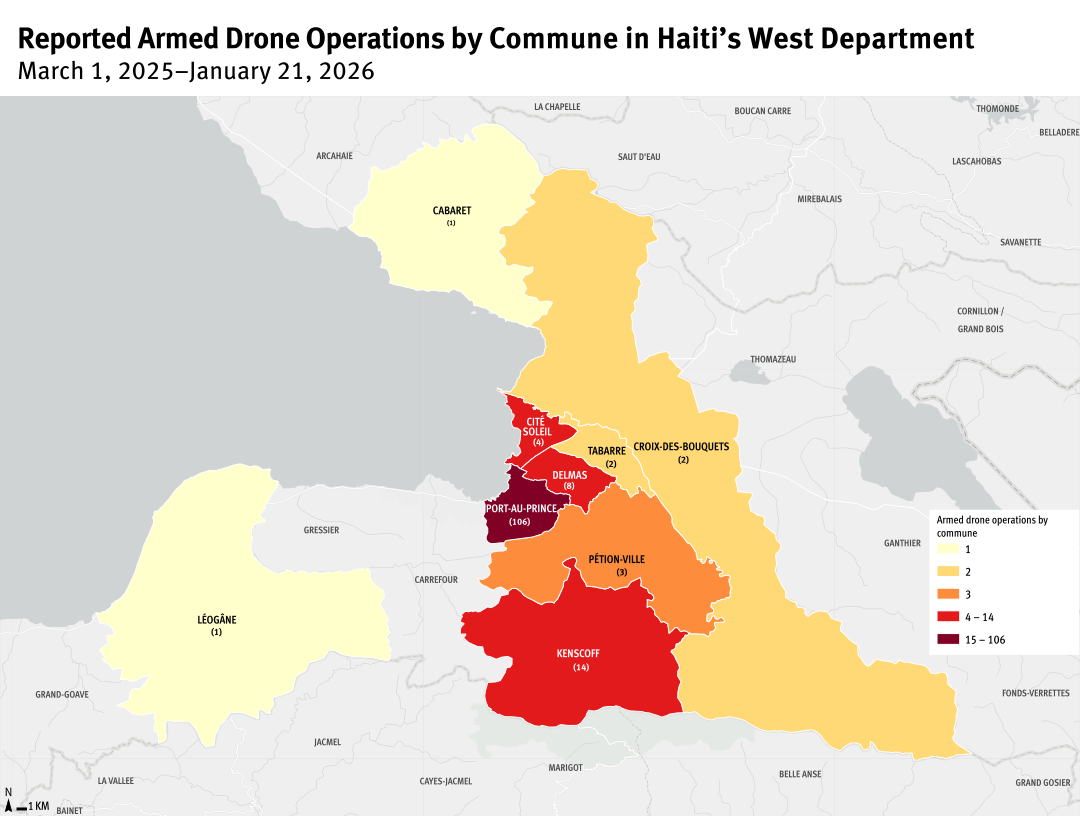
Researchers also analyzed seven videos uploaded to social media or shared directly with Human Rights Watch that demonstrate the use of armed quadcopter drones and geolocated four of them to Port-au-Prince. The videos show the repeated use of drones equipped with explosives to attack vehicles and people, some of them armed, but none who appear to be engaged in violent acts or pose any imminent threat to life. These videos bolster the impression that many of the drone attacks are attempts to target and extrajudicially kill people, rather than a law enforcement response that might justify the deliberate, lethal use of force.
Quadcopter drones can maneuver between buildings while tracking individuals and moving vehicles. They transmit detailed live video feeds to their operators, who control both the drones' flight and use of weapons.
Some people living in Port-au-Prince told Human Rights Watch that drones are a constant source of terror, leaving some afraid to leave their homes. "I live with this fear, this anxiety, all the time," said a shopkeeper living in Martissant. "I pray that the drones will no longer be in our area."
Neither Prime Minister Fils-Aimé, the Haitian National Police nor the private military company Vectus Global responded to Human Rights Watch requests for comment.
Researchers have received information about two failed tests of armed drones by criminal group members in May 2025. The Central Directorate of the Judicial Police is investigating people allegedly involved in trafficking drones through the Dominican Republic for criminal groups. The UN Integrated Office in Haiti reported that criminal group leaders have tried to use and acquire drones. However, researchers did not find evidence of widespread drone use by criminal groups.
The International Covenant on Civil and Political Rights, which Haiti has ratified, protects the right to life. Under international human rights law standards, states are required to ensure that law enforcement officers, including those employed by private security contractors working on behalf of the government, seek to minimize injury and preserve human life.
The deliberate, lethal use of firearms and other weaponry is permissible only when strictly unavoidable in order to protect the life of any person. Any use of force, including nonlethal force, should be both necessary and proportionate.
Haitian officials have offered no indication that drone strikes were in response to any threat to life that might allow for the deliberate lethal use of force through such attacks. Instead, many of these attacks appear to be attempts to target and kill people in circumstances that amount to unlawful, extrajudicial killings.
Haitian authorities and any private military actors partnering with them should put in place strong safeguards to ensure that any deliberate lethal use of drones armed with explosives or other weaponry occurs only in the very narrow circumstances where human rights law allows it.
The authorities should also transparently investigate all allegations of unlawful killings, prosecute those responsible, and provide reparations to affected families. They should publicly clarify the command structure relevant to drone attacks, and the role private military contractors play in these operations.
The Gang Suppression Force, a UN Security Council-authorized international force created to help combat criminal groups in Haiti, should refrain from providing any operational support to the Haitian security forces until adequate safeguards are put in place to prevent unlawful killings, and should require transparency and accountability from Haitian authorities as a condition of any such cooperation.
Human Rights Watch has previously documented the use of armed quadcopter drones in attacks on civilians in populated areas in the context of armed conflicts in Ukraine and Sudan. Human Rights Watch is not aware of any other situation where quadcopter drones armed with explosives have been used repeatedly in the context of law enforcement operations.
"Restoring security in Haiti is essential," Goebertus said. "But unlawful attacks with armed drones are adding a new layer of abuses to the violence that has devastated communities for years."
September 20 Attack and Aftermath
The densely populated neighborhood of Simon Pelé, where the September 20, 2025, attack took place, is controlled by the Simon Pelé criminal group. The group imposes its own rules and enforcement mechanisms and commits serious abuses against the population, including killings and sexual violence. Residents said that their phones are regularly searched, both in their homes and when they try to leave the neighborhood, and that they fear being killed if the group suspects residents of cooperating with the police.
Many families in extreme poverty rely on support distributed by the criminal group, residents and community leaders said. "You're talking about an area where there are no services: no school, no health care, no sanitation," said Rosy August Ducena, program director for RNDDH. "Most people there live below the poverty line."
The day of the attack, the leader of the Simon Pelé criminal group, Albert Steevenson, alias Djouma, was preparing to distribute gifts for children at a recreation complex as part of his birthday celebration. Community leaders said such celebrations are a common practice by criminal groups. Videos verified by researchers confirm that the recreation complex, a large semi-enclosed area with colorful murals, had previously been used as a venue for concerts and has continued to be used as a gift distribution site and outdoor recreation complex for children since the attack.
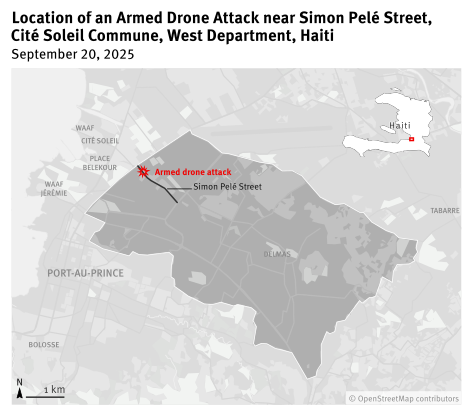
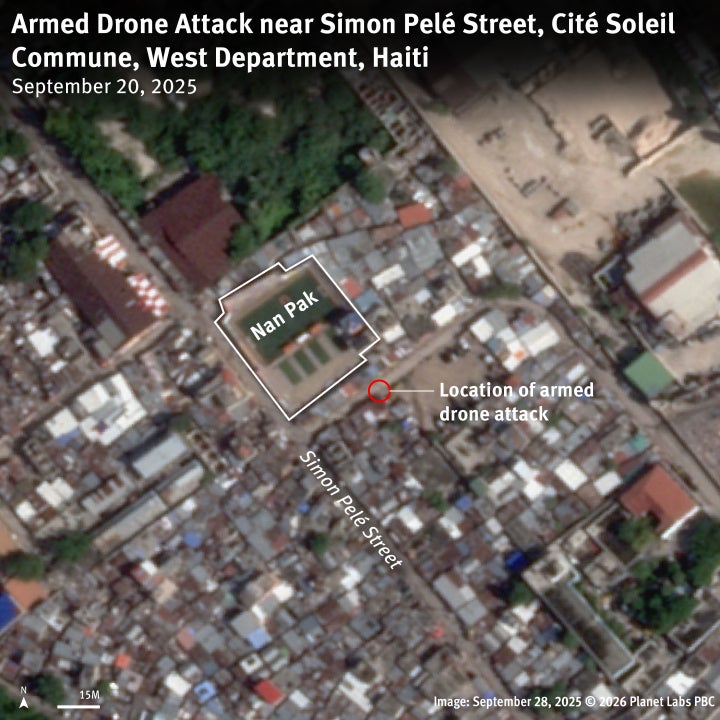
People interviewed said many of the children affected were playing near the complex, waiting for the gift distribution or accompanying caretakers who were running errands there. Family members and witnesses described a scene of chaos and panic when the explosion occurred, with dozens of injured people waiting for help.
According to Doctors Without Borders, at least 17 people injured in the attack were treated at hospitals that day, 9 of whom, including 3 children, died. A doctor who treated victims said that the most common injuries she observed were partial and complete traumatic amputations, with most patients she treated losing at least one limb and having open and complex fractures.
The doctor said fragmentation injuries from the blast were also common. The most severe injuries appeared to have been caused by blunt force trauma, with the blast most likely having propelled people against objects or buildings or caused objects to strike them.
Family members said that the attack occurred just outside the recreation complex sometime between 7 and 8:30 p.m. Affected residents said that they were near the complex, some of them running errands while their children played in the area near the gift distribution site, when the explosion occurred.
A resident who lost both her 3-year-old daughter and her husband, an artisan working outside at the site of the explosion, said:
I heard the sound of the explosion.… My husband and daughter were together at the place where my husband makes his crafts.… There was panic, and I wanted to go and see what had happened.… I didn't see [their bodies] at the scene. I saw blood in the areas where they had been.… I was taken to Terre Noire Hospital to see them. When I saw them, my daughter's foot was crushed, and she had other holes in her body. [My partner] also had a crushed foot and many holes in his neck.
Another woman, whose 6-year-old daughter was killed, said she had been doing laundry in her home near the "Nan Pak" complex and briefly stepped out to buy food while her daughter played nearby: "When I arrived near the vendor, I heard an explosion. It was chaos, people were mutilated, there were noises everywhere.… It was full of children. Many people were dead."
She buried her daughter immediately, by herself, explaining that she was too shocked to wait for help. "Her face and her rib cage, and even around her heart, all that area had been affected," she said.
A resident who arrived shortly after the explosion saw a woman sitting at the site with her baby. "The explosion had taken off the baby's two feet," he said. "Two women and a man had also lost their feet. I didn't get there right away, so there must have been more injured."
Another woman said her 21-year-old daughter had been injured while buying food near the complex. A metal fragment propelled by the blast went through her daughter's body, hitting near the hip and exiting through her back, she said. Her daughter survived but spent 22 days hospitalized.
A community member from another neighborhood in Cité Soleil said she agreed to help care for 3-year-old twins when their father told her their mother had been killed in the strike.
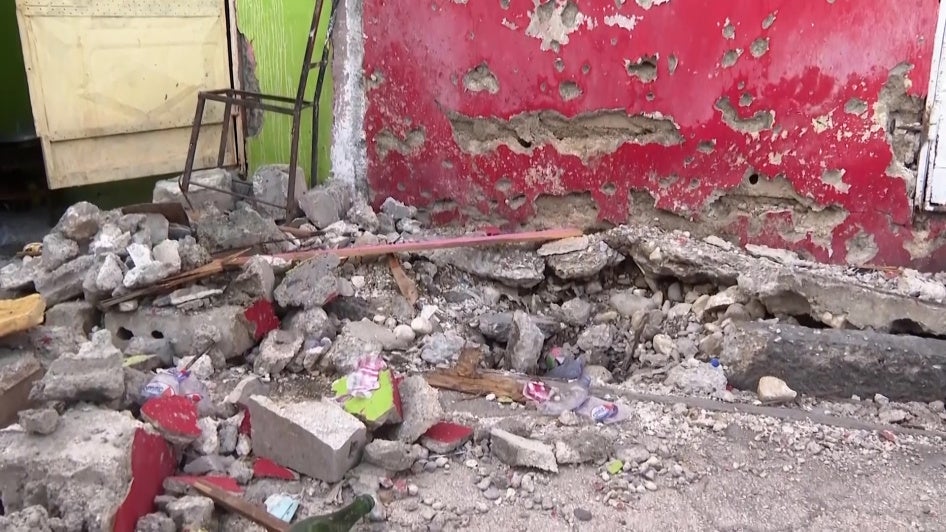
Human Rights Watch analysis of footage of the aftermath of the attack indicates that the damage is consistent with the detonation of a device containing high-explosives and pre-formed fragments. The damage is also consistent with the high-explosive payload of the size and weight that quadcopter drones known to be operated in Haiti are capable of delivering.
Several residents said that the explosion occurred in an area filled with families. The woman who lost her 6-year-old daughter said, "In the spaces where the gangs are, there are innocent people, people who raise their children, who follow normal paths."
Some residents said that criminal group members prevented families from retrieving bodies or burying their family members, which they believed was to maintain control over the neighborhood and information about drone attacks.
A man, whose 43-year-old son sold juice in the area and was killed, said that some criminal group members transported injured people to a nearby hospital in their cars. He said that his son was not part of the criminal group.
The father of a man who was killed and several others said the criminal group organized and controlled access to a funeral inside the "Nan Pak" complex. "We could only watch from the outside, observe like any passerby, as if we were nobody," the father said. Some residents said that only people who accepted money or support from the criminal group had been allowed to attend the funeral.
The woman who lost her daughter and her partner said she did not have the money for a burial and had to leave their bodies at the morgue.
Residents interviewed in November 2025 said that drones continued to fly over the community daily. One resident that she saw drones "all day, every day," and that people kept their children close when they saw them for fear of what happened on September 20.
January 1 and Other Attacks
Human Rights Watch interviewed a witness to a different drone strike that took place on January 1, 2026, in downtown Port-au-Prince that killed at least one person who was not a criminal group member. Human Rights Watch confirmed the date and location of the drone strike with a source with reliable knowledge of drone operations.
A shopkeeper said that between 12:30 and 1 p.m., she was traveling with her cousin to downtown Port-au-Prince in separate vehicles when she saw a drone fall and explode onto the truck carrying her cousin.
The woman fled the explosion but returned to the scene a few minutes later, where she found her cousin dead. She said that she had been unable to recover the body because she would have had to pay criminal groups for the remains.
She stated that she had not seen or heard any sign of a threat before the explosion. "I was on the phone with my cousin when the explosion happened, so I knew that her [truck] had been hit, but I don't know why they hit that [truck]," she said.
Human Rights Watch also reviewed and analyzed videos and images showing the use of explosive quadcopter drones in other apparent attacks on people, vehicles, and buildings in Port-au-Prince.
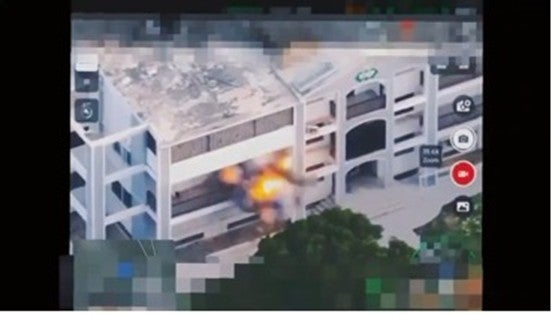
Video compilation uploaded to the social media platform X on June 16, 2025, showing four quadcopter drones striking a building in Martissant.
The videos analyzed by Human Rights Watch show quadcopter drones flying into their target, detonating upon or moments before impact. The videos that Human Rights Watch geolocated show quadcopter drone attacks on people in the street, as well as hitting buildings and vehicles in the Martissant and Village de Dieu areas of Port-au-Prince. One video uploaded to social media on June 17 shows the live feed of four quadcopter drones striking people and two buildings in Martissant.
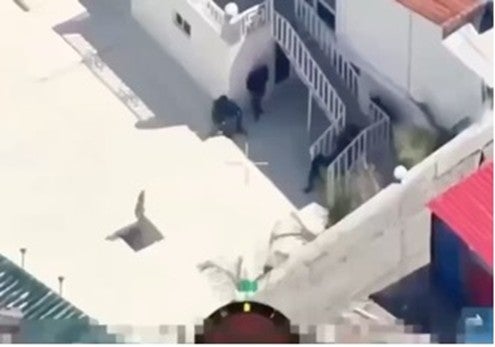
Video uploaded to the social media platform X on May 31, 2025, showing an armed drone attack on a courtyard in Village de Dieu.
In another video, a drone films a quadcopter drone flying toward a courtyard in Village de Dieu and exploding just above the ground. Nine people, two of whom appear to be armed, rush to take cover shortly before the drone explodes. The video does not show the people attacked engaging in any acts of violence or appearing to pose an imminent threat to life prior to the attack. It is unclear from the video whether anyone was injured or killed. The video cuts to a road, also in Village de Dieu, where a drone is tracking a vehicle with its camera. A second drone strikes the car.
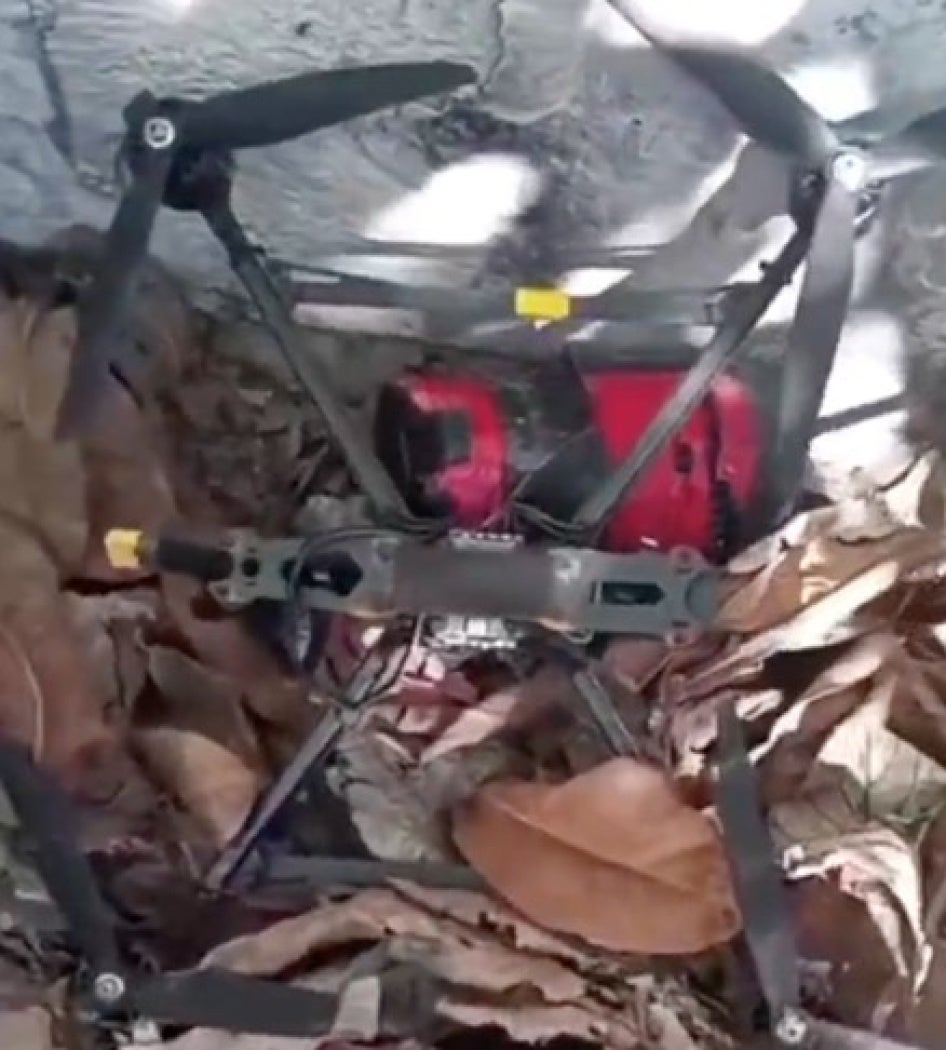
Researchers also reviewed photos and videos uploaded to social media of quadcopter drones found on the ground, reportedly in Haiti's capital, together with what appear to be unexploded munitions. The munitions appear similar to 3D-printed drone munition designs that can be found online. Researchers were unable to confirm the location of the drones and munitions due to lack of geographical information in the footage.
Unexploded ordnance left behind by armed drones that fail to function presents severe risks and can result in the direct loss of life or severe injuries that can cause a permanent disability or life-long scarring and psychological trauma.
Security Forces and the Role of Private Contractors
On March 1, 2025, Prime Minister Fils-Aimé announced that he and the Transitional Presidential Council had created a security "Task Force" to stop the advance of criminal groups. The UN Integrated Office in Haiti said the Prime Minister's Office, the Prime Minister's Security Unit, and the General Security Unit of the National Palace coordinate the Task Force, which is responsible for drone operations.
The prime minister said the Task Force was initially operated under the leadership of the police inspector general, Vladimir Paraison. Paraison became interim head of the Haitian National Police on August 8, 2025. Starting on January 4, 2026, the police and Paraison posted about several joint operations between the police and the Task Force on social media.
The UN Integrated Office in Haiti and other informed sources said the Task Force operates with the support of Vectus Global, a private military company led by Erik Prince. Prince's former private military company, Blackwater, was implicated in serious crimes in Iraq in September 2007, when its employees opened fire on Iraqi civilians, killing 17.
Prince has said that Vectus Global signed a one-year contract with the Haitian transitional government and hired Salvadoran operators to support the Haitian police in using armed drones.
Human Rights Watch sent letters to Haiti's prime minister, the Haitian National Police, and Vectus Global sharing its findings on the documented drone attacks and requesting a response. At time of writing, none had replied.
Human Rights Watch also analyzed two videos uploaded to an X page called "Haitian Security Task Force" in May 2025 showing six drone strikes, two of which researchers geolocated to Port-au-Prince. The videos are overlayed with an emblem that reads "Task Force Haïti Sécurité." A source who archived the footage and shared it with Human Rights Watch researchers said the page first issued a post on May 8 and was taken down on May 26.
Prime Minister Fils-Aimé told the Wall Street Journal in August 2025 that the drone operations have "stopped the bleeding" and driven criminal group members into hiding. He also said that "keeping innocent citizens safe is a government priority" and that "one civilian [passing] away is one too many." However, at time of writing, the families of victims interviewed said they had not had any contact with government officials in relation to the killings, nor access to justice or reparations.
Applicable International Human Rights Law
At least some of the drone strikes analyzed by Human Rights Watch appear to be attempts to carry out extrajudicial killings. Haitian officials have made no statements that would tend to push back against this analysis and have not replied to the request for comment on this and other points. Extrajudicial killings are unlawful violations of the rights to life and due process under international law, and officials responsible for such killings should be held accountable.
Under international human rights law, the deliberate, lethal use of force in law enforcement contexts can be permissible only when unavoidable in order to protect life. Some UN experts have warned that the use of drones may depersonalize policing, making it more difficult to ensure that force is applied minimally and appropriately, particularly in complex and crowded urban environments.
A UN resource book on the use of force and firearms in law enforcement notes that "military weapons"-which would include quadcopter drones armed with explosives designed to attack targets and produce area effects-"may be inappropriate for law enforcement, and given their nature, they may make it more difficult to comply with the obligation to apply the minimum force necessary to achieve the legitimate law enforcement objective."
The guidance further states that military instruments "of the offensive type" should generally "not be used in law enforcement," and that, "if they are needed for a particular situation, they must be used only by a special unit trained in their use, under special supervision and after strict authorization at the highest levels."
Haitian authorities should refrain from using armed drones equipped with explosives, due to the difficulty of using these weapons in a manner that is consistent with the obligation to apply the minimum force necessary to achieve a legitimate law enforcement objective. The use of explosives designed to produce lethal effects over an area, including with preformed or natural fragmentation, should at minimum be severely restricted in law enforcement operations.
Any further or proposed use of these types of armed drones and the individual types of explosive munitions they carry should be formally and thoroughly evaluated to ascertain whether and in what circumstances these weapons could be used in a manner consistent with international human rights standards.
Any evaluations should include a technical evaluation, taking into consideration drones' limitations, reliability, and accuracy; an assessment of their effects, including the risks of the use of explosives in cities and towns; and an evaluation of the overall potential human rights impact of their use.
Authorities should also ensure transparency around and accountability for any unlawful death resulting from a security operation, and conduct prompt, thorough, and independent investigations to disclose, to the greatest extent possible, the number and identity of victims, and provide adequate reparation where violations have occurred.


