
The Greater Horn of Africa is expected to be warmer and wetter than usual in the last quarter of 2026 as El Niño strengthens.
October to December is a critical rainfall period for the equatorial and southern parts of the Greater Horn of Africa, contributing up to 70% of total annual rainfall in parts of Ethiopia, Kenya and Somalia and up to 40% of total annual rainfall in parts of Rwanda, Burundi, Tanzania and Uganda.
There is an increased likelihood of wetter-than-normal conditions in the last quarter of 2026 in the region, according to a new seasonal climate outlook released by the IGAD Climate Prediction and Applications Centre (ICPAC) , together with National Meteorological and Hydrological Services (NMHSs) in the region.
This is due to the El Niño event which has developed, and it is expected to strengthen further during the remainder of the year (2026). Furthermore, a positive phase of Indian Ocean Dipole (IOD) is also expected to develop through August October 2026. These conditions normally lead to enhanced rainfall over the region during the rainy season.
WMO will issue its next El Niño Update on 3 September, providing authoritative global information to support decision-making. Seasonal outlooks from the extensive network of WMO Regional Climate Centres and WMO Regional Climate Outlook Forums form an integral part of El Niño monitoring and prediction and are also used by the WMO Coordination Mechanism for humanitarians (WCM) to provide information and expert advice to the humanitarian sector to support anticipatory action and protect the most vulnerable.
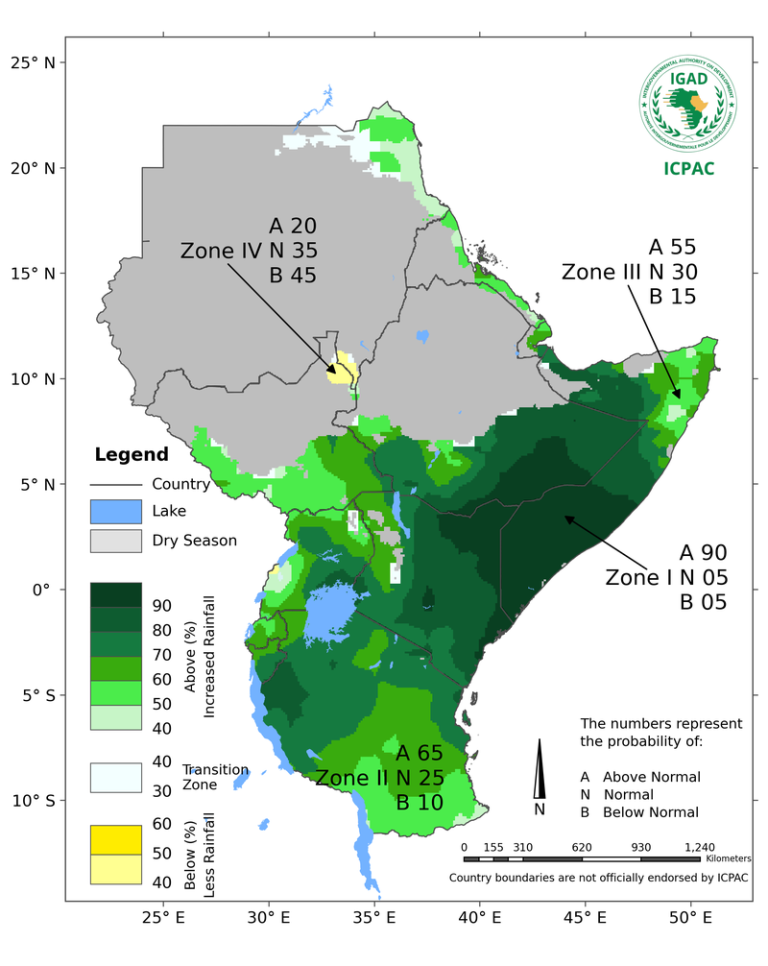
The regional downscaled rainfall forecast indicates an increased likelihood of wetter-than-normal conditions in the Greater Horn of Africa, with a 90% chance of enhanced rainfall over southern Ethiopia, central to southern Somalia, and north-eastern Kenya, according to ICPAC, which acts as a WMO regional climate centre.
The forecast also indicates a high chance of seasonal rainfall exceeding 400 mm in parts of central to southern Somalia, central parts of Kenya, the Lake Victoria Basin region, Burundi, western Rwanda and western Tanzania.
The above-average rainfall is expected to improve pasture and water availability for livestock. However, excessive rainfall substantially raises flood risk, which could lead to loss of life, crop destruction, damage to critical infrastructure, elevated risk of water- and vector-borne disease outbreaks, and disrupted access to health and nutrition services, according to an accompanying report from the Food Security and Nutrition Working Group.
The timing of the rains is expected to vary across the region. Early to normal onset is more likely across much of the eastern and southern parts of the region, including Somalia, central and eastern Kenya, southern Ethiopia, and most parts of Tanzania.
The temperature outlook indicates an increased likelihood of warmer-than-average temperatures across most parts of the region. The highest probabilities are indicated over the eastern parts of the region, particularly eastern Kenya, Ethiopia, Eritrea, Djibouti and much of Somalia.
Based on the current climate conditions and the expected evolution of El Niño and the positive IOD, 1997 and 2023 have been identified as relevant analogue years. During these years, wetter-than-normal conditions were observed across much of the region during OND. Although each El Niño event is unique, analogue years provide useful context for preparedness and planning; however, this forecast remains the primary reference for decision-making for the last quarter of the 2026 season.
ICPAC issued its new outlook at the Greater Horn of Africa Climate Outlook Forum held in Kigali, Rwanda, on 17-18 August. It was attended by representatives from the 10 countries of the Greater Horn of Africa region (Burundi, Djibouti, Ethiopia, Kenya, Rwanda, Somalia, South Sudan, Sudan, Tanzania, and Uganda), as well as key climate-sensitive sectors such as agriculture and food security, livestock, water resources, health, disaster risk management, and humanitarian agencies, media, and development partners.
NMHSs will issue detailed country-specific forecasts and advisories as part of the wider mobilization of the entire WMO community to monitor and inform decision-making about the ongoing El Niño.


