
The strengthening El Niño is set to affect temperature, rainfall and tropical cyclone patterns throughout the South-West Indian Ocean region, impacting climate-sensitive sectors and indeed all aspects of society.
There is no one single regional impact scenario, according to the South-West Indian Ocean Climate Outlook Forum, which urged governments and communities to prepare for multiple hazards. The climate outlook covers October-December 2026 and January-March 2027.
Southern parts of the region need to strengthen preparedness for drought, water stress and food-security risks; northern and wetter areas need to prepare for flooding and landslides; while island States require a flexible multi-hazard approach encompassing extreme heat, heavy rainfall, marine impacts and tropical cyclone risk.
The outlook also highlights potentially significant implications for agriculture and food security, water resources, health, marine ecosystems and fisheries. Drought and heat may reduce agricultural productivity and increase water stress in southern areas, while excessive rainfall could result in flooding, crop damage and water contamination.
The forum was hosted by the Seychelles Meteorological Agency from 15-17 September. It brought together Members from across the region including Comoros, La Réunion (France), Madagascar, Malawi, Mauritius, Mozambique, Seychelles, South Africa and the United Republic of Tanzania.
It factored in the strengthening El Niño conditions, as well as other regional climate drivers, notably the Indian Ocean Dipole, which has been evolving from a neutral state towards a positive phase, and (in the south of the basin), the Subtropical Indian Ocean Dipole, which has been evolving from a positive phase to a neutral phase.
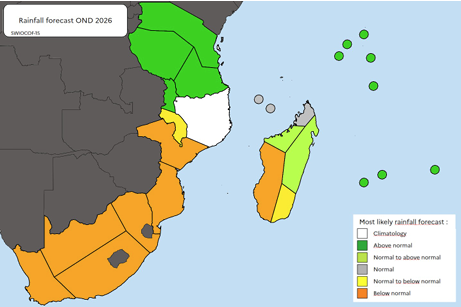
In summary, the main expected impacts for October 2026 to March 2027 are:
- Drier conditions and increased drought risk across the southern part of the region, particularly South Africa, southern and central Mozambique, Malawi and south-western Madagascar. This could increase risks to agriculture, pasture, water resources, food security and livelihoods.
- Wetter conditions and increased flood risk across parts of the northern region, particularly Tanzania, northern Malawi, Seychelles and parts of the Mascarene Islands, with associated risks of flooding, flash floods, landslides, infrastructure disruption and water contamination.
- Mixed rainfall signals over Madagascar, with the north and east more likely to experience normal to above-normal rainfall, while the south-west is more exposed to below-normal rainfall and drought stress.
- Above-normal temperatures across the entire region, with a substantially increased likelihood of exceptionally high temperatures.
- Below-normal tropical cyclone activity for the South-West Indian Ocean basin overall, influenced by El Niño. Cyclone tracks are expected to shift southward, potentially reducing landfall risk for Madagascar and Mozambique, while the Mascarene Islands retain a near-normal cyclone risk. Importantly, below-normal basin-wide activity does not imply an absence of local cyclone risk.


