
The European Commission has announced its intention to issue up to €80 billion of EU-Bonds in the second half of 2026. This will bring the total planned EU-Bond issuance for 2026 to €180 billion, in line with the Commission's earlier indication for the year.
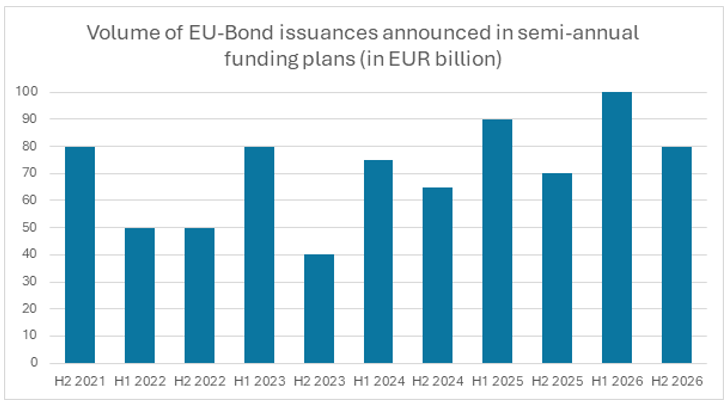
The proceeds will be used to fund EU policy programmes financed through borrowing on capital markets. These include disbursements to EU Member States under the NextGenerationEU programme, support for Ukraine (including payments under the new Ukraine Support Loan ), disbursements under the Security Action for Europe (SAFE) instrument , and contributions to other EU programmes.
The Commission will continue to carry out all issuances under its unified funding approach , using a mix of long-term and short-term instruments. This approach enables the Commission to meet disbursement needs across the increasing range of policy programmes funded by capital market operations, supporting a stable pattern of EU-Bond issuances.
The Commission will also continue to issue NextGenerationEU Green Bonds on the basis of reported green expenditures by Member States under the Recovery and Resilience Facility. To date, €84.3 billion have been raised through issuance of NextGenerationEU Green Bonds. Such issuances can continue to take place after 2026, as part of the roll-over operations under the management of the NextGenerationEU-related borrowing.
Background
The Commission borrows on international capital markets on behalf of the EU and disburses funds to Member States and third countries under various borrowing programmes. EU borrowing is guaranteed by the EU Budget, with contributions to the Budget being an unconditional legal obligation of all Member States under EU Treaties.
Using proceeds raised by EU-Bonds and NextGenerationEU Green Bonds issued since mid-2021, the Commission has so far disbursed over €241.8 billion in grants and €166 billion in loans to EU Member States under the Recovery and Resilience Facility. Up to €78.4 billion have been allocated to other EU programmes benefitting from NextGenerationEU funding.
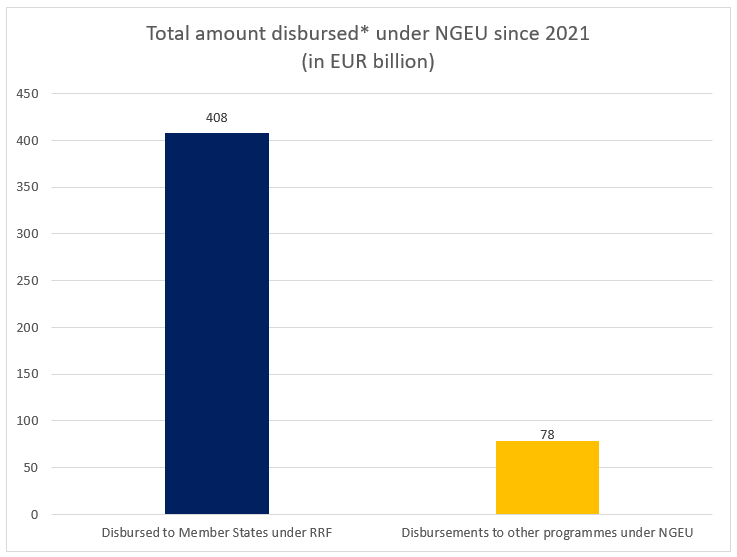
*: Disbursements funded by borrowing, excluding expenditures financed by the Emissions Trading System (ETS) and Brexit Adjustment Reserve (BAR)
EU borrowing will also continue to finance disbursements to Ukraine under the ongoing Ukraine Facility (where €25.6 billion of the total envelope of €33 billion has already been disbursed) as well as providing new support under the €90 billion Ukraine Support Loan .
EU borrowing also finances the Security Action for Europe (SAFE) instrument, which supports the procurement of defence-related capabilities through loans to Member States, and where pre-financing disbursements started in May 2026.
To support financing needs and ensure continued access to capital markets on favourable terms, the Commission is continuously enhancing the structure and the delivery of its borrowing operations.
Since January 2023, the Commission has been issuing single-branded EU-Bonds rather than separately labelled bonds for individual programmes with transactions based on structured semi-annual funding plans and pre-announced issuance windows.
Primary issuances are supported by EU-Bonds' secondary market liquidity. The existence of a framework incentivising EU Primary Dealers to provide quotes on EU securities on electronic platforms, and the availability of a repurchase facility, are enhancing the functioning of the EU-Bonds' ecosystem.
The growing depth and liquidity of the EU-bond curve has also been reflected in the execution of syndicated transactions. In 2026, several issuances were priced by reference to points on the EU's own curve. Using the EU-Bond curve as a pricing reference supports an efficient price formation and gives confidence to investors in volatile markets.
In the second half of 2026, the Commission plans to execute EU-Bond issuance through four syndications and six EU-Bond auctions. Auctions will continue to play an important role in the programme, with three-leg tranches and non-competitive allocations following each EU-Bond auction supporting a flexible and efficient implementation of the funding plan. Short term funding, including EU-Bills will also continue to supplement the Commission's EU-Bond issuances, reinforcing its capacity to manage funding needs.


