
Suspended in the path of a proton beam from CERN's Super Proton Synchrotron (SPS) was an unusual target: a large silicon tracker destined for space. Known as "Layer-0", this new layer of silicon sensors will be mounted on top of the Alpha Magnetic Spectrometer (AMS) while it orbits Earth on the International Space Station (ISS). The additional tracker, assembled at CERN, will increase the detector's particle acceptance rate by 300%, helping the AMS make the most of its remaining years in space before the planned end of the ISS programme in 2030.
From 28 June to 27 July at the EHN1 facility in CERN's North Area, Layer-0 was hung from a robotic arm that moved it through more than 700 positions as it was hit by the SPS beam. Fully automated and synchronised with the detector data acquisition, the movements ensured that all of the tracker's sensors were exposed to the stream of protons. This allowed the team to precisely scan the detector plane, mapping the response and position of each sensor and confirming the functionality of the detector. Further data is still being analysed.
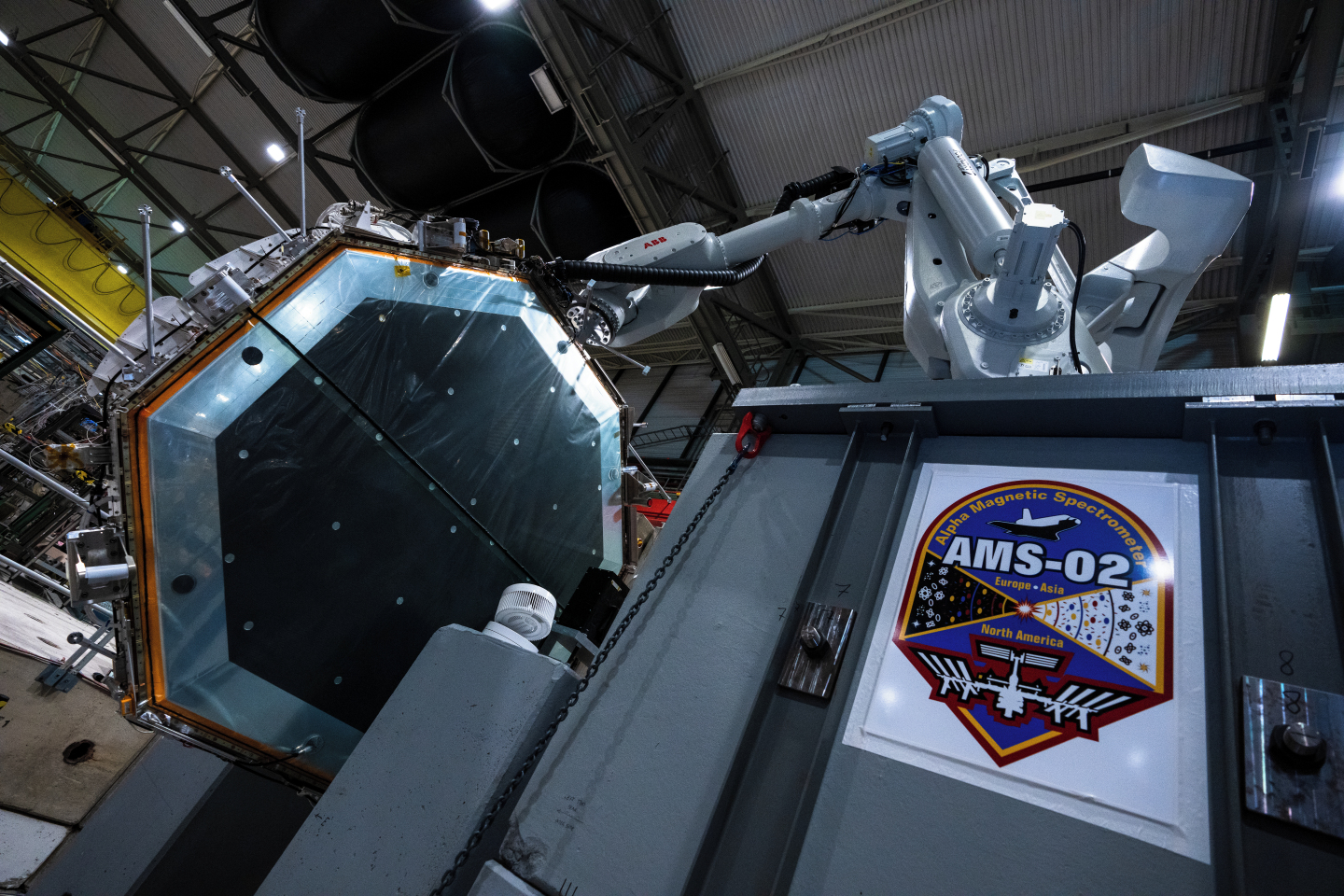
"This was our last chance before CERN shuts down all the beams for LS3," says Corrado Gargiulo, CERN-AMS Chief Engineer. "It is the first time that such a robotic arm has been used here in the North Area, marking a step towards using robotic and automated systems for handling detectors in CERN's underground areas." This effort will help with the development of technologies envisaged for potential future detectors, including the Future Circular Collider.
Exposing detectors to particle beams for calibration is standard practice in particle physics, but for the AMS, the exercise is particularly important. Layer-0 is three metres in diameter and will sit on top of the nine existing tracker layers, which are about one metre across. To correctly align the new and existing layers, the exact position of each of its 768 sensors must be known within a few micrometres, less than the width of a human hair.
Only a few milestones remain before Layer-0 can leave Earth. Having already passed extensive vibration and thermal-vacuum tests, Layer-0 will now undergo a final acceptance test at INFN-University of Perugia in Italy until 30 August, followed in October by the last of a series of measurements performed at CERN.
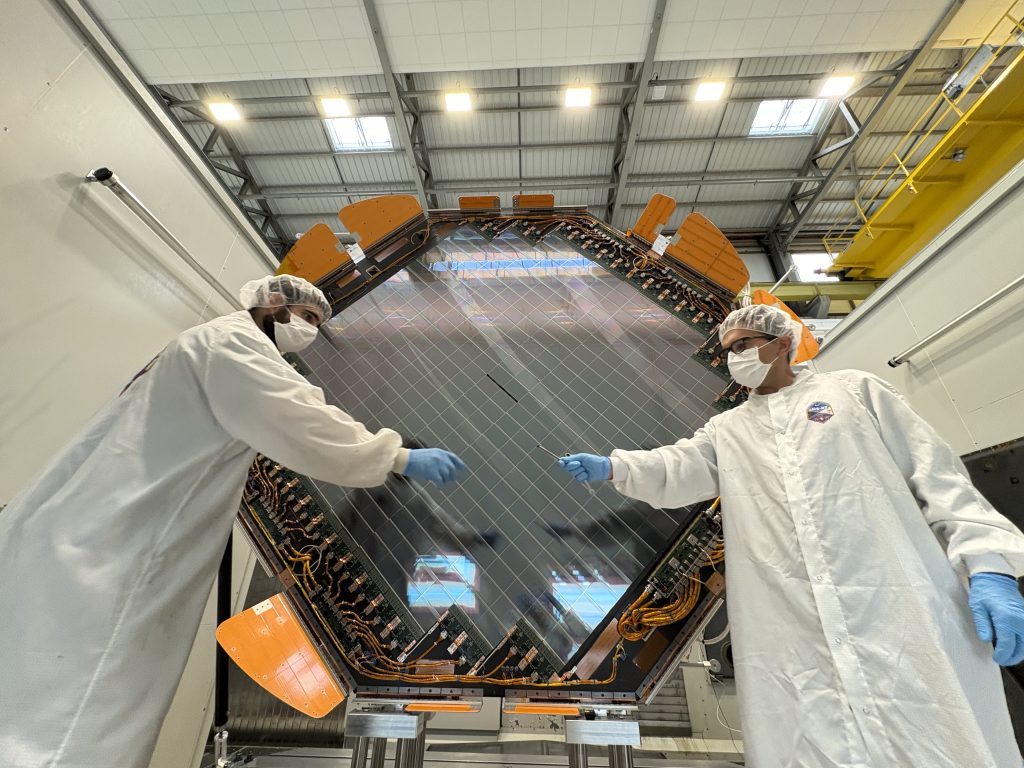
In January 2027, the new tracker is expected to fly from Geneva airport directly to the Kennedy Space Center on a commercial cargo plane. Its final journey to the ISS is planned for April, aboard a dedicated SpaceX Cargo Dragon. It will travel together with a new PDS (power distribution system) radiator, forming the largest single scientific payload ever carried by a Dragon spacecraft. This replacement radiator is vital for the AMS, as it will help restore the entire detector to its intended operating temperature following the performance degradation of the previous radiator over several years of operation in space.
Installing the new equipment in orbit will present challenges of its own. A series of preparatory spacewalks will be required beforehand to install the interface that will "receive" the new layer. Extensive astronaut training is ongoing at the Neutral Buoyancy Laboratory in Houston, one of the world's largest indoor pools, with Gargiuloassisting in the simulation of the installation. By May 2027, mechanical and power connections are expected to be completed during further spacewalks, bringing the new system fully online.
With its new silicon tracker and radiator, the AMS is preparing for a second decade of cosmic-ray exploration from space, ready to continue its mission throughout the final years of the ISS.


