
The classic paradox asks: What happens if an unstoppable force meets an immoveable object? Last week in Levering's Great Hall, 34 teams of first-year mechanical engineering students turned that well-known question into a high-stakes contest during the annual Freshman Design Competition, the culmination of the Intro to MechE Design and CAD course.
The competitors were tasked with designing and building a vehicle powered solely by a wind-up spring motor activated by pulling a string. As long as the car had at least three wheels and met the size specifications, the teams could be as creative as they wanted. As is customary for the event, the vehicles' designs—from a duck and a British flag to an ice cream truck—were as creative as the teams' names, including Wheelie Fast, Baltimotor, Mexicanics, and Kermit Collider.
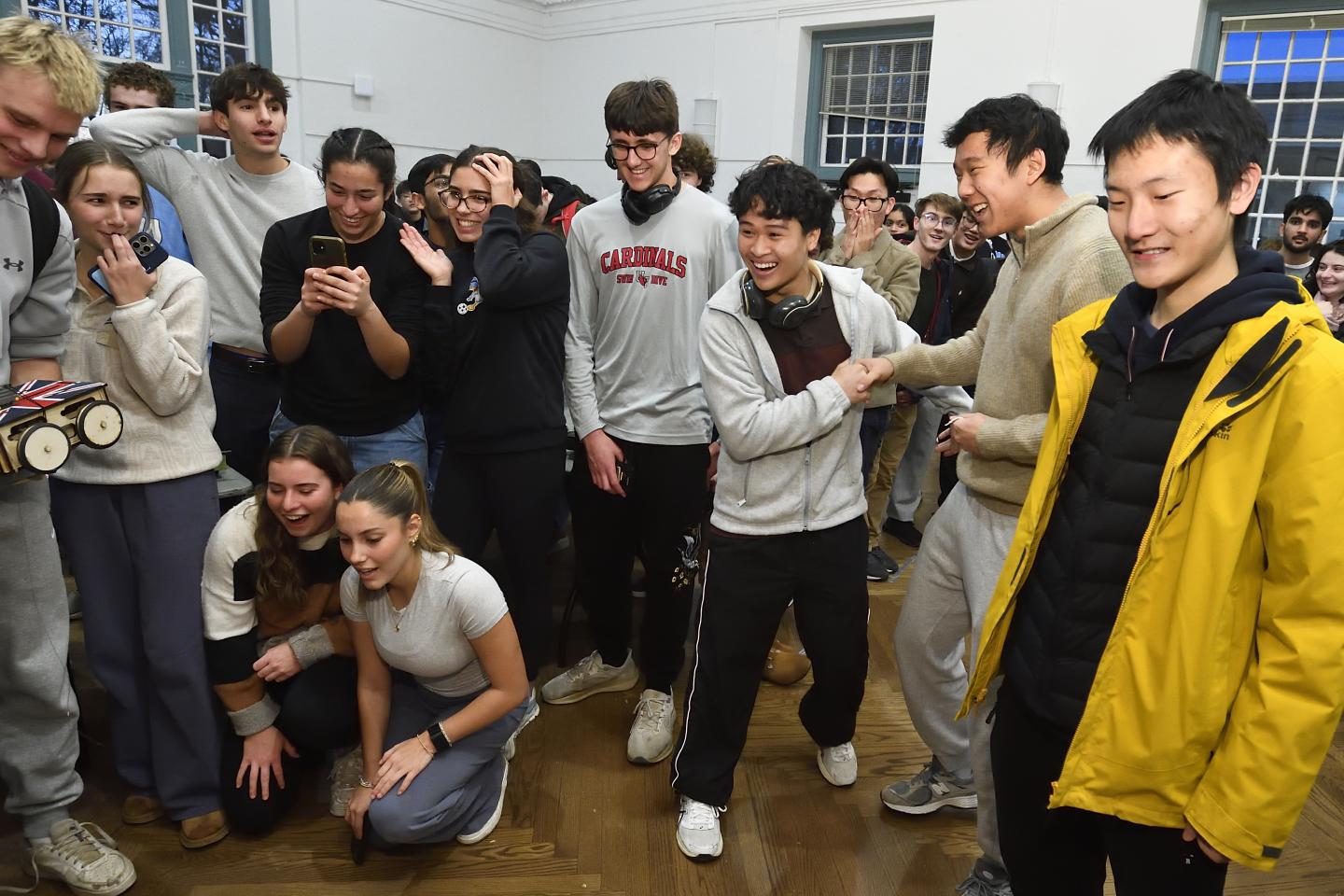
Image credit: Will Kirk / Johns Hopkins University
Each team sent a semester's worth of work down an 8-feet-by-1-foot track for head-to-head matches that lasted only seconds, with victory going to the vehicle that pushed its opponent past the middle line. In the moments before the string was pulled, uncertainty hung in the air.
"We wanted to mimic an all-wheel drive car to retain traction," said Savannah Cabrera, a member of team Lightning McQueens, noting that the track was littered with bumps. "Our plan was just to create something that functions properly."
Emily Yao, a member of team NEN, said she was uncertain how her team's car would fare, but had prepared for any outcome.
"If it flips over, it explodes," she said, revealing the flames painted on the car's undercarriage. "We can also change its expression depending on how we do," she added, pointing out the frown drawn on the car's front.
Some teams focused on speed, others on size or brute force, and some even fashioned ramps to launch the opposing cars to their demise. But for the winning team, Pizza Car, with its unassuming slice of cheese pie design, it was fundamental engineering principles that ruled the day.
"We figured it was a matter of who got to the middle first, so we focused on maximizing torque and acceleration," said team member Allison Chuang, who, along with teammates Christopher Yang and Jason Zhao, advanced through four levels of the competition bracket, defeating teams Tortoise and Sexy Subaru in the final round-robin match in front of a silent, standing-room crowd.
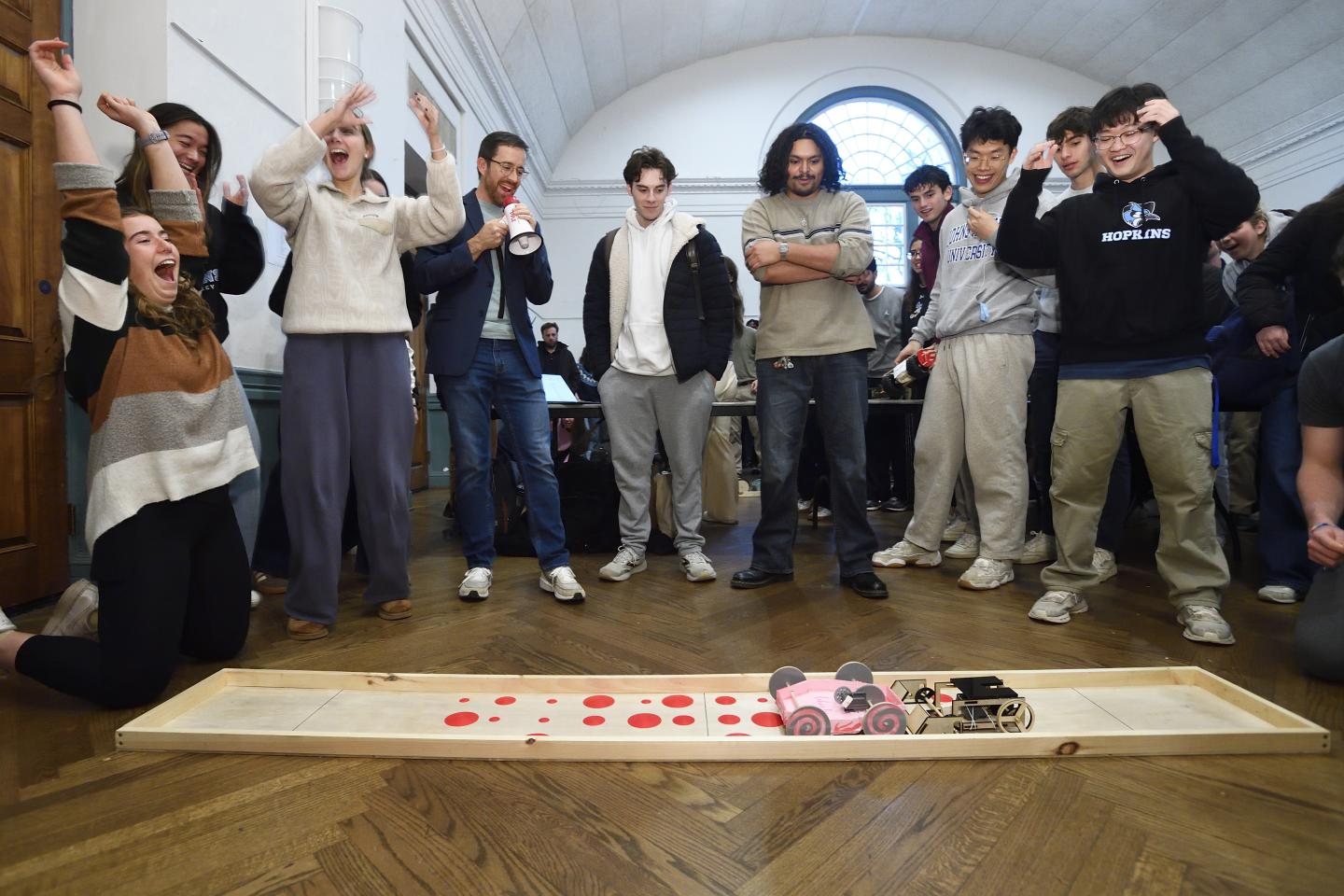
Image credit: Will Kirk / Johns Hopkins University
"Consistency was key," Zhao said. "We stuck with the triangle shape from the beginning."
Chuang noted that like many of their competitors, the team didn't have high hopes going into the competition. "I'm still shocked," she said.
Todd Murphy, a lecturer in the Department of Mechanical Engineering and lead instructor for the class, was not as surprised.
"If you'd asked me a few weeks ago, I'd have said Pizza Car was a top contender," said Murphy, who led the contest via bullhorn.
He added that the class and competition embody the spirit of Hopkins Mechanical Engineering.
"The students learn to use new tools to make something out of nothing and work with people they barely know," Murphy said. "This project is well-suited to their abilities at this stage and brings a lot of fun to the design process."
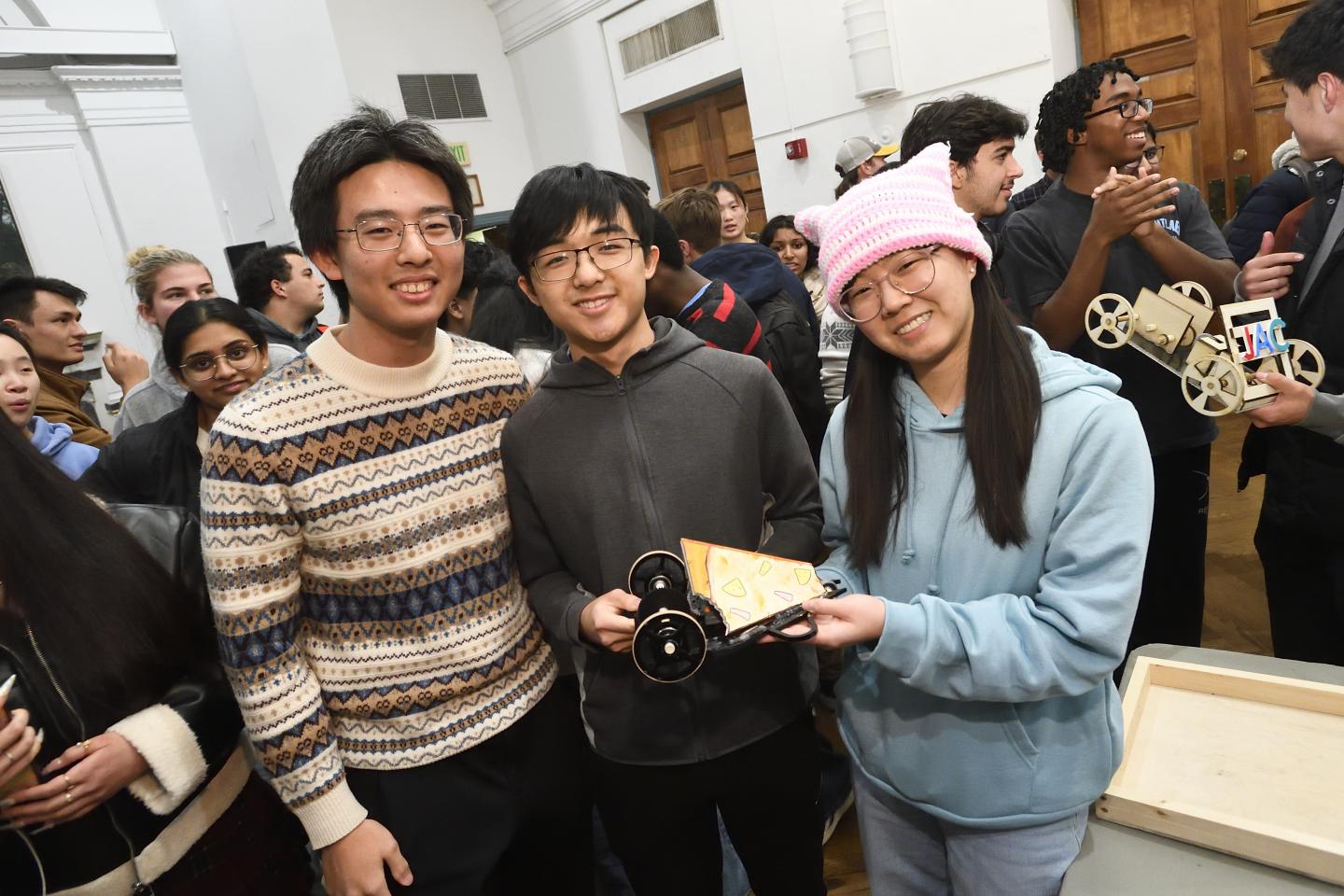
Image credit: Will Kirk / Johns Hopkins University


