
Gloria Steinem, the journalist and women's rights campaigner who became one of the most influential voices of the feminist movement, has died at the age of 92. In an announcement on Instagram, her family said she had passed away on Wednesday at her home in New York City, surrounded by some of the many who loved her.
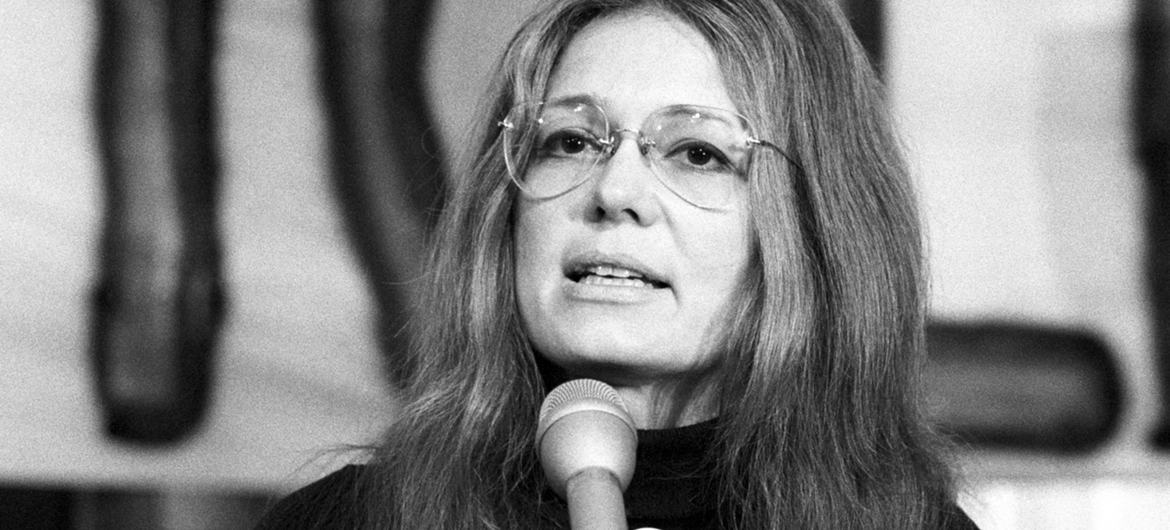
Following news of her death, UN News revisits a powerful moment from Ms. Steinem's appearance at UN Headquarters in New York in 2016, when she took her message about violence against women to the global stage.
In her landmark speech ten years ago, the pioneering activist warned that violence against women is inseparable from questions of peace, security and democracy.
"The single most important element or determinant of whether a country is violent within itself or whether it will be willing to use military violence against another country is not poverty, not access to natural resources, not religion or even degree of democracy. It's violence towards females."
'This is a world issue'
Ms. Steinem pointed to the many forms violence against women can take, from sexual violence in war - to trafficking, female genital mutilation (FGM) and violence in the home.
She also spoke about the consequences of cultures where sons are prioritised over daughters, and the resulting long-term impact on societies.
"This is not a women's issue…Hello. This is not a children's issue. This is a world's issue."
Violence against women remains a pervasive global public health and human rights concern.
According to the latest data from the gender equality agency UN Women , an estimated 840 million women - almost one in three - have been subjected to physical and/or sexual intimate partner violence, non-partner sexual violence, or both at least once in their life.
Legacy and inspiration
Ending violence against women and girls is central to the global effort to achieve gender equality and the Sustainable Development Goals (SDGs).
For Ms. Steinem, the treatment of women offered a revealing measure of the societies in which they lived.
"The easiest way to figure out how democratic and peaceful any group is, is to see: are there women there and how are they being treated?"
A lifetime of challenging inequality
Ms. Steinem became one of the most recognizable voices of the feminist movement in the United States during the 1960s and 1970s.
She helped highlight issues including reproductive rights, discrimination, political representation and violence against women - bringing them into the mainstream. She was also a co-founder of Ms. magazine and worked with generations of activists seeking greater equality.
Hope for humanity
Underlining that "each of us has some part of the knowledge, the solution, the insight, the understanding that will contribute to the whole", she said that listening was key.
"You know, there's nothing more important than listening to each other."
In her later years, Ms. Steinem continued to write and to bring people together, including in her own New York home, creating regular "Talking Circles" - a tradition she wanted to continue beyond her lifetime, according to her family.


