
Hines drew upon his 'four Cs' at the state Capitol's celebration of King's legacy
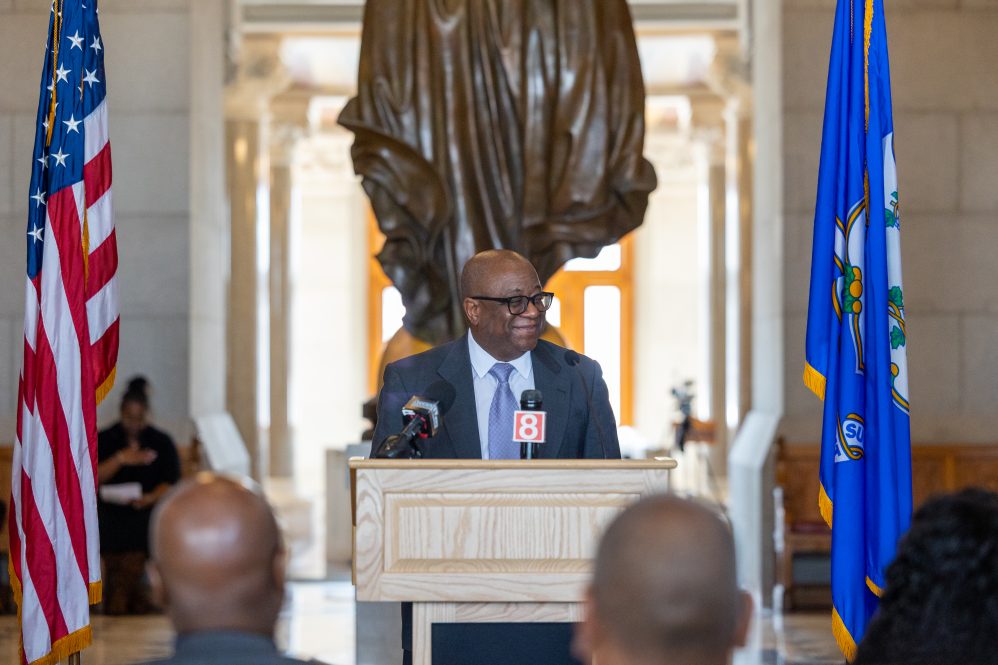
Vice President of the Office for Inclusion and Civil Rights Dr. Jeffrey Hines gives the keynote address during a ceremony recognizing Martin Luther King, Jr. Day at the Connecticut State Capitol on Monday, Jan. 19, 2025. (Sydney Herdle/UConn Photo)
Dr. Jeffrey F. Hines, the vice president of the Office for Inclusion and Civil Rights at UConn and UConn Health, delivered the keynote address at the Connecticut Martin Luther King, Jr. Holiday Commission Commemoration on Monday morning at the state Capitol in Hartford.
The event was a celebration of King's 97th birthday and the commission's 40th anniversary.
Established in 1986, the Connecticut Martin Luther King Jr. Holiday Commission was created to honor and advance King's legacy throughout Connecticut. Its mission is to promote the principles King espoused and to provide programs and opportunities that help keep his dream alive for future generations.
The theme of Hines' address was "Keep the Dream Alive Through Compassion, Courage, Commitment, and Coalitions."
"We gather not simply to remember Dr. King, but to recommit ourselves to the unfinished work he left us," said Hines, who is also a member of the Departments of Obstetrics and Gynecology and Public Health Sciences in the School of Medicine. "We gather not to admire the dream from a distance, but to ask what it requires of us - here, now, and together.
"Martin Luther King, Jr. Day is not just a commemoration. It is a call to action. A reminder that the dream is not a finished chapter in our history, but a continuing responsibility in our present."
The event also featured remarks from Gov. Ned Lamont, Lt. Gov. Susan Bysiewicz, Secretary of the State Stephanie Thomas, U.S. Sen. Richard Blumenthal, and U.S. Rep. John Larson.
Hines reflected on what he called his four Cs – principles that are essential about keeping King's dream alive: compassion, courage, commitment, and coalitions.
"Dr. King believed that justice begins with compassion - not as sentiment, but as moral action," said Hines. "Compassion, in his vision, was not weakness. It was strength rooted in humanity. It was the ability to see others fully, especially those whom society has rendered invisible, ignored, muted, erased, harmed, in pain, or simply in hiding.
"Compassion requires proximity. It asks us to move closer to the lived and life experiences of others, even when those experiences challenge our assumptions or discomfort us. I'm always one to say that our best learning happens at the margins of our discomfort. It requires us to listen deeply, actively, and with empathy - not to respond, not to rebuke, but to understand."
Hines explained that if compassion is the foundation, courage should be the catalyst for change.
"Dr. King's courage was not symbolic," said Hines. "It was lived. It involved risk, sacrifice, and sustained resistance to injustice. He spoke truth when silence was safer. He challenged systems when accommodation was easier. And he did so knowing there would be consequences - criticism, isolation, and personal sacrifice."
Hines said King understood that change does not come from moments alone, but from commitment sustained over time.
"Commitment is what remains after the applause fades today," said Hines. "It is what carries the work forward when progress feels slow and setbacks feel heavy. It is the discipline of staying engaged even when results are not immediate. Commitment helps us overcome fatigue, exhaustion, and defeat. It moves us to drive forward and to support the harm we suffer along the way.
"Commitment requires investment - not only of resources, but of attention, accountability, transparency, and resolve. It requires us to examine outcomes, not just intentions or impulses."
The final C for Hines is coalition - no one keeps the dream alive alone.
"The civil rights movement was not the work of a single individual," said Hines. "It was a coalition - many races and ethnicities, skin colors and accents, genders and gender expression, of people of faith and conscience, of students, workers, clergy, and elected officials who believed that justice required collective effort.
"Coalitions are not easy. They demand trust, patience, and the willingness to work across difference. They require us to resist the false comfort of isolation and the temptation of division. They are authentic and truly co-creative – not extractive.
"If we do our part together, then we will not only keep the dream alive, we will move and bend the arc of the dream and bring it closer to its sustained promise. Move boldly with zeal. Look to your left and look to your right and say 'we will continue this work – today and tomorrow.'"


