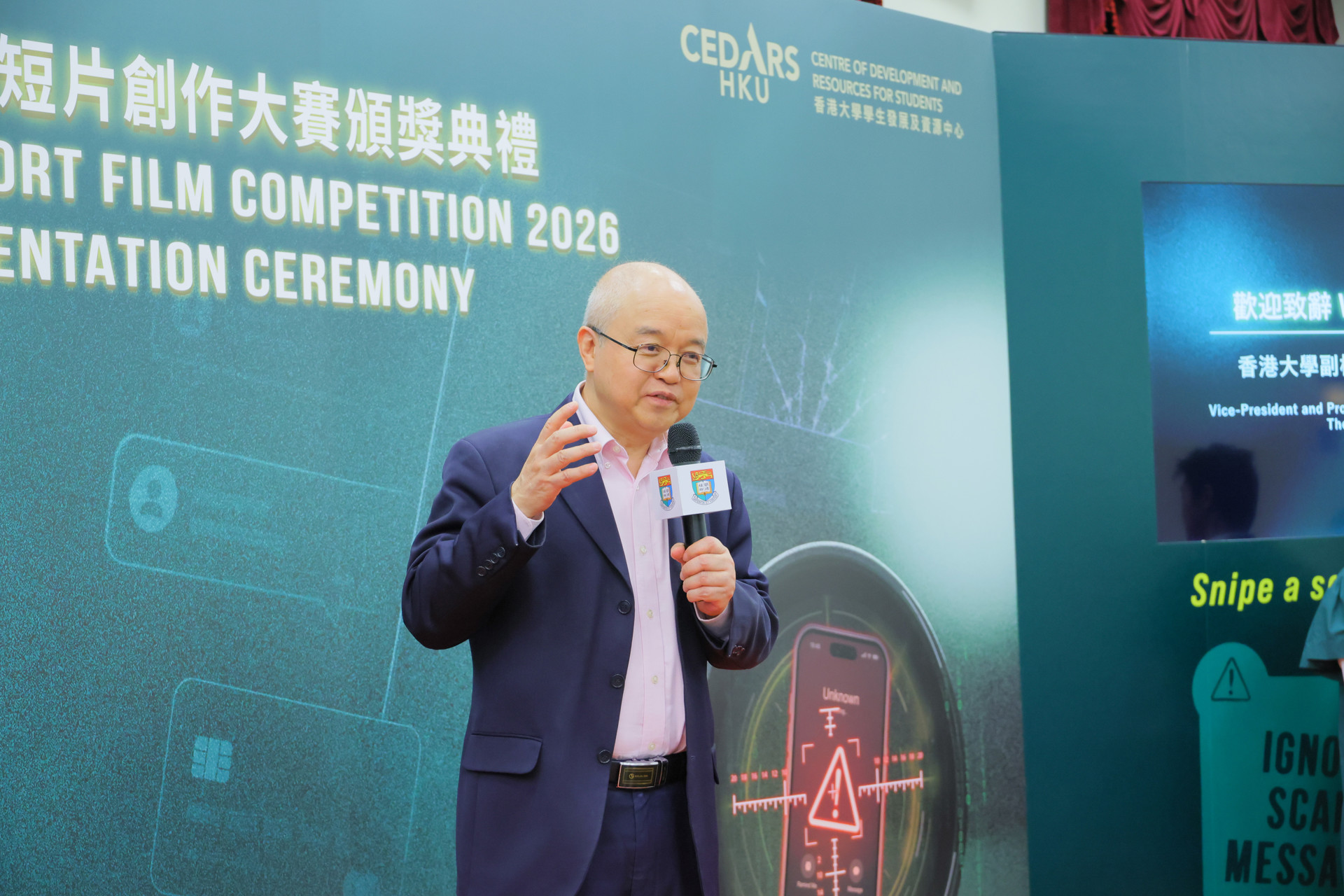
The University of Hong Kong (HKU)'s ScamSniper Film Competition, jointly organised by the Communications and Public Affairs Office (CPAO) and the Centre of Development and Resources for Students (CEDARS), concluded with an Award Presentation Ceremony held on 28 November 2026.
Co-organised as part of HKU's ongoing anti-scam education efforts, the competition invited participants to produce short films that raise awareness of common scam tactics while promoting vigilance and critical thinking among university students and the wider community.
The competition attracted an enthusiastic response, receiving more than 150 entries from both the Student Division and the General Public Division. Participants competed in two categories, namely Live-Action Mini Drama and AI-Generated Short Film, demonstrating a wide range of creative approaches to anti-scam storytelling.
Professor Yang Wang, Vice-President and Pro-Vice-Chancellor (Institutional Advancement), delivered welcoming remarks, while Professor Kelvin Yeung, Dean of Student Affairs, gave the opening speech.
Professor Yang Wang said, "The creativity, passion and social awareness demonstrated by participants have been truly inspiring. Through compelling storytelling and innovative uses of technology, these films translate important anti-scam messages into relatable and impactful narratives that can help safeguard our community."
In his opening speech, Professor Kelvin Yeung highlighted the importance of fostering scam awareness among young people. He noted that creative and peer-driven educational initiatives could play a valuable role in helping students identify fraudulent schemes and make informed decisions when confronted with suspicious situations.
The judging panel brought together expertise from education, filmmaking, communications and student engagement. Judges included Academy Award-winning filmmaker Professor Ruby Yang, Director and Professor of Practice at the School of Future Media of HKU; Professor Yang Wang; Professor Kelvin Yeung; Mr Feng Wang, Director of Communications and Public Affairs; student representative Mr Bowen Xie from CEDARS' Anti-Scam Campaign; and Ms Stephenie Ang from the Anti-Deception Coordination Centre of the Hong Kong Police Force.
During the ceremony, the judges presented awards to winning teams from both divisions and recognised outstanding works across the Live-Action Mini Drama and AI-Generated Short Film categories, as well as special awards.
The competition centred on scam scenarios that commonly target university students, including impersonation scams, online investment fraud, fake employment schemes, phishing attacks, e-commerce scams and money mule recruitment. Through creative storytelling, participants transformed these important public safety messages into engaging and educational content.
To further extend the educational impact of the initiative, selected winning entries may be adopted as educational video materials for use within the University to support anti-scam awareness programmes and student education activities.
As digital fraud continues to evolve, the University remains committed to working with students, staff and community partners to strengthen scam awareness and promote a safer and more informed community through innovative educational initiatives.