
It's 20 years to the day since the UN Human Rights Council began its work as the world's principal forum tasked with promoting and defending fundamental rights everywhere, particularly the world's most vulnerable people.
"Human rights were built for moments like this," said Awa Dabo, the newly appointed Deputy High Commissioner for Human Rights, "when rights have come under pressure, when people need protection and principles must turn into action."
Created to replace the UN Commission on Human Rights, the 47 Member States of the new Council were urged to avoid "political point-scoring or petty manoeuvre" - the words of then Secretary-General Kofi Annan on 19 June 2006.
Now, in its 62nd session in Geneva, the Council is busier than ever as it pushes for accountability in many new emergencies and unresolved crises.
But, has it matched up to expectations? And has it adapted to a world where "human rights are under assault [and] violated flagrantly?", as UN chief António Guterres underscored in a special event on Friday marking two decades of the Council .
'It was not easy'
"Building the Council was not an easy task," recalls Luis Alfonso de Alba Góngora, its first president.
"Member States have very different views of what needed to be changed and what needed to be retained from the old Commission [on Human Rights].
It was not easy because the international context situation was not good either; there were countries that opposed the creation of the Human Rights Council and were not supporting the building of the new institution. There were conflicts in Gaza, as today, conflicts in Lebanon…It was not easy."
Every voice counts
In common with other UN bodies, one of the Council's aims at its creation was to include as wide a range of participants in its discussions, from governmental to non-governmental speakers and from independent investigators to civil society activists.
This level of participation "makes sure that Indigenous Peoples are represented" among others whose voices struggle to be heard, explained Volker Türk, High Commissioner for Human Rights.
"I have been to many interactive panels that involve children and young people, but that involve also survivors and victims. That's a model of participation that the UN needs to stand for and needs to even go further on."
Council-watchers will often hear the president, who's appointed on a rotating basis from regional blocs for a year, reminding delegates gently and often that they should be respectful towards each other.
The remark serves as a reminder of the lethal reprisals facing many human rights activists face today and of the key role the forum plays in raising their concerns.
Special investigators
Another key feature of the Council is its human rights investigators who are mandated to monitor situations of concern and report back to raise awareness and encourage action.
There are around 50 Special Rapporteurs who are the "frontline for voices that are unheard", maintained Farida Shaheed, Special Rapporteur on the right to education. "We also do speak when others fall silent, and sometimes people don't like what we say. We're bringing to the table things that are not always discussed."
Considered approach
The Council has higher status than its predecessor as a subsidiary body of the UN General Assembly. It meets in three regular sessions a year and every time it does so, there are usually two dozen or more resolutions to consider on everything from advancing human rights in specific countries of concern such as South Sudan to freedom of religion or belief and the right to a clean, healthy and sustainable environment .
Most of these texts detailing what actions the Council expects are adopted without a vote at the end of each session. Some undergo revisions before being approved while others can be withdrawn from the final list. Sometimes this happens following hushed-tones informal negotiations near the UN's many coffee machines as caffeine-starved delegates dash out from the more plush, carpeted surroundings of the iconic Room XX in Geneva, which is the Council's home.
When agreement on an issue can't be reached, such as on Ukraine , a vote is called and the resolution is either adopted or not. And while the Council continues to face accusations of anti-Israeli bias - a nation that remains on its agenda 20 years on - defenders of the forum point to its human rights peer-review of each UN Member State, which happens every four and a half years.
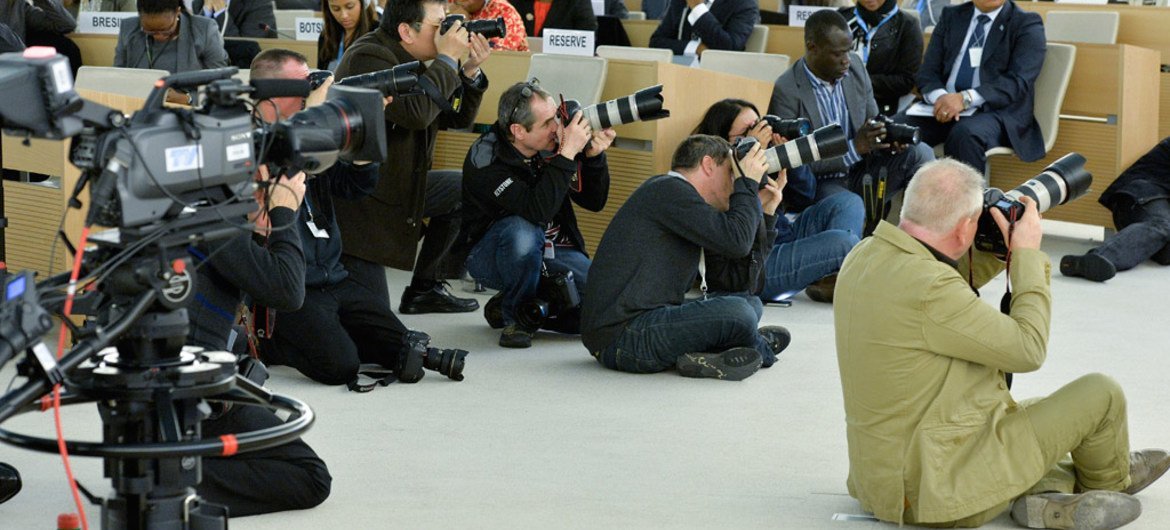
Funding crunch
Although human rights are one of the UN's three pillars along with peace and security and development, the current UN-wide funding crisis represents an existential challenge to the work of the Council.
Delegates have less time to speak and interpretation has had to be cut back.
Echoing concerns about the dire financial situation expressed by the High Commissioner for Human Rights, independent experts have also frequently highlighted how a lack of funding has forced them to rationalise their workload.
Heady days
Over and above the challenges facing the Council, senior communications official Rolando Gomez remembers the excitement of the first session back in 2006.
"As part of the small media team supporting the launch, there was a real sense that we were witnessing the beginning of something new, a renewed commitment by the international community to strengthen the UN's work on human rights and give these issues a more prominent place on the global agenda.
"While it has faced its share of challenges and controversies, it has become an indispensable forum for dialogue, accountability and action on human rights issues worldwide," he said.
"What has always struck me most is its ability to provide a unique stage for voices that are often not heard elsewhere - victims, human rights defenders, independent experts and civil society representatives whose testimonies bring human rights realities into sharp focus."
Also in the Council at the very beginning was veteran political counsellor Bob Last from the UK Mission "On day one there was a mixture of excitement and hope. Excitement because we were starting something big and with a chance to build a new institution, something not many of us who work at the UN ever get to do.
"And hope because this was a chance to improve on the failings of the Commission on Human Rights. There was, and still is, disagreement on what those failings were. But on that first day, [former UN Secretary-General] Kofi Annan was very clear on what he saw as the Commission's failings, why he had called for its replacement and his hopes for the Council."


