
Leading international financial institutions came together at the ILO on 1 and 2 December 2025 for the IFI Symposium on Measuring and Assessing Quality of Employment to identify practical ways to strengthen the measurement of job quality in development finance: how to meaningfully measure not only the number of jobs created by development bank's operations, but also the quality of those jobs.
Participants included major development finance institutions-including the World Bank, the Asian Development Bank, the African Development Bank, the European Investment Bank, the European Bank for Reconstruction and Development, the Islamic Development Bank, the Council of Europe Development Bank, the OPEC Fund for International Development, the International Finance Corporation, IDB Invest, British International Investment, Proparco, ENABEL, FMO, the UK Foreign, Commonwealth & Development Office, KfW, and Swedfund-alongside academics, ILO experts and others at the ILO headquarters.
Opening interventions reaffirmed the shared interest in practical and transparent indicators that reflect both the quantity and the quality of employment supported through development initiatives. A recap of earlier exchanges provided the groundwork for this year's focus on methodological clarity and multidimensional approaches to capturing employment conditions.
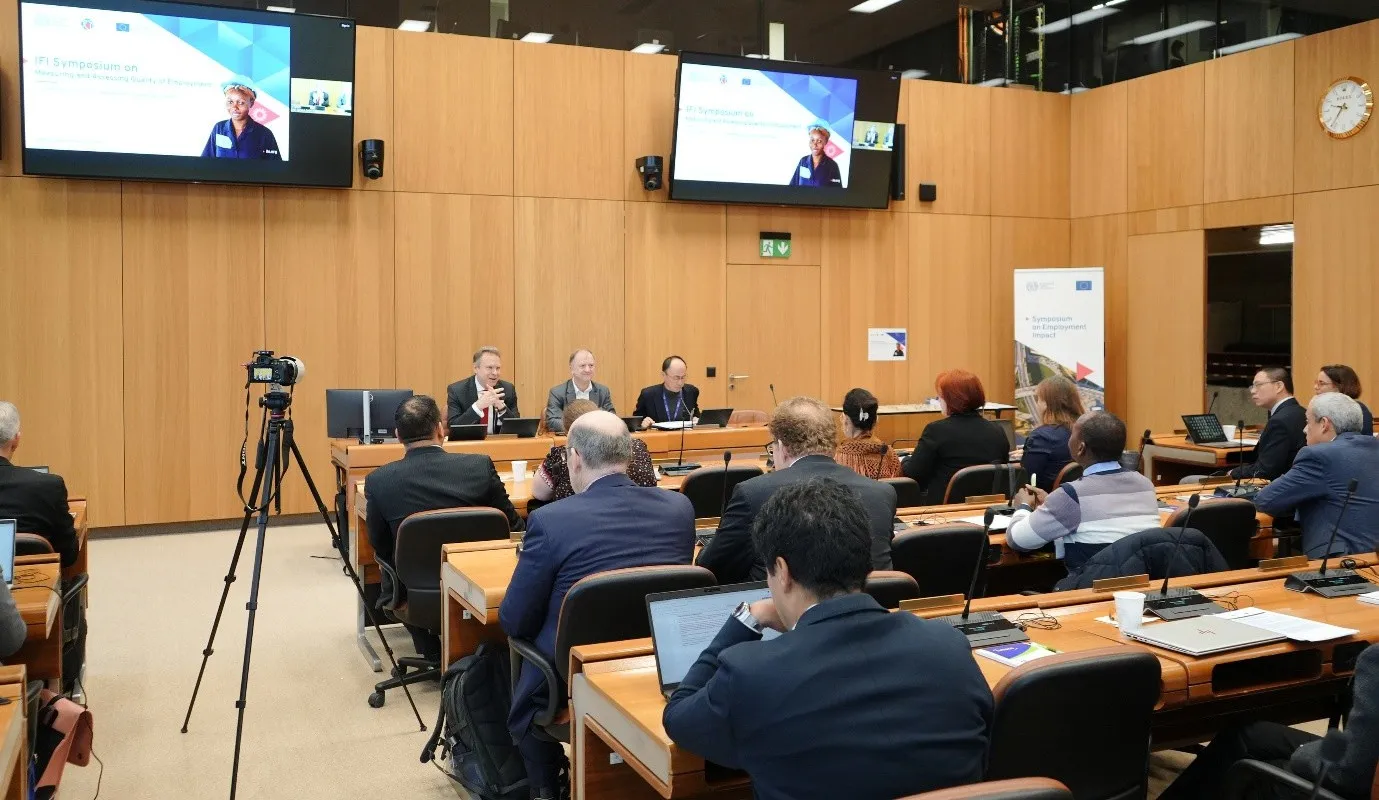
© S2/ILO
Wages as a starting point
The first thematic session focused on wages as a measure of job quality, drawing on the World Bank's new scorecard indicator using labour earnings as a proxy. While participants acknowledged that wages alone cannot fully capture job quality, they agreed that labour income provides a practical and implementable starting point, particularly in contexts where more comprehensive data are lacking.
ILO specialists shared guidance on international standards for wage measurement, including minimum wage adequacy, living wage methodologies, and gender pay gap analyses, highlighting both areas of progress and persistent gaps in global wage data availability.
Complementary indicators: informality, social protection, and working time
The second session broadened the discussion to additional dimensions of employment quality. Informality was identified as a central challenge, particularly in regions where workers lack contracts, social protection, or stable earnings. Participants highlighted the need for multidimensional approaches to capture conditions of informality, including working environments, vulnerability, exposure to occupational risks, and access to social protection.
A dynamic discussion on platform work and digital labour markets emphasized both opportunities and challenges. Issues such as algorithmic management, blurred boundaries between work and personal time, and emerging entitlements-such as the "right to disconnect"-demonstrate how technological change is reshaping employment conditions and complicating the assessment of job quality.
Clarifying what can be measured and what must be assessed
A dedicated methodological session explored the distinction between measuring job and its quality based on existing data and assessing prospective employment impacts through modelling or counterfactual analysis. Institutions shared practical experiences using both approaches and reflected on how best to balance rigour with operational relevance.
Speakers from the ADB, IFC, EBRD, and IDB Invest described how job-quality considerations inform project design, implementation, and reporting across different time horizons.

© S2/ILO
From principles to practice
Speakers also reflected on how fiscal and financial interventions-such as tax incentives, wage subsidies, stimulus programmes, and MSME financing-have stimulated employment and protected livelihoods across different regions. Yet the consensus remained that the number of jobs created reflects only part of the development impact.
Participants showcased how job-quality measurement is being operationalized in practice, including the development of regional and continental dashboards and indicators capturing earnings, informality, NEET rates, social protection coverage, and gender disparities. These multidimensional metrics enable governments and institutions to monitor labour-market progress well beyond headline employment figures.
The way forward: harmonization and collaboration
Across all sessions, a clear message emerged: no single institution can address the challenges of job-quality measurement alone. The symposium highlighted several areas where closer alignment could strengthen collective efforts. These included greater alignment of methodologies, improved data-sharing practices, and continued dialogue to ensure that emerging metrics are coherent, practical, and suitable for operational use.
Participants acknowledged that while various methodological approaches offer distinct strengths, transparent and open exchange will be essential to move toward greater harmonization. Strengthened collaboration can also support capacity building within national institutions responsible for employment measurement. The discussions further highlighted the importance of integrating job-quality considerations more consistently into operational practice within IFIs, particularly in settings where cooperation on employment-intensive infrastructure development is already underway.
A proposal was put forward to convene a broader meeting of technical and operational teams to strengthen linkages between assessment methodologies and implementation, thereby enhancing synergies and increasing the collective impact of development finance on the quality of employment.
The symposium is supported through the STRENGTHEN2 project, co-funded by the European Union.


