
- Tatsuki Sakai from Japan is a humanitarian and development professional in the food security sector.
- He participated in the FY2024 Primary Course of the Program for Global Human Resource Development for Peacebuilding and Development, commissioned by the Ministry of Foreign Affairs of Japan. It was held online and on-site, in Hiroshima and Tokyo, Japan.
- The Program is implemented by Hiroshima University in collaboration with the United Nations Volunteers (UNV) programme and UNITAR.
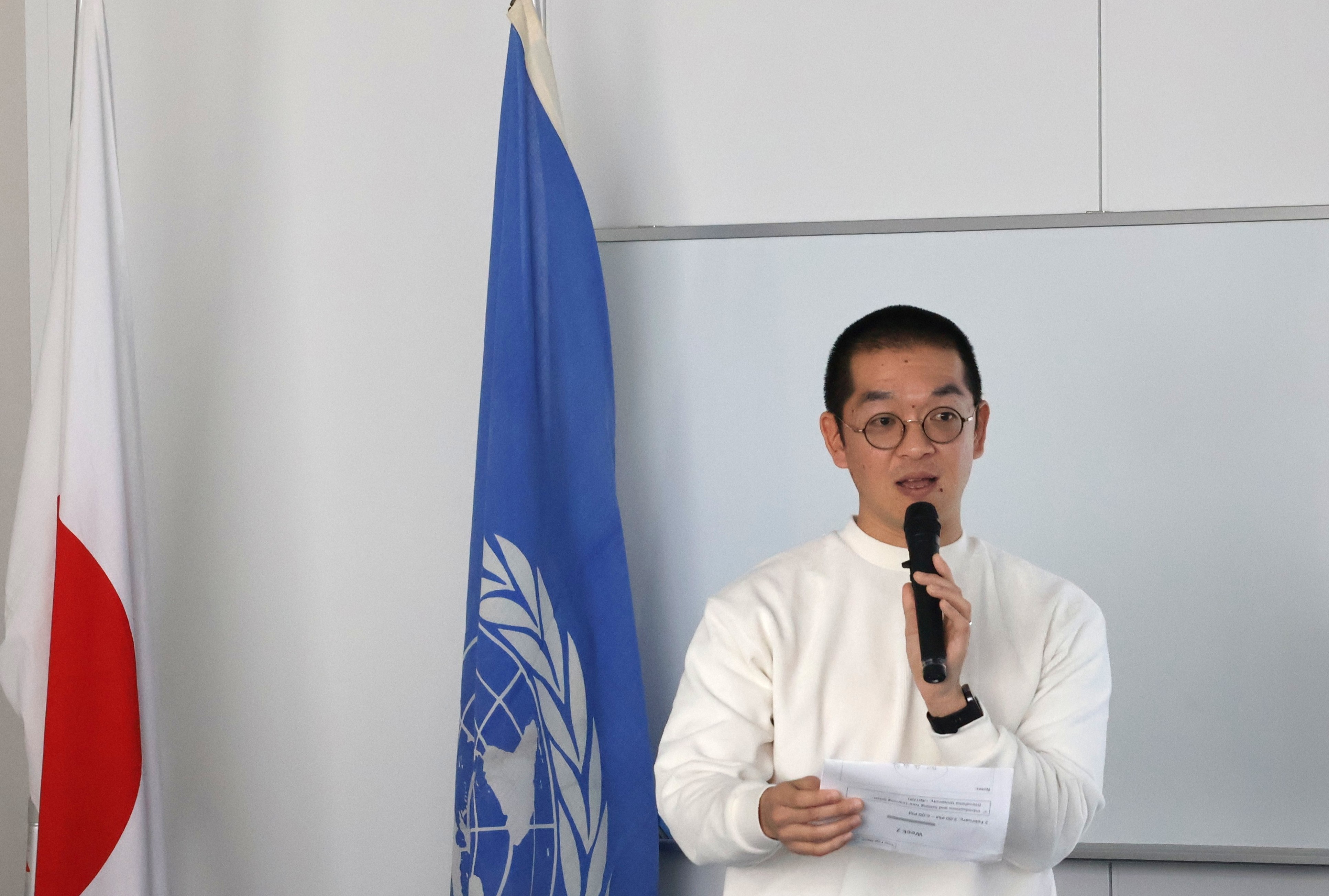
1 June 2026, Hiroshima, Japan - Tatsuki Sakai from Japan is a policy officer at the World Food Programme (WFP) Togo, where he manages an agriculture and school feeding programme.
Tatsuki's passion for food security was sparked in childhood by a movie that he saw, which showed children dying of starvation. It made him question the stark inequality between those with plenty to eat and those without. That spark eventually led him to work for the Embassy of Japan in the Republic of Cameroon, where he supported food aid programmes for developing countries, and the Japan International Cooperation Agency (JICA) Tanzania, where he worked on agricultural development.
Eager to broaden his horizons further, Tatsuki joined the FY2024 Primary Course of the Program for Global Human Resource Development for Peacebuilding and Development. The Program aims to discover, develop and build human resources for peacebuilding. The Primary Course focuses on young professionals committed to building careers in peacebuilding and development and includes about four weeks of training held online and onsite, in Hiroshima and Tokyo. It is commissioned by the Ministry of Foreign Affairs of Japan and implemented by Hiroshima University in collaboration with the United Nations Volunteers programme and the United Nations Institute for Training and Research (UNITAR).
During the four-week in-person training in Japan, Tatsuki engaged in daily discussions with fellow Program Associates, who came from diverse backgrounds. The Program Associates learned from each other on a wide range of topics and built friendships. Tatsuki says the chance to build those relationships were invaluable.
I'm sure that we will be connected with our peers even after we go back to our home countries …. This relationship with peers is invaluable to me." -Tatsuki Sakai (Japan), Alumni of the FY2024 Primary Course
Tatsuki was particularly impressed by the Program sessions on career development. These sessions gave him valuable, real-world insights into how to succeed in the competitive environment of the United Nations. He found especially helpful the approach of starting with desired outcomes and working backwards, as well as using SMART (specific, measurable, achievable, relevant, and time-bound) objectives to achieve them. He's looking forward to applying these concepts in his daily work at WFP Togo, where he supports home-grown school feeding programmes, linking smallholder farmers to school meals.
Looking to the future, Tatsuki is determined to keep striving for a better future for food security for the people of Africa.
I want to contribute to the end of the hunger…I will utilize what I learned here in [my job]. And I [hope] to continue to be engaged in projects at the local level." -Tatsuki Sakai (Japan)
About the Human Resource Development Program by the Ministry of Foreign Affairs of Japan
The Ministry of Foreign Affairs of Japan has implemented its human resource development program in peacebuilding since 2007. In fiscal year 2015, the Program for Global Human Resource Development for Peacebuilding and Development was launched to comprehensively conduct the discovery, development and career-building of human resources. The Program has actively advanced capacity development in this field, serving as a vital resource for a broad spectrum of practitioners - from young professionals seeking their entry point to mid‑career experts aiming to leverage their experience and advance to the next stage. For three years starting from fiscal year 2024, Hiroshima University will manage and operate the Program in cooperation with UNITAR.
Ministry of Foreign Affairs of Japan: https://www.mofa.go.jp/fp/ipc/pagewe_000001_00215.html
Global Peace and Development Career Network: https://gpad.hiroshima-u.ac.jp/en/
About Hiroshima University
Hiroshima University was founded in 1949 in Hiroshima City, the site of the first atomic bombing in human history. Guided by its Charter, Hiroshima University is committed to respecting the human rights and individuality of each person and to fostering human resources that will contribute to the realization of a free, peaceful, and sustainable society. It also aims to be a university which is open to and trusted by society, thereby contributing to the local and international community. Furthermore, Hiroshima University will lead the world in providing cutting-edge solutions to global issues. In this way, we aim to nurture educated and internationally-minded individuals who are committed to addressing the challenges and pursuit of peace.
About UN Volunteers
The United Nations Volunteers (UNV) programme is a UN organization that promotes volunteerism to support peace and development worldwide. It mobilizes skilled volunteers to serve in UN agencies, government programs, and community initiatives, especially in areas affected by conflict, poverty, or environmental challenges. Japanese participants who graduate from the Primary Course are offered a one-year post with the UNV programme.
About UNITAR
Established in 1965, the United Nations Institute for Training and Research (UNITAR) is the dedicated training arm of the United Nations. Its mission is to strengthen knowledge and skills through high-quality training, research and innovative learning solutions.
Through strategic partnerships and a global learning platform, UNITAR builds skills of individuals, and enhances capacities of institutions and organizations, particularly those in vulnerable contexts, to accelerate progress towards the 2030 Agenda for Sustainable Development and the Pact for the Future.


