Low-Frequency Spectrum: Key Player in Future Networks
CSIRO
Key points
Low-frequency signals travel further and penetrate obstacles better than higher-frequency bands, making them ideal for agriculture, mining, energy and environmental monitoring.
CSIRO's on-farm trials show this spectrum can support low-power video streaming and AI-assisted livestock monitoring using low-cost, off-the-shelf equipment.
By providing a robust coverage layer, low-frequency networks can strengthen resilience for regional communities and critical infrastructure.
While the world sprints toward ever faster mobile speeds, another connectivity story is quietly unfolding at the opposite end of the dial.
Low-frequency spectrum – the radio bands below one gigahertz (GHz) – is emerging as a practical workhorse for long-range, low-power connectivity.
This part of the connectivity 'dial' sits far lower than the frequency used for mainstream wireless internet or most mobile coverage.
It won't supercharge movie downloads, enable real-time gaming or support high-definition streaming.
But it does deliver something far more valuable for those in rural or remote areas: a signal that keeps going when everything else drops out. In a country as vast as Australia, that's a gamechanger.
The floodlight at the bottom of the dial
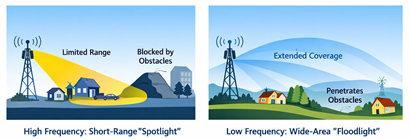
Lower-frequency signals have longer wavelengths, which helps them travel further, bend around obstacles, penetrate trees and walls, and remain stable during bad weather conditions. Image: Created using GenAI for scientific illustration.
Dr Ming Ding, a privacy technology research scientist and Group Leader of the Privacy Technology Group at CSIRO's Data61, said we should think of Australia's connectivity landscape as a dark paddock at night.
"High-frequency networks (like the ones powering 5G) act like spotlights – bright, intense, quick performance – but only over short distances. Move out of the beam and the brightness fades fast," he said.
"Low-frequency networks behave more like floodlights: softer, steadier, but illuminating a much wider area. They may carry less bandwidth, but they travel farther and provide more reliable coverage across large open areas."
That's because of physics. Lower-frequency signals have longer wavelengths, which helps them travel further, bend around obstacles, penetrate trees and walls, and remain stable during bad weather conditions.
"This idea isn't new – analogue TV and radio lived in these low-frequency bands for decades – but the opportunity now is very different. As legacy broadcast systems evolve and spectrum management adapts, there is growing opportunity to explore new industrial and connectivity use cases in these lower bands," explained Dr Ding.
As sensors multiply and AI systems move to the edge – meaning processing happens closer to the device instead of a central cloud – the challenge is no longer 'how fast can we go?' but 'how do we stay connected everywhere?'.
Low-frequency is quietly stepping into that role.
Moving the dial on low-frequency systems
According to Dr Ding, interest in low-frequency systems is growing because industries increasingly need reliable connectivity in places where wireless coverage doesn't perform as well.
"Today's mainstream wireless networks, particularly those operating in higher‑frequency bands, are designed to deliver very fast data rates, but typically over shorter distances and with denser infrastructure (for example, tens or hundreds of base stations per square kilometre).
"That works well in urban environments, but it creates limitations in regional and large‑area settings," he said.
Three shifts are putting the radio band back in the spotlight:
Smarter tech, smaller data loads: Modern sensors and cameras can now analyse information on the spot and transmit only the important bits – an alert, summary or small compressed clip.
Cheaper, accessible hardware: Off-the-shelf radios and antennas mean teams can experiment quickly without multimillion-dollar builds.
Coverage matters more than speed in regional Australia: Low-frequency signals travel farther, clear hurdles and need fewer towers to cover large areas.
For industries like agriculture, mining, energy and environmental monitoring, what matters isn't the fastest data – it's connectivity that doesn't vanish over the next hill.
Dr Caroline Lee, a CSIRO research scientist specialising in animal behaviour and welfare, said that reliable monitoring technologies are critical for farmers to understand how their cattle behave and interact with their environment.
"For farmers, connectivity isn't a luxury, it's the backbone of modern operations. So much of today's decision making requires reliable data that's delivered in real-time from paddocks, pumps, livestock and machinery," said Dr Lee.
"It's not a zero-sum game. Low-frequency doesn't compete with or replace high-frequency technology, it fills a vital gap. As wireless systems evolve beyond 5G toward 6G, different networks will work together in complementary ways to enable better coverage and resilience," added Dr Ding.
Proof from the paddock
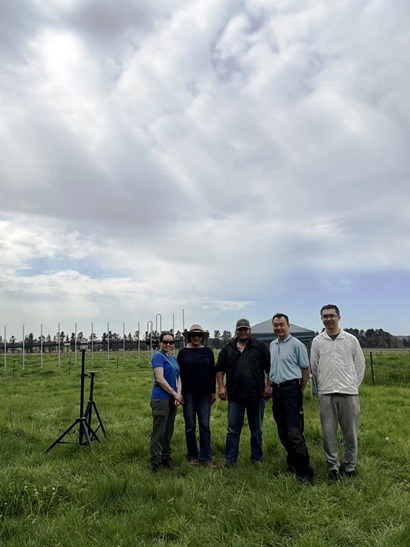
CSIRO researchers partnered with Japan's Sharp Corporation on an AI-enabled livestock monitoring platform to take low‑frequency spectrum out of the lab and onto Australian farmland.
To test how this works in practice, CSIRO researchers partnered with Japan's Sharp Corporation on an AI-enabled livestock monitoring platform to take low‑frequency spectrum out of the lab and onto Australian farmland – an ideal test‑bed for a technology designed to handle distance, barriers and harsh weather.
"It's important to test technologies in real‑world environments because that's where they ultimately have to operate," said Dr Ding.
"Laboratories are useful for validating core concepts, but they cannot fully replicate terrain, buildings, weather, mobility, interference and infrastructure constraints. What works in theory may behave differently under stress."
Using a modest ~240-megahertz (MHz) signal – far below WiFi or 5G – and an extremely low transmission power of approximately 0.01 milliwatt, the team streamed live video from paddock mounted cameras to the AI-enabled livestock monitoring platform.
This was deliberately conservative and regulatory compliant. The goal was to push the limits under realistic constraints: low transmit power, off-the-shelf equipment, real terrain, real weather and real cattle. Yet the system was able to stream video reliably when tested under real farm conditions, with response times that are effectively near 'real time' for monitoring purposes and adapt dynamically to environmental conditions.
"What impressed us most was how stable the link remained in real farm conditions. Dust, wind, moving animals and long distances normally push rural networks to their limits. The fact that this system held steady shows the potential of low-frequency infrastructure for day-to-day farm monitoring and management," said Dr Lee.
The project was designed to protect people's privacy from the start. Because the cameras sometimes captured people as well as animals, the researchers built safeguards into the system to prevent sensitive details – such as exact locations – from being exposed.
"Low-frequency networks give us a foundation that other technologies can build on – from livestock monitoring to water management or biosecurity. It's an important piece of the puzzle if we want to unlock the potential of tech-enabled agriculture at a national scale," added Dr Lee.
Beyond the farm gate
Even if you've never set foot on a cattle farm, the implications matter.
Low-frequency networks could strengthen emergency communications during storms, support electricity grid monitoring across long corridors, power bushfire detection systems that operate through smoke and heat, and improve safety across rail, road and logistics.
"Low-frequency systems are not competing for ultra-fast speed. They provide the reliable coverage foundation that mission-critical industries depend on. A stronger coverage layer means fewer black spots, more stable services and paves the way for more resilient communities," said Dr Ding.
"It's about making the entire connectivity stack stronger."
Turning into Australia's next advantage
Over the next decade, low-frequency networks may quietly anchor Australia's connectivity.
"Given Australia's geography, wider coverage and resilience often matter more than extreme peak speeds. Low-frequency bands can cover large distances with fewer sites, making them a practical and cost-effective option for the right use cases," said Dr Ding.
In a country where distance defines daily life, that's not just a technical win – it's a practical one.
"Our project is one example of how this spectrum can support emerging intelligent monitoring technologies under real-world constraints, which is why both researchers and industry are looking at and listening to it more seriously. It demonstrates that future networks must balance speed with resilience, security and sovereign control," he concluded.
This in-field research on Australian farms was conducted with Sharp Corporation as part of a commissioned project funded (No. 05101) by the National Institute of Information and Communications Technology (NICT), Japan, under its beyond-5G and 6G initiative. The project also built on ongoing work into secure 6G telecommunications networks undertaken in partnership with CSIRO and the Department of Home Affairs, and was further supported by the Australian Trade and Investment Commission (Austrade).
/Public Release. This material from the originating organization/author(s) might be of the point-in-time nature, and edited for clarity, style and length. Mirage.News does not take institutional positions or sides, and all views, positions, and conclusions expressed herein are solely those of the author(s).View in full here.