
Malawi is mobilizing government commitment and community engagement to improve forecasts and early warnings and build resilience in a country regularly battered by extreme weather and climate shocks.
Four days of high-level discussions and field visits under the auspices of the Climate Risk and Early Warning Systems initiative highlighted both significant progress and persistent challenges - particularly the need for sustainable financing, stronger coordination and filling the gaps in basic observing systems.
"Malawi can tell the story for least developed countries, small island developing states and developing countries that we can indeed put in place an early warning systems," said WMO Secretary-General Celeste Saulo.
"WMO's work matters when it changes people's lives. I do believe that Malawi can be a lighthouse, where we have a strong commitment from the political leadership and government for Early Warning Systems, and the strong capacity of the Department of Climate Change and Meteorological Services to deliver," she said.
Celeste Saulo and Kamal Kishore, Special Representative of the United Nations Secretary-General for Disaster Risk Reduction, and Head of the UN Office for Disaster Risk Reduction , joined CREWS Steering Committee members and partner organizations for the four-day mission which took the delegation from government headquarters to rolling plateaus and remote villages.
"The climate crisis is already leading to more devastating disasters. This makes investing in disaster risk reduction more urgent than ever, and multi-hazard early warning systems are among the most powerful tools for protecting lives and livelihoods from disasters. Through the Early Warnings for All initiative , and in collaboration with the CREWS initiative, we have a unique opportunity to extend this protection to every person in Malawi and around the world," said Kamal Kishore.
Minister of Natural Resources Patricia Wiskes launched the Early Warnings for All initiative roadmap for Malawi to strenghten national coordination to protecting lives and livelihoods through effective early warning services. Malawi is one of a growing number of countries in Africa with targeted roadmaps.
"We can't talk about climate resilience without talking about national meteorological agencies," said Minister Wiskes, underlining the central role of national services in protecting lives and livelihoods.
Minister of Finance Joseph Mwanamvekha emphasized the economic imperative of early warning services in a country highly exposed to climate-related hazards. He highlighted the importance of sustained partner engagement to ensure long-term support and strong national ownership of weather and climate services.
The UN Resident Coordinator and the UN Country Team reaffirmed their commitment to supporting the implementation of Early Warnings For All in Malawi through better coordination and coherence.
Partners emphasized the importance of translating investments in data and forecasting into community-level early action, while outlining a clear way forward focused on operationalizing end-to-end early warning systems, closing capacity gaps, and mobilizing sustainable financing to ensure that no one is left behind.
A new US$ 3.84 million initiative to strengthen Malawi's capacity to generate, process, and share high-quality weather and climate data and close gaps in the basic observing network was launched by Malawi's Department of Climate Change and Meteorological Services (DCCMS), in partnership with the United Nations Development Programme (UNDP) and the Systematic Observations Financing Facility (SOFF).
It will also enhance evidence-based decision-making and improve access to tailored early warnings that protect lives, livelihoods, and property across Malawi.
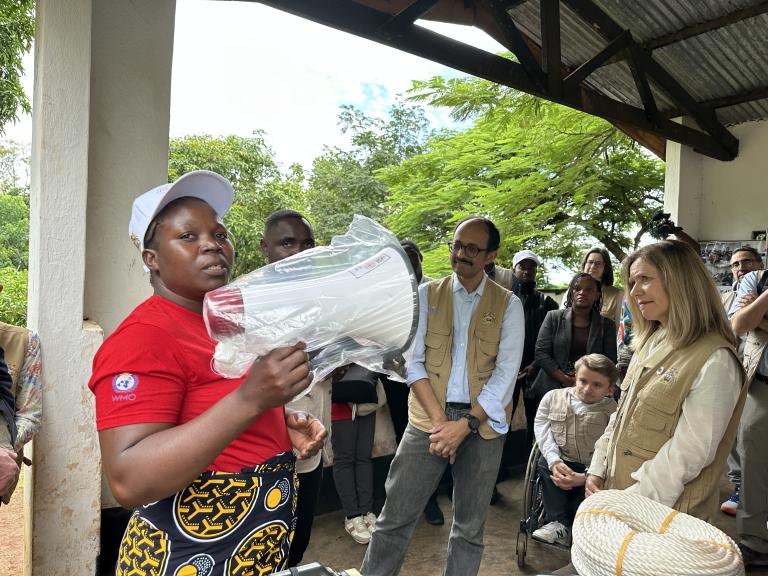
Field visit to Masongola Ward, Zomba
To gain first-hand insight into the benefits of the CREWS Malawi project on the ground, the CREWS Steering Committee members and partners met local communities in Zomba in an eye-opening and inspiring visit.
Community members shared testimonies of how better forecasts and early warnings, better grassroots preparedness and strengthened local coordination mechanisms are helping to safeguard lives and livelihoods.
"We had sobering discussions and concrete examples of life-saving measures - even emotional at times," commented Francis Pigeon, the CREWS Steering Committee Chair (Environment and Climate Change Canada).
"Indigenous knowledge, inclusivity and gender equity are front and centre of the many projects implemented throughout these communities," he said.
Mr Pigeon commended the Government of Malawi for its strong leadership and clear commitment to making early warning and early action a national priority, as well as the launch of the launch of a new strategic plan for Malawi's Department of Climate Change and Meteorological Services (DCCMS) under the leadership of its director Lucy Mtilatila.
"WMOs vision is for science driven weather and water and climate services need to serve all people with timely early warning systems - CREWS turns this vision into reality in the most vulnerable countries," said Celeste Saulo.


