

SERIES INTRODUCTION
Four years on from the 2022 floods, with further damage from the 2024 floods and Ex-Tropical Cyclone Alfred since, Tweed Shire Council is telling the full story of how the Tweed community has rebuilt. Not as a list of projects or a budget acquittal, but as a genuine account of what flood resilience looks like across every part of community life.
Over 7 weeks from 19 June to 28 July 2026, Council will release 7 chapters, each a standalone story, each told through the voices of the people who lived it, built it and are still living in it. Together they form one integrated narrative: what it really means to rebuild a community after a flood.
For the first week, we are focusing on Murwillumbah and its civic heart. As you enter Murwillumbah across the river, the view is different now. Where a damaged building once closed off access to the riverfront, open parkland now faces the water. The state heritage listed Murwillumbah Railway Station, gateway to one of Australia's top regional trails, has been upgraded, made accessible and reactivated. And a program of improved signage, wayfinding and place activation is completing the transformation of the town's key arrival points.
These are not separate projects. Together they tell one story: a town investing in how it presents itself to the world, and to its own community. A town that has been through a great deal and is choosing to face the river, not turn away from it.
"When we talk about flood recovery, it's easy to talk about roads and buildings. But resilience is so much bigger than that. It's the oval where sport returns, the hall where people gather, the park where children play again, the riverbank that holds. Over the next seven weeks we want to show what four years of recovery looks like across every part of our community, and what we've learned along the way. Murwillumbah's riverfront is where that story begins."
Cr Chris Cherry — Mayor of Tweed Shire
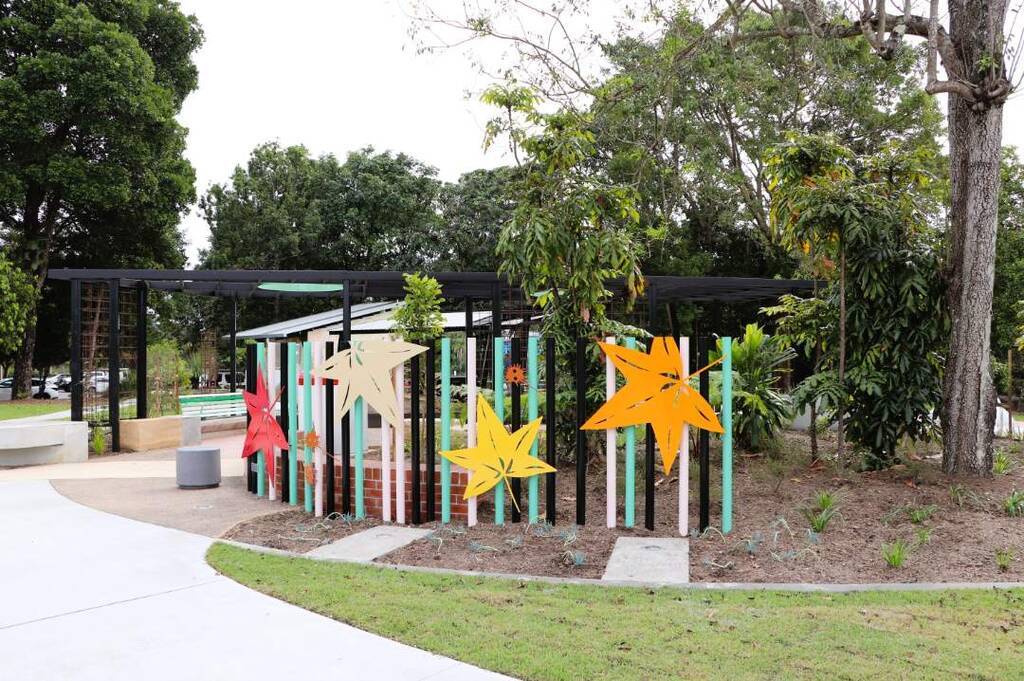
Budd Park's new riverfront open space, opposite the Murwillumbah Railway Station.
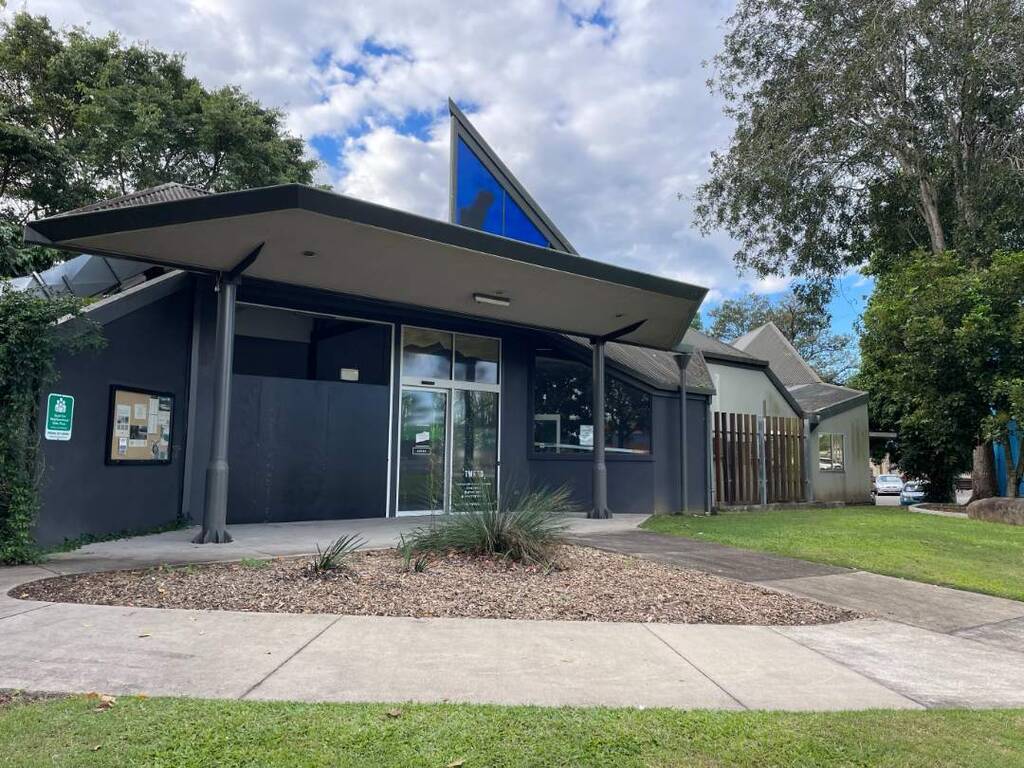
A building removed. A riverfront returned.
The World Heritage Rainforest Centre, formerly the Murwillumbah Visitor Information Centre, had been a much-loved fixture of the town for decades. The 2017 and 2022 floods changed that. Engineers found ground movement, termite damage, drainage failure and compromised footings. The building had become uninsurable and the cost of ongoing repairs unsustainable. Council made the decision to demolish rather than rebuild.
In the space, Budd Park became a real community asset. Completed in June 2025 and funded at $999,870 through the Community Assets Program, jointly funded by the Australian and NSW Governments, Budd Park now features accessible shelters, barbecues, picnic tables and seating, connecting pathways, bike racks, a drinking fountain, flood markers, public art, landscaping and tree planting, and improved accessible parking. Flood-resilient materials and anchored structures mean the park is built to withstand future events and recover quickly when they come.
The Visitor Information Centre has relocated to Murwillumbah Railway Station, right at the trailhead of the Northern Rivers Rail Trail, where it now serves the growing stream of visitors the trail brings to the region.
"Across 3 flood events we're managing nearly 5,000 damaged sites and close to $350 million in recovery works. Every decision about how we rebuild is a strategic one. Budd Park is a good example of that thinking in practice, we assessed the risk, we assessed the cost, and we made a call that the community's interests were better served by open, resilient public space than by attempting to restore a structurally compromised building in a flood-prone location."
Troy Green — General Manager, Tweed Shire Council
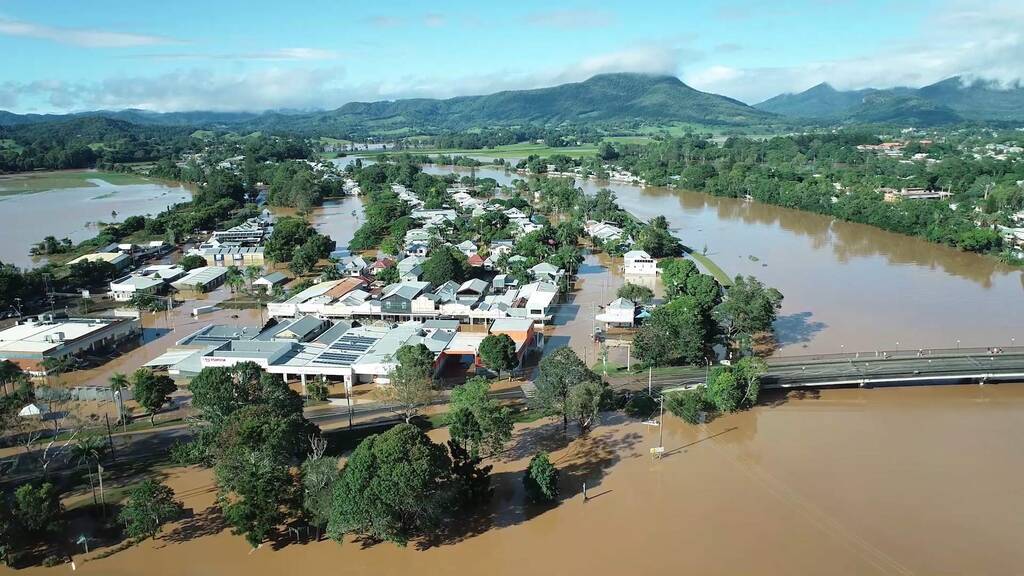
Floodwater covers Budd Park and the Murwillumbah riverfront (right) during the February 2022 flood.
The trail that connects the town.
From the state heritage listed Murwillumbah Railway Station, opposite Budd Park, the Northern Rivers Rail Trail stretches 24 kilometres through some of the region's most spectacular landscape, connecting rural villages and more than 15 businesses, the Tweed Regional Gallery and Margaret Olley Art Centre, and drawing visitors into Murwillumbah's town centre.
When Cyclone Alfred hit in early 2025, the storm dropped vegetation across the full length of the trail. A seven-week clean-up operation followed, contractors cutting, clipping and removing dangerous branches and debris, to restore the experience for visitors and keep the tourism economy and active transport corridor moving as quickly as possible after the event.
At the Railway Station trailhead, 2 separate grant programs and Council funding have delivered significant accessibility and heritage upgrades. A $73,000 Community Assets Program grant delivered a fully accessible public toilet, a new accessible parking bay, a southern entry platform cut-through and a pedestrian refuge to Prospero Street. Station building upgrades valued at $160,000 delivered heritage toilet refurbishments, an improved facilities and staging area, and an accessible ramp to the station platform. A further $70,000 through the Accessible Seating and LRCI programs delivered accessible seating and pathway improvements along the 24 kilometre trail. Total project investment including Council contribution reached $215,000.
"One of Australia's top regional trails and a two-time silver medallist at the Australian Tourism Awards, the Northern Rivers Rail Trail has become one of the region's most significant visitor drawcards, and the upgrades at Murwillumbah Railway Station have made it accessible to a much wider audience. When you combine that with the transformation of Budd Park and the activation of the station precinct, you're creating a genuine destination arrival experience, something that gives visitors a reason to stop, stay and spend time in Murwillumbah."
Tiffany Stodart — Manager Destination Communication and Customer Experience, Tweed Shire Council
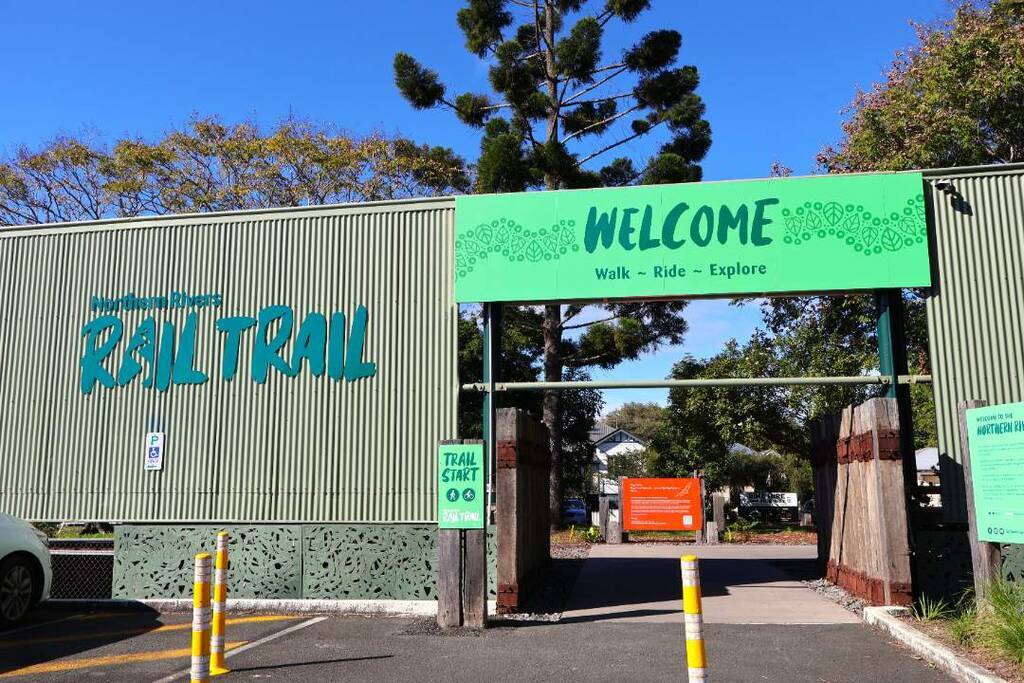
The Northern Rivers Rail Trail begins opposite Budd Park, opening the centre of Murwillumbah to visitors. Photo by Cayln Armstrong
Light and life returning to the town centre.
Alongside the physical transformation of Budd Park and the Railway Station, the Grey to Glimmering project is investing in the station precinct and town arrival experience. Funded through the NSW Government's Resilient Business Activation Program and supported by local business and community stakeholders, the project is delivering festoon and feature lighting at Murwillumbah Railway Station, an upgrade to the Alma Street roundabout completing the town entry, and a signage and wayfinding program for Murwillumbah and South Murwillumbah.
The state heritage listed Railway Station has always been a significant landmark for Murwillumbah. These investments are restoring its role as a genuine arrival point, a place that orients visitors to the town and tells them there is something worth exploring here.
"The business community has invested a lot of faith in this town through some very difficult years. What's happened at Budd Park and the Railway Station precinct gives us real reason for confidence. When visitors arrive and see a town that's made this kind of investment in itself, it changes the conversation. We're not a flood-affected town asking for sympathy, we're a destination worth choosing."
Phillip Hepburn — Treasurer of Business Murwillumbah · Owner, Tweed River House
What comes next.
On the land where 44 flood-affected homes once stood, a new conversation is beginning. The South Murwillumbah Masterplan, a partnership between Tweed Shire Council and the NSW Reconstruction Authority, will invite the community to co-design the future of the precinct between Alma Street and Buchanan Street along the Tweed River. With residential use no longer permitted on buyback sites, the project opens the door to reimagining this land as connected, flood-resilient public space.
A precinct masterplan for the state heritage listed Murwillumbah Railway Station will also be developed as part of the project, recognising the station's growing role as a tourism and recreation hub. Community consultation is expected to begin shortly.
KEY FACTS
- Budd Park upgrade: $999,870 · Community Assets Program · jointly funded Australian and NSW Governments · completed June 2025
- NRRT trailhead upgrades (CAP): $73,000 · Community Assets Program · jointly funded Australian and NSW Governments · accessible toilet, parking bay, cut-through, pedestrian refuge
- Station building upgrades: $160,000 · heritage toilet refurbishments, improved facilities and staging area, accessible ramp · total project cost $215,000 including TSC contribution
- Accessible seating and pathways: $70,000 · Accessible Seating and LRCI programs · seating and pathway improvements along 24km trail
- Grey to Glimmering: NSW Government Resilient Business Activation Program · total grant $175,000 · total project cost $215,000 including TSC contribution · station lighting and proposed Alma Street roundabout upgrade, and town signage and wayfinding (subject to Departmental approval).
- Community Assets Program total: $15.5 million jointly funded by Australian and NSW Governments
- Flood Restoration Program: $186.7 million invested to date across 4,954 damaged sites — three flood events
ABOUT THE FACING THE RIVER SERIES
This media release is part of Tweed Shire Council's seven-week flood resilience media series, Facing the River, running 19 June to 28 July 2026. Each chapter tells a different dimension of the Tweed's recovery story, across civic space, sport and wellbeing, community hubs, infrastructure, neighbourhood liveability, the natural environment and the relocation of flood-affected businesses to higher ground.
Week 1 — Civic Heart: 19 June, 10 am
Week 2 — Sport and Wellbeing: 25 June, 10 am
Week 3 — Community Hubs: 2 July, 9:30 am
Week 4 — Infrastructure and Connectivity: 9 July, 10:30 am
Week 5 — Neighbourhood Liveability: 17 July, 10 am
Week 6 — Working with Nature: 23 July, 10 am
Week 7 — Trading Turbulent Waters for Solid Ground: 28 July, 10 am
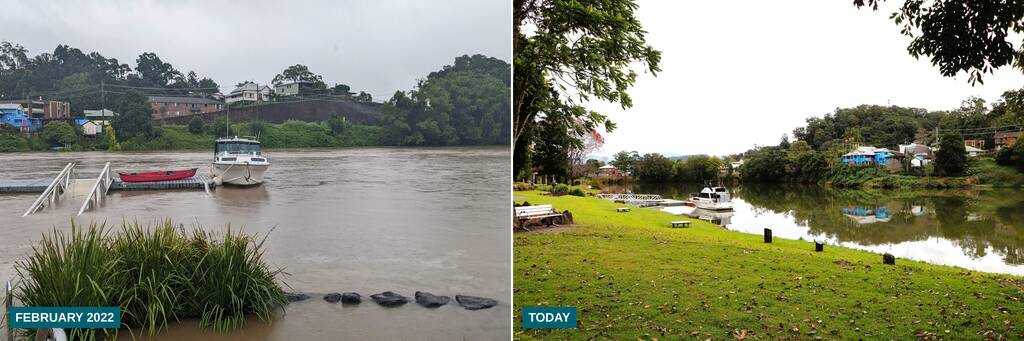
Then and now: Budd Park's pontoon at Murwillumbah during the February 2022 flood, and the same riverfront today, reopened as accessible community parkland.
Downloads
Photo 1: South Murwillumbah under floodwater
Caption: South Murwillumbah under floodwater during the record 2022 flood (top), and the same view of the Tweed River and town in 2025 (bottom).
Photo 2: Budd Park's new riverfront open space
Caption: Budd Park's new riverfront open space, opposite the Murwillumbah Railway Station.
Photo 3: The much-loved World Heritage Rainforest Centre
Caption: The much-loved World Heritage Rainforest Centre, left uninsurable after the 2017 and 2022 floods and demolished by Council.
Photo 4: Floodwater covers Budd Park and the Murwillumbah riverfront
Caption: Floodwater covers Budd Park and the Murwillumbah riverfront (right) during the February 2022 flood.
Photo 5: The Northern Rivers Rail Trail begins opposite Budd Park
Caption: The Northern Rivers Rail Trail begins opposite Budd Park, opening the centre of Murwillumbah to visitors. Photo by Cayln Armstrong
Photo 6: Then and now: Budd Park's pontoon at Murwillumbah
Caption: Then and now: Budd Park's pontoon at Murwillumbah during the February 2022 flood, and the same riverfront today, reopened as accessible community parkland.
Connection to Council's Community Strategic Plan:


