
The world is entering a period in which abnormal water supplies are becoming the norm, with river flows, groundwater and glaciers all showing signs of sustained disruption, the UN weather agency warned on Thursday.
"This is not a single bad year, but a persistent decade-long signal," said Celeste Saulo, Secretary-General of the World Meteorological Organization ( WMO ), presenting the agency's latest State of Global Water Resources report.
The assessment shows that 2025 was one of the driest years for river flows worldwide in 35 years, with below-normal discharge across 36 per cent of the world's river basin area.
It was also the seventh consecutive year in which rivers with historically "normal" flows were in a clear minority, underscoring what WMO describes as an increasingly erratic and unpredictable water cycle.
"Water-related extreme events continue to devastate communities and economies," Ms. Saulo underscored.
Water 'savings account'
Groundwater, glaciers, snow, soil moisture, lakes and other freshwater stored on land, act as a buffer during droughts and dry seasons. Ms. Saulo described these slower reserves as the planet's "savings account".
Traditionally, she explained, they have absorbed bad years so that a single dry season does not immediately become a water crisis.
"We are depleting that savings account," she said, noting that terrestrial water storage has been declining since around 2014-2016, while groundwater levels in many regions have fallen over several years.
Nearly two-thirds of monitored groundwater wells were outside their normal range in 2025, with conditions shifting further towards deficit, than recovery.
There were, however, some positive signs. Parts of South America saw a partial recovery in water storage after a severe multi-year deficit, while central and southern Africa maintained much above-normal water levels across several major lakes.
Glacial melt
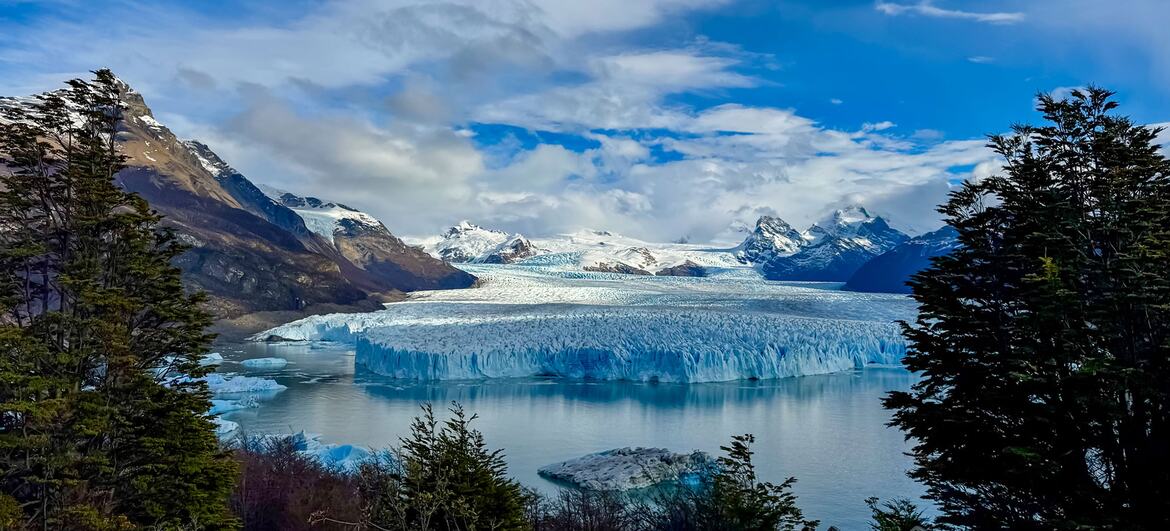
Every major glacier region on Earth lost ice for the fourth consecutive year.
"All 19 glacier regions around the globe lost ice; in Central Asia, Iceland, the Russian Arctic and western Canada and the United States, it was among the three worst years on record," said Wayne Jenkinson, WMO's Director of Hydrology and Cryosphere.
In 2025 alone, glaciers lost around 408 gigatonnes of ice, while cumulative losses between 2023 and 2025 reached roughly 1,400 gigatonnes - equivalent to around one third of the freshwater the world withdraws in a year.
Some regions with smaller glaciers such as Central Europe, the Caucasus, the western Canada and the United States may already have reached "peak water", Jenkinson warned.
"After this point, the glacier gives less meltwater each year simply because there is less ice left to melt. That matters for every community downstream that relies on water during hot, dry summers," he said.
Narelle van der Wel, WMO's Head of Cryosphere Monitoring, Predictions and Services, stressed that while some further glacier loss is unavoidable, the eventual scale of the decline is not predetermined.
"Some glacier loss is inevitable, but total loss of glaciers is not yet inevitable," she said, pointing to emissions reductions as central to limiting future losses.
Moving the baseline
The report does not attribute every observed change to climate change alone. WMO says pressure on water resources and natural variability also contribute.
Mr. Jenkinson said governments need to prepare for "moving baselines" as historical patterns become less reliable.
"The situation 30 years ago is not where we are today," he said. Countries, he added, need to prepare "for those changes that have really already arrived".
Over the past five years, Asia and Africa accounted for at least half of reported water-related extreme events and more than 80 per cent of associated deaths, yet both remain among the regions with the largest gaps in water observations.
Water monitoring has improved significantly since WMO began publishing the report five years ago, with 52 countries now providing data from more than 3,100 river-flow stations, compared with just seven countries and 14 stations in the first edition.
However, WMO says better monitoring, data-sharing and early warnings will be increasingly important as countries adapt to water conditions that are already radically changing.
The recent China-Nepal disaster, which WMO described as a "catastrophic compound crisis" involving a rock and glacier failure, showed how difficult such hazards can be to anticipate.
"Water respects no borders," Ms. Saulo said. "This is why we need shared data, shared standards and shared early warnings."


