
The HRSA Scholars Program will pair financial assistance with advising and practicum experience to support MSW students and strengthen Connecticut's behavioral health workforce
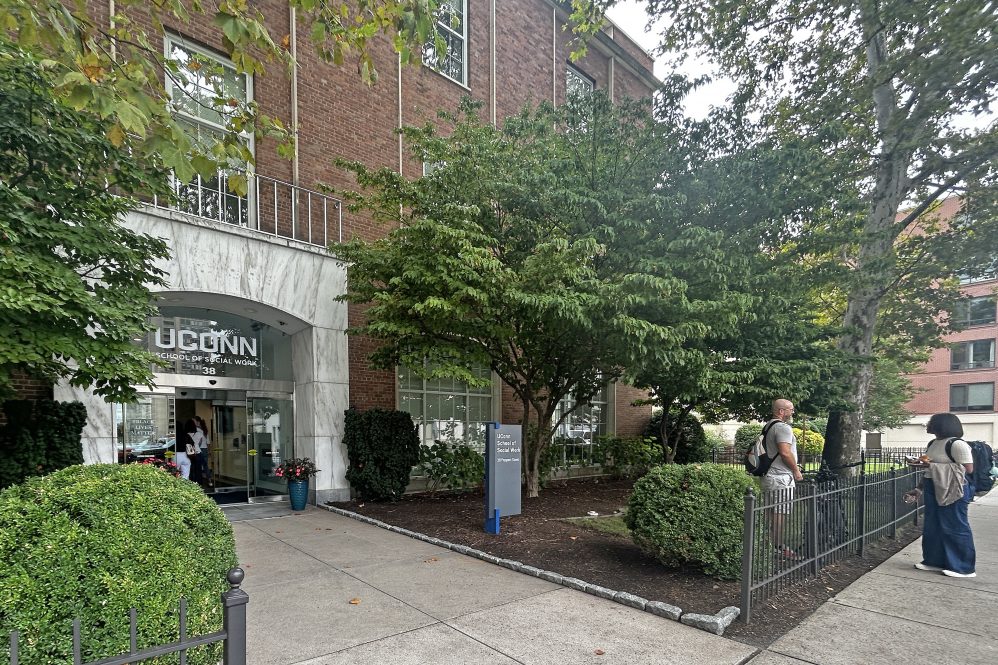
The UConn School of Social Work received a $3,250,000 federal Health Resources and Services Administration (HRSA) grant to help offset the tuition cost for eligible full-time Master of Social Work (MSW) students from disadvantaged backgrounds. (Olivia Drake/UConn)
For students preparing to become social workers, the cost of graduate education can stand between a commitment to helping others and the opportunity to put that commitment into practice.
A new program at the UConn School of Social Work aims to help close that gap while preparing graduates to provide behavioral health services in communities where care can be difficult to access.
Supported by a federal Health Resources and Services Administration (HRSA) award, the HRSA Scholar Program will provide approximately $25,000 annually to eligible full-time Master of Social Work (MSW) students from disadvantaged backgrounds who demonstrate financial need. HRSA will provide UConn SSW with $649,995 the first year, with an anticipated total 5 year funding of $3,249,940.
After the initial launch next fall, the program will combine financial assistance with academic advising, professional development, and year-long practicum placements in primary care settings and medically underserved communities.

"We have talented, dedicated students who want to serve communities facing significant barriers to behavioral health care," says project PI Rachel Schwartz, MSW program director and associate professor-in-residence. "These scholarships will help reduce the financial obstacles to completing their education and give them support as they prepare for that work."
Located in Hartford, a federally designated Health Professional Shortage Areas (HPSA), the SSW has a long-standing commitment to expanding educational opportunity while addressing critical behavioral health workforce shortages. Currently, 51% of full-time MSW students meet HRSA's definition of disadvantaged, and average unmet financial need among full-time students exceeds $32,000.
Support through graduation and into practice
Scholarship recipients will receive individualized faculty advising and participate in the Practicum and Advisory Success Seminar (PASS). Additional support will include career preparation, financial literacy education, peer support, and networking opportunities.
Schwartz will work with admissions and financial aid staff to determine eligibility and scholarship awards. As the scholars' academic advisor, she will also help students navigate their coursework and practicum requirements and connect them with resources to support degree completion.
"Financial assistance is one part of helping students succeed," Schwartz says. "We also want students to have people they can turn to, opportunities to learn from one another, and guidance as they move from the classroom into practice."
During their year-long practicum placements, scholars will train under qualified clinical supervisors in settings that serve medically underserved communities or integrate behavioral health services into primary care.
Faculty and practicum supervisors will also participate in professional development focused on mentoring and supporting students from disadvantaged backgrounds.
Building on community partnerships
When we invest in their education, we are also investing in the communities they will serve. - Jennifer Manuel, professor and associate dean for research
The School maintains partnerships with more than 540 practicum agencies across Connecticut and beyond, including federally qualified health centers, integrated behavioral health providers, and community organizations serving medically vulnerable and underrepresented populations. According to Liane Lussier-Smith, practicum education director in the School of Social Work, more than half of the School's practicum placements involve work with vulnerable communities.
"The HRSA Scholars Program will build on those partnerships to help students gain experience in communities with substantial needs and prepare for employment in similar settings after graduation," she says.
Jennifer Manuel, professor and associate dean for research, will serve as co-investigator and lead evaluator, tracking student progress, practicum experiences, and employment outcomes to assess the program's effectiveness and guide improvements.
"Our goal is to help students complete their MSW and enter the workforce prepared to make a difference," Manuel says. "When we invest in their education, we are also investing in the communities they will serve."


