
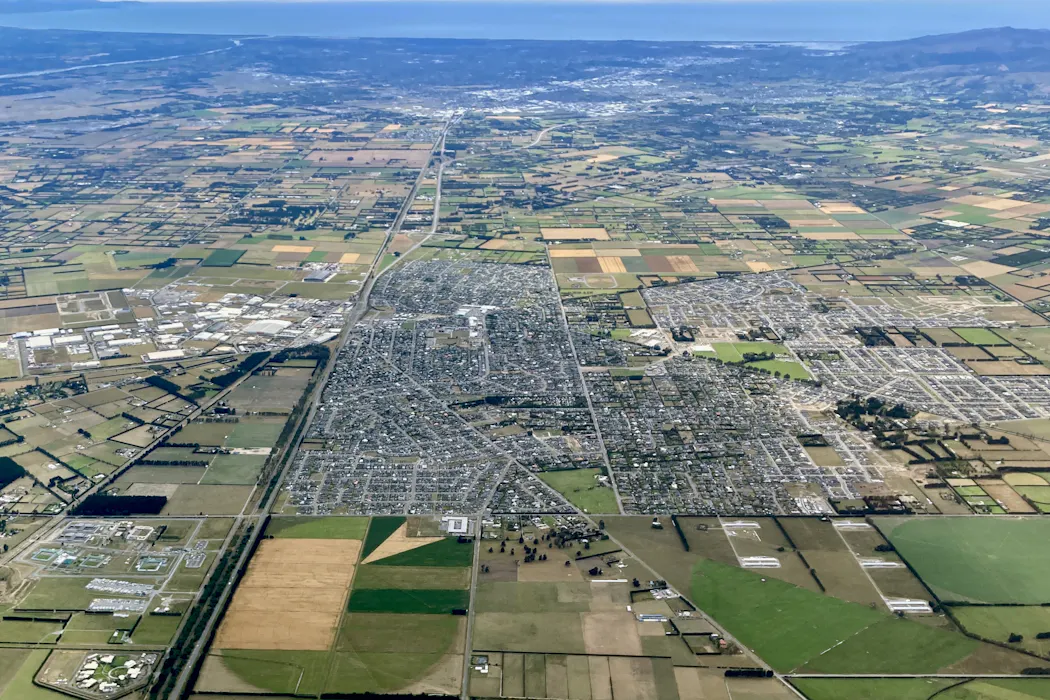
Travel 25 kilometres south from Christchurch on the new 110 kilometre-per-hour, multi-million-dollar "road of national significance" and you'll reach New Zealand's fastest growing town .
Author
- Katie Pickles
Professor of History, University of Canterbury
Situated within the country's fastest growing district of Selwyn, Rolleston now boasts a population over 34,000 - predicted to reach 50,000 by 2050. It is already Canterbury's second-biggest urban area, surpassing Timaru and Ashburton.
Rolleston was growing fast before the 2010-11 Canterbury earthquakes. And its continued expansion - including a proposed large-scale housing development - is part of a national pattern of mushrooming, car-dependent satellite towns and fast-tracked urban sprawl.
From 2000 to 2025 the town grew by a staggering 1,246%, or 11% annually. By comparison, New Zealand grew by 38% in that period, or 1% a year.
But the Rolleston that has evolved - largely a dormitory suburb of Christchurch built on once-productive land - is very different to the town first envisaged by planners in the early 1970s.
'Town of the future'
According to the 2023 census , 52.9% of Rolleston's residents commute to Christchurch for work, compared to the 32.4% living and working in the town. As my research has found , this was not the original intention.
In November 1973, the Labour government of Norman Kirk announced the controversial purchase of 10,000 acres (4,000 hectares) of land to develop a town for up to 50,000 people.
Influenced by postwar international trends for new towns, the ambitious "town of the future" project was intended as a solution to Christchurch's growing population.
A separate, planned town would help preserve the city's greenbelts, avoid urban sprawl and encourage economic and population growth in the South Island, away from Auckland in the north.
It was hoped the town would be "as self-sufficient as possible in terms of industries and recreation to avoid adding further to the problems of Christchurch".
The planning work was careful, progressive and informed by international examples. Among its aspirations were affordable housing, alternative transport, sustainable energy and water systems, and a "balanced community".
But in November 1975, when Robert Muldoon and his farmer-friendly National Party came to power, the new government fulfilled an election promise and scrapped what Muldoon called "ill-conceived" plans for Rolleston.
Colin McLachlan, the National MP for Rakaia and close colleague of Muldoon, had always opposed the compulsory purchase of farmland. And there were fears of creating an under-resourced, "one class, one age", isolated and socially deprived suburb.
Looking back with the benefit of hindsight, however, we have to ask whether Rolleston's original plan, and ideas from the 1970s in general, might have been on the right track - and could perhaps inform today's planning.
Haphazard development
Those 1970s plans had hoped to avoid cars shaping urban form. Green spaces featured, with a focus on urban design that did away with rows of spread-out houses with big garages facing dominant roads.
Aware of the social and environmental pitfalls of car dependency, the plans encouraged walking, cycling and public transport - potentially capitalising on Rolleston's origins as a railway junction.
The plans also emphasised the importance of creating a wide range of industry and employment in the town. Public service jobs were suggested, along with various kinds of manufacturing. The possibility of a major industrial area adjacent to the town was raised.
Building an inclusive, resilient community was a priority. It should have a marae, be accessible to disabled and older people, and have strong public services. Māori and Pacific people were to "retain valued traditions and customs".
But as Muldoon's command economy gave way to the neoliberal market revolution of the mid-1980s, Rolleston's urban form was left more to chance than planning.
Predictably, private real estate interests have dominated its rapid, haphazard development. Climate resilience, such as extensive tree planting and solar panel installation, has not been a priority.
As predicted in the 1970s, without adequate resourcing, infrastructure and social services struggle to keep up with demand.
Rolleston now has eight schools, two sports centres and Te Ara Ātea - a library, community and cultural centre. But it is constantly playing catch-up. Much needed after-hours medical care has recently begun, but there is no hospital offering emergency services.
Learning from the past
With the government's new fast-track law speeding up the proliferation of new subdivisions, the district council (along with others throughout New Zealand) is calling for a halt to more greenfield housing applications and the removal of residential developments in rural areas from the Fast-Track Approvals Act.
Meanwhile, car-dependent, big-box retail is thriving, including the biggest supermarket in the South Island, with 500 parking spaces. Traffic congestion within the Rolleston town centre is rising.
The projected expansion of the Inland Port, a transport and logistics hub located to the west of the town near major rail and road systems, promises more employment - but will also increase road use.
Rolleston's experience is familiar, of course. Dormitory suburbs with few new jobs, traffic congestion, expensive new roads, struggling infrastructure, shrinking section sizes, bigger carparks and sprawling growth on arable land have become features of New Zealand development.
But with climate change affecting how and where we live, building resilient places is more important than ever. Rolleston offers a case study in the challenges facing planners now - but also in how historical models might show an economic, social and cultural way forward.

Katie Pickles does not work for, consult, own shares in or receive funding from any company or organisation that would benefit from this article, and has disclosed no relevant affiliations beyond their academic appointment.


