
The global system governing nuclear disarmament is facing its most serious crisis in decades, driven by growing mistrust among major powers and the steady erosion of arms control agreements, a senior disarmament expert has warned.
Yet even as the architecture weakens, signs of progress - including nuclear-weapon-free zones and rising youth engagement - offer grounds for cautious hope, a UN researcher on nuclear non-proliferation has told UN News.
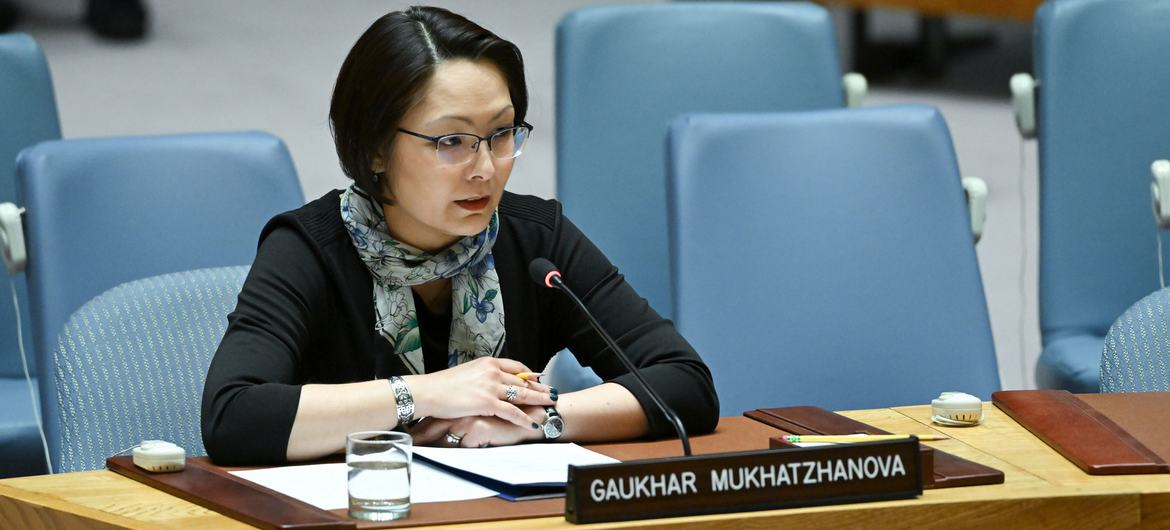
Gaukhar Mukhatzhanova, a fellow with the UN Institute for Disarmament Research (UNIDIR) - an autonomous institute studying disarmament and international security issues - said that decades of arms control built through painstaking negotiations are now at risk of unravelling.
"The situation right now is very difficult," she added.
"We are observing the disintegration of the arms control architecture that was built primarily through negotiations between [the then] Soviet Union - and subsequently Russia - and the United States."
Arms control architecture under strain
That erosion has left the global non-proliferation regime increasingly fragile, with most Cold War-era agreements either abandoned or expired. The 2010 US-Russia New START accord - which capped deployed strategic nuclear warheads - expired this week without a successor in place.
While both American and Russian presidents acknowledged the dangers of a renewed nuclear arms race, no replacement for the New START is currently under negotiation.
This is a troubling backdrop for the next review conference of the Treaty on the Non-Proliferation of Nuclear Weapons (NPT), scheduled for April-May in New York, Ms. Mukhatzhanova said.
Opened for signature in 1968 and extended indefinitely in 1995, the NPT remains the only binding multilateral treaty requiring nuclear-weapon States to pursue disarmament.
However, the political conditions that once made cooperation possible have deteriorated sharply, added Ms. Mukhatzhanova.
"We are back to a period of severe mistrust between the major actors - arguably worse than during the Cold War," she said.
We are back to a period of severe mistrust between the major actors - arguably worse than during the Cold War
Challenges and emerging risks
Statements by the US suggesting a possible resumption of certain forms of nuclear testing have raised alarm, even if limited to so-called "subcritical experiments" - highly explosive tests where no chain reaction is involved.
Such moves, Ms. Mukhatzhanova said, risk undermining the Comprehensive Nuclear-Test-Ban Treaty (CTBT) and reopening questions many hoped were settled.
"If full-scale explosive testing were to return," she warned, "we are talking about a really drastic and very negative change - one that would open the door for others to resume nuclear testing."
New technology, new risks
Hypersonic weapons, autonomous systems and artificial intelligence are accelerating arms competition and increasing the risk of miscalculation.
"The concern is that too much is left to the decision of a machine," Ms. Mukhatzhanova said, warning that AI-driven early-warning systems could misinterpret data and trigger inadvertent escalation.
She noted recent UN resolutions calling for "meaningful human control" over nuclear-related technologies.
Room for progress remains
Despite the grim outlook, she highlighted areas where progress continues.
Nuclear-weapon-free zones - covering Latin America and the Caribbean, Africa, Southeast Asia, the South Pacific and Central Asia - demonstrate how states can pursue security without nuclear weapons.
"They are a feel-good story," she said, describing them as practical examples of cooperation even amid global tensions. The Central Asian zone stands out for its strong verification standards and links to broader non-proliferation commitments.
Young people engaging
Ms. Mukhatzhanova also pointed to growing engagement by younger generations, who increasingly question the long-standing narrative that nuclear weapons guarantee security.
"They are ready to challenge that framing," she said. "That gives me hope."
While the arms control system may be fraying, she argued that history shows it can be rebuilt.


