
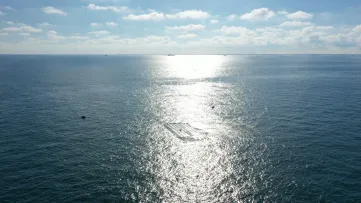
A four-year study in the Dutch part of the North Sea shows that a small-scale offshore solar farm did not cause measurable changes in currents and water mixing. At the same time, multiple species settled on the floating installations within a short period of time, including mussels, barnacles and other small marine animals. The results of the North Sea Two (NS2) project have been published in a white paper on the environmental effects of offshore solar energy.
From 2021 to 2025, Oceans of Energy, Wageningen Marine Research, NIOZ and Deltares monitored the operating offshore solar farm through an environmental monitoring programme. They investigated how the installation affected currents, water quality and the local biodiversity. In doing so, the project provided multi-year field data for the first time on the environmental effects of offshore solar energy in the North Sea.
Four research themes
The research focused on four interrelated themes: changes in currents, effects on the food web, development of biodiversity and habitats, and the use of the area by seabirds and marine mammals.
Measurements in the water were used to determine whether the solar platforms influence currents and water mixing. No measurable changes were found. The currents and water mixing around the solar farm did not differ significantly from the natural variation caused by tides and wave action.
It was also investigated whether the solar farm influences light in the water and algae and plankton, the basis of the food web. The measurements and model studies show that with this small-scale setup no substantial decrease in primary production is expected.
Mussels that settle on the structures filter algae from the water, which may locally reduce the amount of algae. In nutrient-rich conditions, this can lead to clearer water. In nutrient-poor areas, it may influence the available food supply for other species.
Biodiversity
The structures add artificial hard substrates in an environment where natural hard surfaces are scarce. These artificial hard substrates, including all the underwater parts of the solar farm, were quickly colonised by marine organisms. In total, 47 species were found on the platforms, including mussels, barnacles and other fouling species.
"Various species quickly settled on the underwater part of the solar panels. This shows how quickly such structures become part of the marine ecosystem. To understand what this means in the longer term, further research is needed," says marine ecologist Ninon Mavraki of Wageningen Marine Research.
The use of the solar farm by seabirds and marine mammals was monitored with cameras on the installation, supplemented by image analysis. Three gull species and both grey and common seals used the solar farm as resting ground. Their presence varied by season and decreased strongly at higher wave heights.
"Various species quickly settled on the underwater part of the solar panels. This shows how quickly such structures become part of the marine ecosystem."
- Ninon Mavraki
- Marien Ecoloog
Basis for monitoring and scaling up
The study concerned a small-scale setup. The effects of offshore solar energy on currents and light availability are strongly dependent on the scale of the project, as is also shown by a model study. In larger solar farms at sea, and especially when they are combined with offshore wind farms, effects may differ and additional research is needed to fully understand what they could mean for the marine environment. This study provides a valuable basis for that.
According to the researchers, it is important that countries align their measurement methods. This makes results more comparable and ensures a more reliable assessment of environmental effects in future projects at sea.
"Offshore solar energy can be a complement to offshore wind. This research shows that it is important to carefully monitor new energy solutions from the outset, so that energy generation and the marine environment remain in balance," says Brigitte Vlaswinkel, Head of Environment & Sustainability at Oceans of Energy.
The North Sea Two project was carried out within the North Sea Two Innovation Program and received partial funding from the Ministry of Economic Affairs and Climate Policy.


