
Future engineers are soaring to new heights as they design the next generation of autonomous emergency rescue vehicles.
A group at The Ohio State University has created "STUART," a Small Transportable Uncrewed Aerial Rescue Technology flight vehicle. The team - called The Sloopy Works - designed STUART as an entry for the GoAERO Prize, a three-year international competition aimed at helping first responders save lives by designing new medical aircraft. In the process, they set a new Ohio State record.
Weighing 120 pounds and spanning nearly 8 feet across, it is the heaviest drone ever built in the university's history to successfully take off vertically and fly on its own. As a prototype, the drone is only about one-third the footprint it would be if it were full-scale, yet its total lifted weight is 70% greater than the world-speed-record holding autonomous drone flown by Ohio State that took to the skies in 2017.
 "What normally takes an aerospace company five plus years to develop a new vehicle from scratch, we did within one year," said Kevin Disotell, a research scientist in mechanical and aerospace engineering at Ohio State and the director of the team. "This shows that our team was really resilient to be able to deliver an actual flying machine so quickly."
The GoAERO Prize competition comprises three stages, for which the total prize purse is $2 million. Stage 1 teams submitted an aircraft design and Stage 2 teams had to validate that concept by having their drone complete a 100-foot flight while carrying a small payload. Stage 3, which won't begin until 2027, will involve a final fly-off at NASA's Ames Research Center that will make the vehicles carry a 125-pound manikin in an obstacle-style course meant to test specific skills and capabilities relevant to future drone missions.
While the drone with the best performance will earn a $1 million top prize, Ohio State was one of 14 university entries to GoAERO from the United States to have been awarded concept-building funds from NASA's University Innovation project, which promotes university-led research into transformative technologies.
Self-flying vehicles, for instance, can be extremely useful for overcoming obstacles, assessing situations or reaching remote areas that would be impossible for humans to reach alone.
In the United States, more than 4.5 million people currently live in "ambulance deserts," areas where it could take emergency services 25 minutes or longer to reach them. High-tech drones can be used to quickly render aid and deliver life-saving supplies, such as bandages, medicines and blood bags, to these vulnerable communities.
Still, because autonomous technologies can struggle to complete certain tasks in their entirety, such as the rescue portion of a search-and-rescue mission, scientists hope to create aircraft that are more versatile than the small surveillance drones and large rescue helicopters typically used in emergency response situations, as well as help curb the shortage of pilots in rural areas.
"This project is so important, not just here in Ohio, but around the world, because we're tackling technical challenges that can have a real-world impact on families," said Disotell. "Few things are worse than an emergency victim that needs air evacuation, and you can't get a helicopter."
With this goal in mind, STUART, named in honor of Stuart Roberts, an Ohio State College of Medicine professor in the 1960s who developed the world's first hospital-based medical helicopter rescue program, was designed to be a smaller, portable vehicle that could both take off and land vertically. Guided by Matthew McCrink, co-adviser for The Sloopy Works group and an assistant professor in mechanical and aerospace engineering at Ohio State who has built and flown more than 50 complex aircraft, STUART is unlike a traditional helicopter.
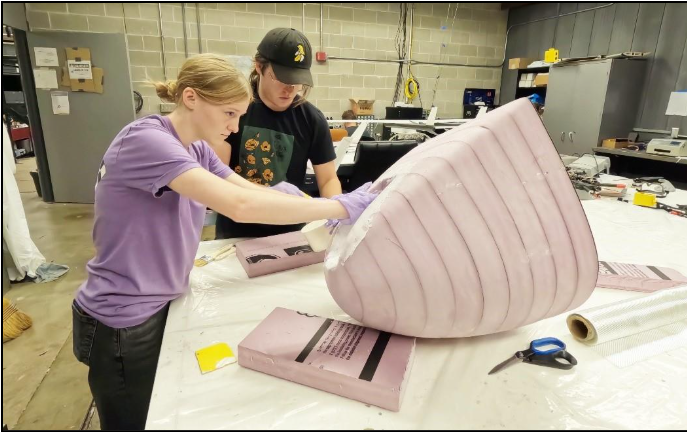 Instead, its powerful propellers are enclosed inside ducts to protect their components and people from damage, and onboard computers control the drone's movements in real time without the need for a human pilot.
During its flight attempt on a particularly cloudy day at The Ohio State University Airport last year, STUART reached the 100-foot marker while flying at 23 feet above ground at an average speed of about 3.4 feet per second. The successful flight demonstration yielded valuable engineering data, said Disotell.
"There were so many real-world lessons along the way in building and flying this prototype," he said. "It was a signature experience that I hope all our students on the team carry with them into their careers."
To document their achievement, the team will present their flight test results at the American Institute of Aeronautics and Astronautics (AIAA) Aviation Forum in June, during which teams can showcase their prototypes to the larger scientific community.
Despite the hurdles the team faced in bringing such a new design to life, many members found the challenges behind the experience inspiring, said Aditya Chittari, president of The Sloopy Works and a graduate student in mechanical and aerospace engineering at Ohio State.
"Taking on the challenge of creating an aircraft for real people and patients is something that we took charge of and did really well," he said. "This experience really pushed me to understand how different aspects of the design can all come together."
While the team did not receive one of the eight prizes for Stage 2, entrants aren't required to win a previous stage prize to continue into the next round of the competition - so the Ohio State team, powered by its enthusiasm for helping bring a new class of technologies to market, is working to forge ahead.
"We're very passionate about where we want to end up in the future," said Chittari. "We're going to keep pushing forward with ways to make an impact."
The project was supported by Farva Technology LLC.


