
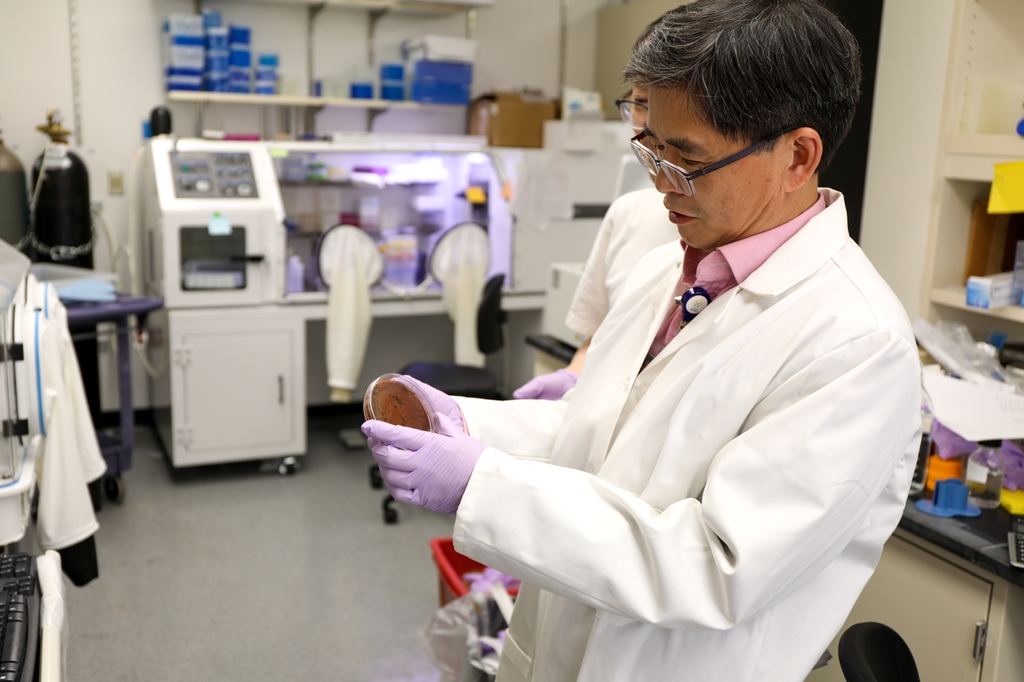
Oregon Health & Science University has received more than $11 million in National Institutes of Health funding, advancing research on oral microbiome science.

The funding includes awards — led by OHSU School of Dentistry faculty Hui Wu, Ph.D., associate dean for research, Justin Merritt, Ph.D., and Jens Kreth, Ph.D., both professors of biomaterial and biomedical science — that build on a coordinated research program spanning disease-causing microbes, health-promoting bacteria and microbiome-directed therapeutics.
Tooth decay is the world's most common noncommunicable disease, affecting an estimated 2.7 billion people and disproportionately harming children. Despite preventive measures, early childhood tooth decay continues to cause pain, infection, missed school and costly care. OHSU's research is an important step to improve prevention and treatment and help reduce its global burden.
"It's rewarding to be able to continue this work, building on the scientific advances we've made over the years and expanding our understanding of the oral microbiome," Wu said. "Importantly, this funding is a significant step toward translating research into treatments and interventions that can improve oral health for millions around the world."
Translational strategies for prevention, treatment
A five-year, $2.1 million grant continues a program supported by NIH since 2012, co-led by Wu and Christian Melander of the University of Notre Dame.
The research focuses on a particularly damaging partnership between Streptococcus mutans, a major bacterial contributor to tooth decay, and Candida albicans, a fungus frequently associated with severe tooth decay in early childhood. When these organisms grow together, they construct a protective biofilm on tooth surfaces that promotes persistent acid production and resistance to conventional antimicrobial treatment.
Working with collaborators in chemistry, structural biology, dentistry and infectious disease, Wu's team will develop and test small molecules inspired by marine derivatives designed to prevent biofilm formation and dismantle established biofilms. Rather than broadly killing oral microorganisms, the strategy seeks to selectively suppress disease-promoting activities while preserving beneficial bacteria.
The award arrives amid broader momentum for microbiome research within the School of Dentistry. Merritt recently received a five-year, $2.9 million grant to investigate the RNA degradosome of S. mutans, which is a protein complex that controls RNA turnover and global gene regulation and allows S. mutans to adapt, survive and promote tooth decay. His team aims to identify critical protein interactions that can be disrupted to selectively eliminate S. mutans while leaving beneficial organisms intact.
Additionally, Kreth has received nearly $3 million in NIH funding for two research projects exploring tiny particles released by Streptococcus sanguinis, a bacterium linked to oral health. His team will study how these particles protect oral tissues and regulate immune responses, with the long-term goal of harnessing beneficial bacteria to maintain a healthy microbiome and prevent disease.
Advancing students, researchers
Wu's second award, $3.1 million over five years, supports the Portland Oral Health Research Training program, or PORT, co-led by Carmem Pfeifer, Ph.D., D.D.S., professor and chair of biomaterial and biomedical sciences. The program leverages OHSU's campus-wide research ecosystem to develop the next generation of oral health researchers.
Established by Wu in 2021, PORT serves dental students, D.M.D./Ph.D. and Ph.D. students, postdoctoral fellows and dentist-scientists through mentored research, multidisciplinary coursework and career development. Trainees receive preparation in scientific rigor and reproducibility, responsible research conduct, data analysis, grant and manuscript writing, communication and professional development.
PORT also integrates two additional NIH-funded research training programs designed for high school students and undergraduates, directed by Kirsten Lampi, Ph.D., M.S., professor of biomaterial and biomedical sciences.
The funding will enable PORT to sustain and further develop OHSU's rigorous, interdisciplinary and professionally structured training environment, Wu says, accelerating the transition of students and trainees into professional careers where they can advance and improve oral health through discovery.
Wu says that by integrating strong interdisciplinary research in microbiology, biomaterials, tissue engineering, and clinical and translational research training, the School of Dentistry is building a distinctive platform to translate precision discovery into real-world oral-health interventions — as well as train the scientists who will carry that work forward.
"Research, patient care and education are all important pillars of our mission. Investment and advancements in these areas allow us to continue to provide the highest quality oral health care services to Oregonians, train the next generation of dentists, and promote scientific discovery," said Ronald Sakaguchi, Ph.D., D.D.S., M.B.A., dean of the OHSU School of Dentistry.
"I'm incredibly proud of our teams and look forward to seeing how these awards will advance their work."
This research is supported by the National Institutes of Health under National Institute of Mental Health grant numbers R01DE022350-11A1, 1T32DE036181-01, 1R01DE035840-01, 1R01DE035736-01, 1R21DE035757-01A1, and DE035757. The content is solely the responsibility of the authors and does not necessarily represent the official views of the National Institutes of Health.


