
When toxic chemicals are released - whether through industrial accidents, deliberate misuse, or unforeseen emergencies - first responders are the last line of defence between a contained incident and widespread harm. Their ability to assess risks, enter contaminated zones, and protect both civilians and themselves must be immediate, coordinated, and precise.
Supporting countries in strengthening national preparedness for chemical emergencies is a core mandate of the Organisation for the Prohibition of Chemical Weapons (OPCW) under Article X of the Chemical Weapons Convention (CWC). A key example is the Course on Emergency Response to Incidents Involving Toxic Chemicals in Unconventional Environments, hosted in Murcia, Spain, in cooperation with the Government of Spain, the Murcia City Council, and the Murcia Fire Brigade.
Now in its third edition, the course brings together experienced first responders from Latin America and the Caribbean (GRULAC), strengthening their ability to manage complex chemical incidents in environments where conventional response approaches may not apply.
From theory to practice in high-risk environments
Unlike classroom-based instruction, the Murcia course is built around real world scenarios. Participants train in industrial facilities, confined underground spaces, sewage systems, and water-treatment environments - locations where toxic industrial chemicals or chemical warfare agents could pose severe risks.
Over the course of an intensive week, responders work directly with personal protective equipment, self-contained breathing apparatus, chemical detection systems, sampling tools, and decontamination units. Scenarios are progressively intensified, requiring participants to apply zoning procedures, conduct safe entry into contaminated areas, collect samples, and manage simulated releases of hazardous chemicals such as ammonia.
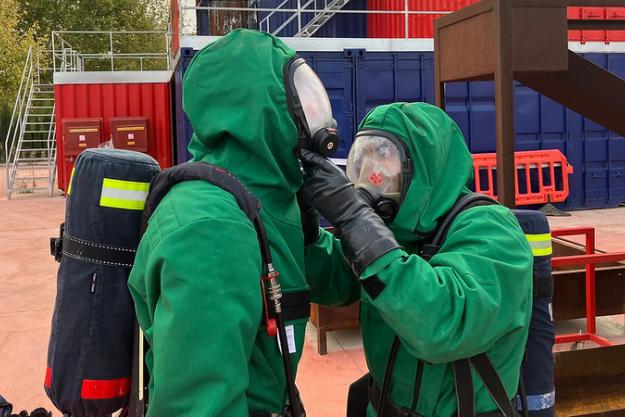
Training participants check protective equipment before entering a mock hot zone.
These exercises mirror the conditions responders may face in real incidents: limited visibility, physical fatigue from extended use of protective suits, time-critical decision-making, and the need to balance responder safety with life-saving actions.
Strengthening national preparedness national partnerships
The effectiveness of chemical emergency preparedness depends not only on training, but on strong partnerships that connect international expertise with frontline operational experience. In Murcia, the OPCW works in close cooperation with national and local authorities, including the Murcia Fire Brigade, to deliver training that reflects real response conditions and national operational realities.
"The Murcia Fire Brigade highly values its partnership with the OPCW, which we consider a strategic alliance for strengthening international preparedness and response capabilities in the field of CBRN emergencies," said Juan Manuel Bonilla Martínez, Fire Officer with the Murcia Fire Brigade.
As a frontline emergency service, fire brigades play a critical role in chemical incident response, supporting hazard identification, containment, rescue, and decontamination, often in confined or unconventional environments. Fire brigades are often the first responders to arrive at the scene, and the decisions they make in those initial moments are critical. While everyone else is evacuating, they are moving in.
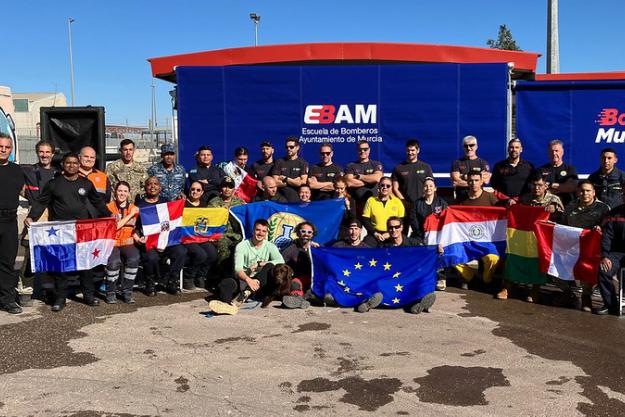
First responders from Latin America and the Caribbean gather at a training conducted jointly by the OPCW, the Government of Spain, the Murcia City Council, and the Murcia Fire Brigade in Murcia, Spain.
"The exchange of knowledge generated through these international training activities is of outstanding value. Lessons learned, new methodologies and updated operational approaches acquired through cooperation with the OPCW are systematically incorporated into our local response protocols. This continuous feedback loop directly enhances the quality, effectiveness and safety of the public service we provide to citizens, reinforcing our capacity to prevent, prepare for and respond to complex chemical incidents," Martinez said.
"Beyond the technical dimension, this partnership strengthens mutual trust, interoperability and a shared culture of preparedness among international emergency response organisations. It reflects a common commitment to the objectives of the Chemical Weapons Convention and to the protection of both responders and civilian populations," he highlighted.
The Murcia Fire Brigade contributes hands-on expertise drawn from operational experience, helping to ensure that OPCW training remains grounded, realistic, and directly applicable to the challenges first responders face in the field.
Building sustainable capacity under Article X
Beyond individual skills, the Murcia training series contributes to longer-term capacity building by fostering professional networks among participants and encouraging the transfer of knowledge within national institutions. Discussions and debriefings throughout the week allow for the exchange of lessons learned and highlight common challenges in the GRULAC region - such as limited resources and a lack of standardisation - particularly in regions where chemical incidents are relatively rare but potentially high-impact.
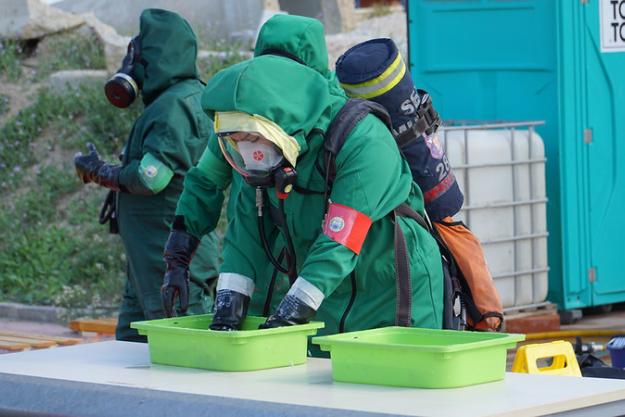
Training participant practices decontaminating when exiting the mock chemical hot zone.
Preparing together for large-scale chemical emergencies: CHEMEX GRULAC
Building on regional cooperation and sustained capacity-building efforts, a major CHEMEX multi-component exercise will take place in the Dominican Republic from 27 April to 7 May. Designed to strengthen the response capacities of GRULAC Member States, the exercise will test a comprehensive emergency response to incidents involving chemical warfare agents and toxic industrial chemicals.
The exercise will cover the full response cycle - from initial operations in contaminated environments to medical response, hospital coordination, and the treatment of affected victims - reflecting the complex realities of large-scale chemical emergencies. This important regional initiative is made possible through the generous voluntary contributions of the European Union, Canada, and Spain, underscoring the value of international solidarity in strengthening preparedness under Article X of the Chemical Weapons Convention.
Background
As the implementing body for the Chemical Weapons Convention, the OPCW, with its 193 Member States, oversees the global endeavour to permanently eliminate chemical weapons. Since the Convention's entry into force in 1997, it is the most successful disarmament treaty eliminating an entire class of weapons of mass destruction.
In 2023, the OPCW verified that all chemical weapons stockpiles declared by the 193 States Parties to the Chemical Weapons Convention since 1997 - totalling 72,304 metric tonnes of chemical agents - have been irreversibly destroyed under the OPCW's strict verification regime.
For its extensive efforts in eliminating chemical weapons, the OPCW received the 2013 Nobel Peace Prize.


