
Key points
- A chance meeting at a 2019 conference led to an ongoing wheat research partnership between Southern Australia and Kansas.
- An example of the power of international collaboration, researchers on both continents are testing shared assumptions about yield potential, nitrogen use and heat stress.
- Thanks to a Grains Research and Development Corporation (GRDC) International Visiting Fellowship, the collaboration is supporting the next generation of agronomists to think and work across borders.
You could be forgiven for assuming that Kansas and South Australia have very little in common.
When it's harvest time for wheat in Kansas, South Australia is only just sowing. The two systems sit in different hemispheres and opposite ends of the policy spectrum – one shaped by government subsidies, the other by open-market competition. Kansas wheat grows in the deep, glacial soils of the Great Plains. South Australian wheat across variable landscapes of heavy soil and sandy ground with a compacted layer half a metre down, often in the same field.
Fly between the two and you might not expect there's much a Kansas extension specialist – responsible for translating academic research into practical advice for farmers - and a South Australian farming systems agronomist could learn from one another.
Fortunately, that wasn't the case in 2019 when Dr Kenton Porker, a farming systems agronomist at CSIRO and Dr Romulo Lollato, a professor at Kansas State University in the US, first met at a conference. In fact, they had so much to say to each other that they're yet to stop talking.
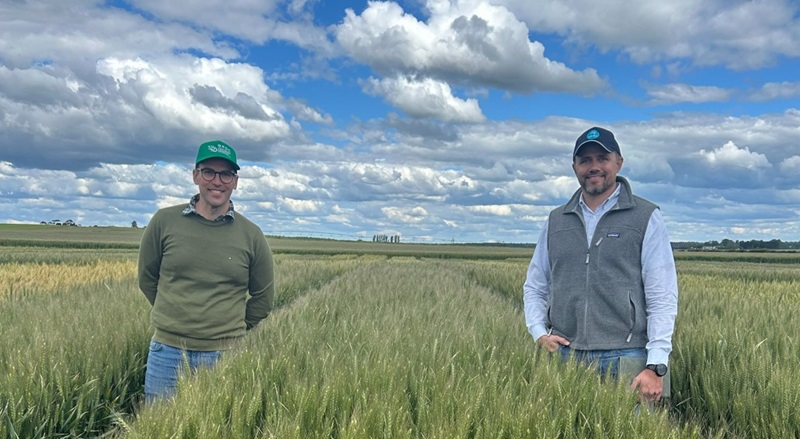
On that first occasion, Dr Porker offered to show his colleague around including a run of his own trial sites, offering a look at how South Australian wheat country actually works.
"We were at a similar career stage, with a similar interest in understanding wheat production and how agronomy influences it – and most importantly in how best to communicate with growers," Dr Porker said.
Dr Lollato recalled getting to witness Dr Porker in action.
"It is always great to meet people with a similar mentality and passion to the one we have, which was the case here. I was able to see Kenton speaking with growers at a field day and saw many similarities in what we were doing," he said.
The same headaches, from opposite sides of the world
That first meeting was the start of a beautiful (scientific) friendship. A catch-up at the American Agronomy Conference later that year, then an ongoing exchange of ideas carried mostly over WhatsApp across a 15-hour time difference.
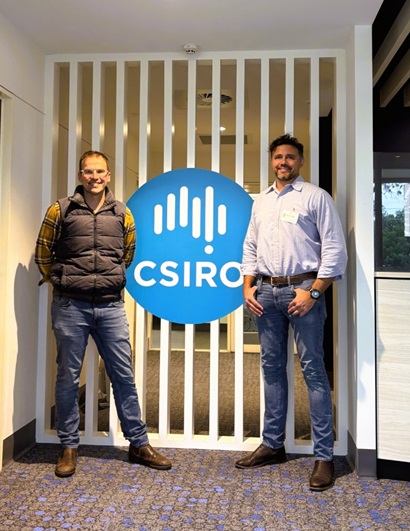
What made it work was the shared learning and insights.
In both regions, wheat is subject to climate challenges. In Australia, wheat has to develop its grain with combined stresses, such as frost, drought and heat. In Kansas, incredibly hot conditions can spark heat stress which damage yield and quality, particularly grain size.
Both systems are constantly recalculating crop inputs and management at the time of greatest uncertainty early in the season, when flowering and grainfill conditions such as how hot and dry the finish will be, is unknown. Both are working within nitrogen budgets that got sharply more expensive when fertiliser supply chains buckled during the ongoing conflicts in Ukraine and Iran. And both, it turns out, are answering to the same unexamined rule of thumb.
"We know what our water limited yield potential should be, and everywhere around the world people say, okay, we should only really be targeting 80 per cent of that potential, because the last 20 per cent is too costly or difficult to achieve due to logistics and or some other barriers," said Dr Porker. "But who came up with that number, and why? That's one of the big things Romulo and I are still working through – what does that look like in the US, in a slightly different and more subsidised system, versus Australia?"
The two data sets, run side by side, turned out to land close together. Different soils, different seasons, different attitudes towards risk – but strikingly similar numbers.
"It was incredible to see that the profitable yield frontier of these two very distinct systems were actually quite similar," said Dr Lollato.
"A winter wheat crop in Kansas, a spring rainfall-dominant environment where the crop is grown in rotation primarily with corn or soybeans and sometimes as a double crop, had very similar levels to profitably narrow the yield gap as that of the Australian spring wheat systems, typically grown as a single annual crop in a winter rainfall-dominant environment in rotation with canola, barley, and winter legumes.
"It's the sort of question that's easy to stop asking once you've spent long enough in one field. Having someone on the other side of the world ask it too, Dr Porker said, keeps both of them committed.
"You never regret looking at another system," he said. "It's hard to explain the benefit in a tangible way, but when you're talking science, explaining your own system to someone else, it just encourages you to understand it at a deeper level."
A very wet complication
This year, South Australia has handed Dr Porker a different kind of challenge.
The paddocks of SA are tracking well above rainfall average, wetter than the threat of a "super El Niño" media headlines would suggest, and his crops are tracking well ahead of where frost and/or spring heat would normally start to bite. The looming risk this season isn't drought. It's that there won't be enough nitrogen in the system to capture the yield the wet start has otherwise set up.

It's a reminder that theory only carries an agronomist so far and underscores that what agronomists actually share is the discipline of building systems robust enough to absorb whatever a season might throw at them.
"There's a temptation to overcomplicate it," Dr Porker said. "What we're trying to think about in systems agronomy is how to set up a system so it can capture all the upsides and downsides."
"Talking about climate extremes, the 2026 Kansas wheat crop went through it all - from nearly perfect sowing and establishment conditions in the fall, to an unusually dry winter and spring, heat, freeze, hail, and then flooding," recalled Dr Lollato.
"These factors led to a large area abandonment and very low yields, resulting in the smallest crop harvested in the state, probably since some 50-plus years ago. If it wasn't for modern genetics and good agronomy, what was a disaster could have been much worse."
The extension instinct
Part of what has kept Dr Porker and Dr Lollato talking, beyond the science itself, is a shared preoccupation with getting science off the page and onto the farm. Dr Lollato's extension workload in Kansas, transferring research and technical knowledge from scientists to farmers, is in Dr Porker's words, "crazy" – but Australian agronomists carry a version of the same brief, translating trade-offs into decisions a grower can actually use. For example, working with leading consultants to show them the ceiling of yield potential, and then working out how best to communicate that to growers and get close to potential.
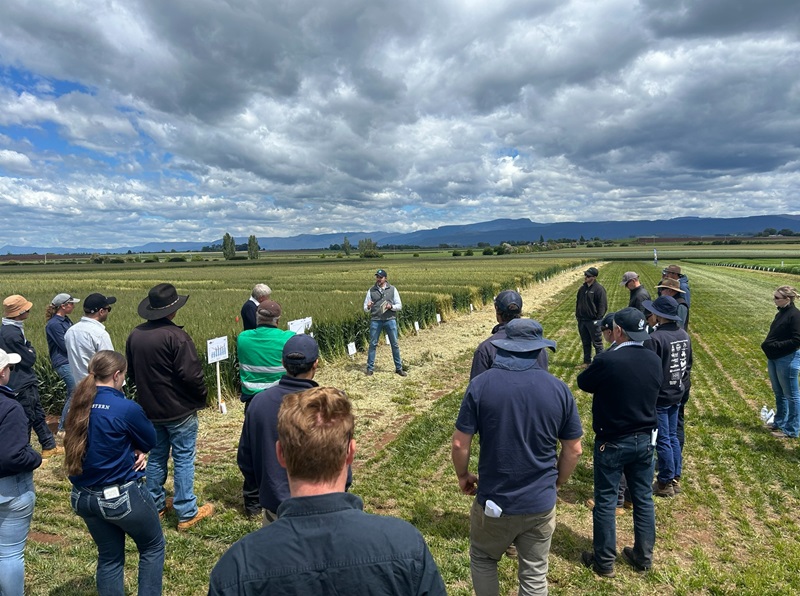
The two men have had an opportunity to look at even broader wheat systems across the globe as part of the Wheat Initiative Expert Working Group in Agronomy . This group, initially led by CSIRO's Dr John Kirkegaard and Dr Brian Beres (a wheat agronomist from Canada) is now co-led by Dr Porker and Dr Lollato and serves as a place for benchmarking ongoing global wheat agronomy research.
Dr Porker is also pushing for a global seminar series to connect early-career agronomists across borders – a small, deliberate counterweight to a field he said is too easily short-staffed.
"I'm relatively young, but I think a lot about how we continue to build capacity in science," he said. "The more we can encourage each other to work together, the better the outcome."
What's next
Dr Lollato return led to Australia in August as a keynote speaker at the Australian Agronomy Conference in Darwin , a trip supported by the GRDC International Visiting Fellowship Program . He shared highlights from his collaboration with Dr Porker as well as other work.
"I was really excited by the opportunity to share our research on the magnitudes of the wheat yield gaps, as well as their underpinning agronomic and social causes, in diverse wheat systems across the globe," said Dr Lollato.
He and Dr Porker are using the trip to compare notes on in-crop nitrogen management and pore over early results from the National Paddock Survey alongside the Kansas data and how different approaches to yield gap studies can deliver impact.

None of it will fully resolve the yield-gap question, or settle the nitrogen debate, or make the time difference any less brutal. Two systems that share almost nothing on paper keep landing, year after year, on the same unanswered questions – which may be the more useful discovery than any single result either of them has published.
"It keeps you invigorated in your job," Dr Porker said. "So, I think it's important."
"It is an immense opportunity not only for professional but also for personal growth", said Dr Lollato. "I loved how creative Dr Porker and other Australian colleagues are in finding agronomic solutions to very complex problems, as well as their integration of growers and crop consultants in the early phases of any given research. I am bringing these ideas back to the US."


