
Extreme weather has battered Pakistan in recent months, leaving a trail of destruction in its wake. Lives have been lost, livelihoods destroyed, and millions displaced.
As communities struggle to rebuild, many have little time to grieve the immense losses they have suffered.
Since June, over six million people in Pakistan have been affected by what have been described as "unusually heavy monsoon rains" which have claimed nearly 1,000 lives, including about 250 children.
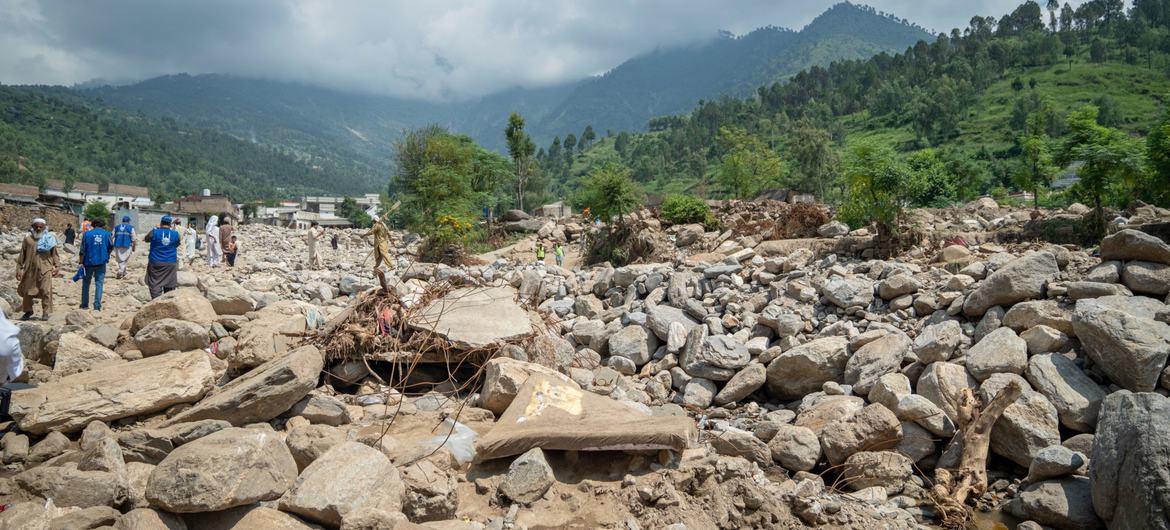
Residents are still recovering from flash floods that turned streams into roaring rivers of mud, with many displaced still sheltering in Government-run camps or with host families who are already stretched to their limit.
In the Buner district of northern Pakistan, dozens perished in Bishnoi village under boulders and debris when flash floods came crashing down the slopes, sweeping away homes and lives in a matter of minutes.
"We had never seen anything like this," said 35-year-old Habib-un-Nabi, a teacher from Bishnoi village.
His simple words carry the weight of grief and disbelief. Habib lost eighteen family members in a single day, including his parents and brother.
Those who survived barely had time to mourn. "We were too busy trying to dig out others, to help whoever we could," recalled Habib.
IOM support
The International Organization for Migration ( IOM ) in Pakistan began humanitarian operations in the northern flood-affected areas, where hundreds of lives were lost and thousands were left homeless.
In Punjab - Pakistan's most populous province and the hardest hit in terms of infrastructure damage during the 2025 floods - IOM worked with partners and through the Common Pipeline, a shared humanitarian logistics system that stores and delivers emergency goods.
Between August and September 2025, the UN migration agency distributed nearly 14,000 family relief kits tailored to local needs across all four provinces under a single project.
These interventions are part of broader efforts to help communities adapt to a climate crisis that is increasingly human-driven, fuelled by deforestation, rapid urbanisation, and the degradation of natural drainage systems.
In Naseer Khan Lolai, a village in Kashmore, 65-year-old Ali Gohar has lived through many floods, yet none has been as devastating as this one.
Entire homes collapsed, cattle were swept away, and the land - owned by local landlords - left farmers like him with little control over their recovery.
As floods and heatwaves intensify across Pakistan, communities are showing that adaptation is not only possible but essential, turning the human cost of climate change into a call for shared responsibility and stronger action.


