
Reintroducing the pioneering writer-scientist, whose influence and relevance carries forward through the centuries
Not many writers from the first half of the 19th century continue to inspire and provoke readers nearly 200 years later, but Henry David Thoreau stands out from his peers – then and now.
On Wednesday, April 8, the UConn Department of Earth Sciences, the Environmental Sciences Program, the Honors Program, the Humanities Institute, the Institute of the Environment and Energy, and the Office of Sustainability will host a special viewing of the new Ken Burns-produced documentary "Henry David Thoreau." The viewing is open to all and will be followed by a discussion with producer Susan Shumaker, UConn Department of History Draper Professor Emeritus Robert Gross, and Department of Earth Sciences professor Robert Thorson, who served as experts for the documentary.
Sometimes, a reading assignment changes the way you see everything. Many of those assigned to read the works of the famed New England Transcendentalist, whether it be "Civil Disobedience" or "Walden," have often found them to be the catalyst for inner change, Thorson says.
"Thoreau really mattered to me when I was a teenager in the late 1960s," says Thorson. "Student protests over the American war in Vietnam were peaking, and both Martin Luther King and Robert Kennedy were assassinated. And within a year, I enrolled in college to defer compulsory military service. My parents were conservative upper Midwesterners in a small town, and neither they nor other adults made sense to me. But Henry Thoreau made sense in a way that nobody else did. To be able to help bring his ideas to a wider audience is great."
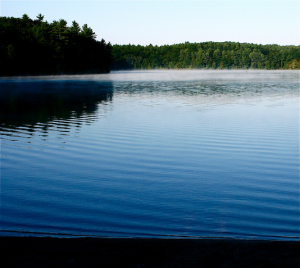
Now, in a similarly tumultuous time, Thorson says the documentary aims to re-introduce and humanize this natural scientist and prophetic philosopher, who for many is a force bringing welcome clarity in bleak times. Rescuing Thoreau from the stereotype of being a misanthropic hermit determined to live in isolation from society is a key aspect for introducing new audiences to one of the most celebrated authors in American literature, Thorson says.
"The documentary repositions Thoreau, not as one of the dead white men of the old canon that we are shedding as we move forward, but reactivating him as a sensitive and self-aware scientist-writer," Thorson says. "There's no question that Thoreau lies at the foundation of two big ideas in America. One, through 'Walden,' is the root of the philosophical ascetic strand of the environmental movement, which is why Rachel Carson kept a copy on her nightstand for devotional reading. The other, through 'Civil Disobedience,' is the root of nonviolent resistance to an unjust government. This essay, written about his night in jail, informed the approaches of Gandhi and Martin Luther King, who both read it when they were in jail. Many others were also inspired by it, from Leo Tolstoy to Emma Goldman, and many more."
Thorson explains that he was asked to join the project early in the process, where he offered expert perspective on the way Thoreau's natural science informs the literature in hopes of breaking down the divide between science and the humanities.
"My main message is to read 'Walden' as a work of science leading to literature, rather than high-minded philosophy that dabbles in natural science," he says. "If you can get people in the humanities to read a little bit of science underneath it, then they'll be more sympathetic, and vice versa. I've written a whole book for Princeton University Press addressing this divide. If we can reach people through literature, history, philosophy, media, books, whatever, that's when things happen. They don't happen when you disengage the heart from the head."
Though written in the mid-19th century, Thoreau's messaging in "Walden" holds true today: less is more, slow down and focus on the present, do not let technology own you. To add emphasis to his arguments, Thoreau documents in "Walden" how he built a small house, of just the right size, in contrast to needlessly large dwellings. Though he is dramatizing his point with what was essentially social theater, it is astonishing to consider that he foresaw, and was advising against, the so-called McMansions of today, says Thorson.
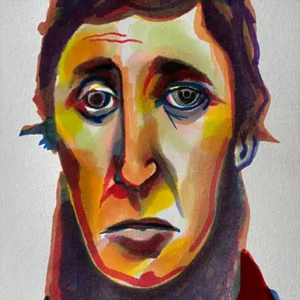
Where Thorson portrays Thoreau the scientist and his investigations of the natural world, Gross says he views Thoreau as a historical figure coming of age in a time of transition. Gross's study places the writer in the context of his hometown – Concord, Massachusetts – as it experienced rapid changes in all areas of life. The inherited institutions from late eighteenth-century New England were losing their collective hold, says Gross, and young people such as Thoreau were claiming greater freedom to shape their own selves.
"It was key to Thoreau's genius that he saw his neighbors throwing away the chance to lead full, deliberate lives and instead conforming to the materialism and superficiality of the times," says Gross. "No one need follow Thoreau's example literally. But his example, in life and on the printed page, is a constant spur to lead a meaningful existence."
By revealing a more complete and humanized account of Thoreau's story, the documentary team hopes that Thoreau's influential legacy will appeal to new audiences at a time when it seems it is needed more than ever.
"Thoreau is the ultimate influencer in the old sense of the word, and his ideas still work," says Thorson. "We hope people will go back and read 'Walden' after seeing the documentary. It's often assigned to somebody in high school or in early college. As they read it, sometimes with dread, they finish the assignment, and then never return to it. But you're not the same person you were when you were a student, so we're asking people to reread it from a modern sensibility. Our world is getting out of control and Thoreau's messages from the mid-19th century are rock solid today."


