
A new University of Otago – Ōtākou Whakaihu Waka study reveals two vastly different life courses for one of Aotearoa New Zealand's least-studied penguin species.
Published today in the journal PLOS ONE, researchers found Erect-crested penguins are split into two populations on sharply divergent paths – one that has been stable for at least 25 years, and the other which has lost more than 40 per cent of its birds in the past 30 years.
The study is led by Dr Thomas Mattern of the Tawaki Project – comprised of researchers based in Otago's Departments of Zoology and Marine Science – in collaboration with the Antarctic Research Trust and the Global Penguin Society.
Dr Mattern says Erect-crested penguins only breed on the Bounty and Antipodes islands, two remote groups about 800km southeast of the South Island.
Between 2022 and 2024, researchers used drones to photograph and count every breeding colony across both island groups – the first time this has been done for the entire species.
"The results overturn a long-standing assumption," Dr Mattern says.
"The tiny Bounty Islands, at just 50 hectares, were found to hold almost as many breeding pairs (about 27,800) as the Antipodes Islands (about 29,800), even though the latter is 40 times larger and historically considered the species' stronghold."
More strikingly, the two populations are moving in the opposite direction.
"Comparing the new counts with historical records going back to the mid-1990s, the Bounty Islands population has remained essentially unchanged for at least 25 years.
"The Antipodes Islands population, by contrast, has declined by more than 40 per cent since 1995."
Dr Mattern says there are compounding factors for this, such as predators, weather and migration routes.
"As Antipodes colonies have shrunk over recent decades, the collective defence they once provided against native subantarctic bird, the skua, a natural predator of eggs and chicks, has weakened, allowing predation losses to increase and colonies to fragment further."
Co-author Dr Klemens Pütz, of the Antarctic Research Trust, says Erect-crested penguins became more targeted after the demise of the Eastern Rockhopper penguin species.
Rockhopper numbers crashed "catastrophically" over the second half of the 20th century, mirroring trends elsewhere across the species' Southern Ocean breeding range, likely due to ocean warming, leaving less than 1,000 breeding pairs on the Antipodes Islands.
"As Rockhoppers disappeared, skuas may have turned to Erect-crested penguin eggs and chicks instead," Dr Pütz says.
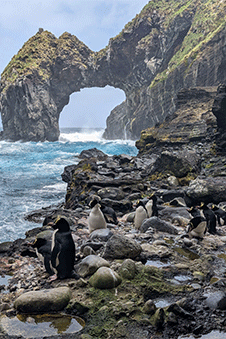 Erect-crested penguins near Castle Cove, Antipodes Islands
Increasingly severe storms, consistent with broader climate trends in the Southern Ocean, have triggered landslides that further fragment colonies and put them at risk, while differences in the penguins' ocean habitat and migration routes likely added to the problem.
Dr Mattern says Antipodes birds travel far into the Antarctic Polar Frontal Zone outside the breeding season, while Bounty Island birds stay close to more sheltered, potentially more productive waters near the breeding sites.
Researchers have dubbed the situation "Schrödinger's Penguin", after the well-known thought experiment in which a cat sealed in a box is imagined to be simultaneously alive and dead until someone opens the box and checks.
For the penguin, the logic runs in reverse, Dr Mattern says.
"With Schrödinger's cat, opening the box settles the question one way or the other.
"With Erect-crested penguins, it's the opposite. From a distance, without proper surveys, everyone assumed there was a single answer for the whole species.
"Once we actually opened the metaphorical box and looked, we found there wasn't one state at all, but two: stable on the Bounty Islands, declining on the Antipodes Islands."
The Erect-crested penguin is one of just four penguin species worldwide ranked "Endangered" on the International Union for Conservation of Nature Red List, as is another New Zealand species, the hoiho/yellow-eyed penguin.
But while the hoiho's plight has drawn sustained public and conservation attention, the Erect-crested penguin has gone largely unnoticed.
Dr Mattern says the ranking is based on inflated 1970s population estimates. Reassessed against the new data, that ranking broadly still holds for the Antipodes Islands, but not for the Bounty Islands.
"Averaged across both populations, the global ranking would actually improve to "Vulnerable", masking the severity of the Antipodes decline, and downplaying how exposed the Bounty Islands, likely the species' last secure stronghold, are to industrial fishing.
"A single, ostensibly improved threat ranking is like putting the lid back on Schrödinger's box, trading a convenient illusion for the stronger protection the Bounty Islands population actually needs," Dr Mattern says.
*The study was funded by the Vontobel Foundation (Switzerland) through the Antarctic Research Trust, the Global Penguin Society, and conducted under permits from the New Zealand Department of Conservation.
Publication:
Mattern T, Pütz K, Mattern H, Long R, Houston D, Keys B, White J, Seed R, Otis M, Ellenberg U, Garcia-Borboroglu P, Lüthi B
PLOS ONE


