'I would like to believe that there is a future where we can actually be negotiating between left and right'
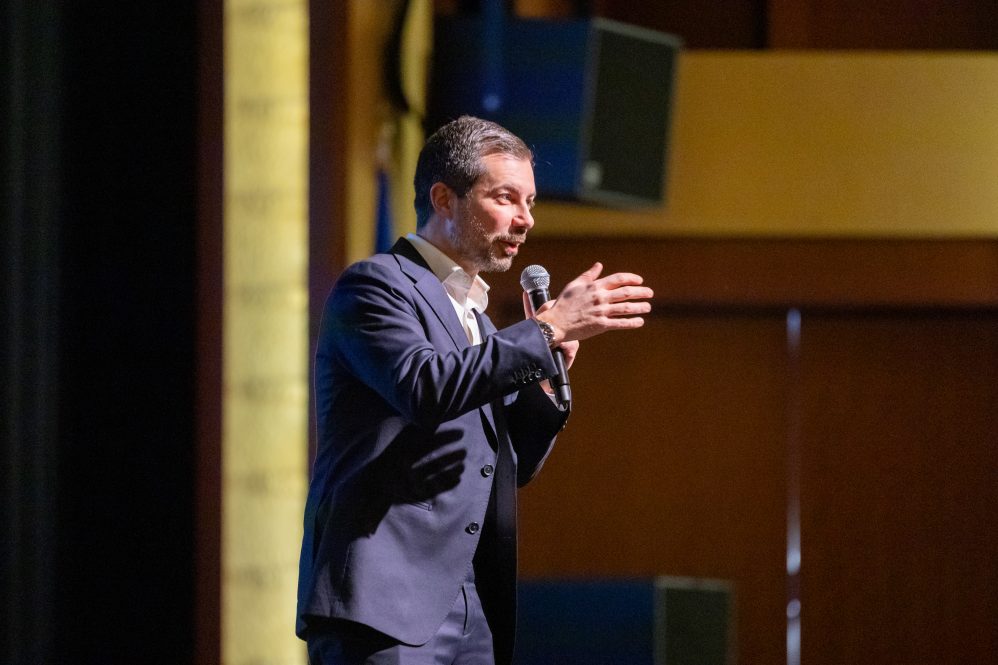
Former U.S. Transportation Secretay Pete Buttigieg speaks in the Belding Theater of the Bushnell Center for the Performing Arts during the Connecticut Forum's "On Democracy and the Future of the Parties" event on Saturday, Jan. 25, 2026. (Sydney Herdle/UConn Photo)
Former U.S. Transportation Secretary Pete Buttigieg had a simple three-word answer Saturday night to the question of whether he's running for president in 2028 - "I don't know."
"I'm not being cagey. It's just too early to make a big decision like that," he told a Connecticut Forum audience at The Bushnell in Hartford.
When author, political commentator, and co-founder and editor-in-chief of The Dispatch Jonah Goldberg pressed him, asking what would have to happen to get him to run again for high office, Buttigieg joked, "I feel like I'm being led down a path here."
More seriously, the Democrat who in 2020 won the Iowa caucuses and finished second in the New Hampshire primary, said it's a family decision.
Six years ago, he wasn't a dad to twin 4-year-olds, and that makes a difference, he admitted.
"There's going to be an interest in something totally different than we have right now," he speculated about the 2028 race.
So many institutions have been "burned down" under the current administration, he said, and while Democrats may be inclined to reverse many of the recent decisions and bandage together things like the U.S. Department of Education and USAID to look like they did in 2024, "That's a bad idea."
If these institutions were working well, he continued, the country wouldn't have elected someone who ran on a platform of upsetting the status quo. Whoever comes into the office next needs to rebuild from scratch - and do it smartly.
The question for the next few years should be "how do we fashion a future where we have a better everyday life," he said, and "I'm going to work on that no matter what."
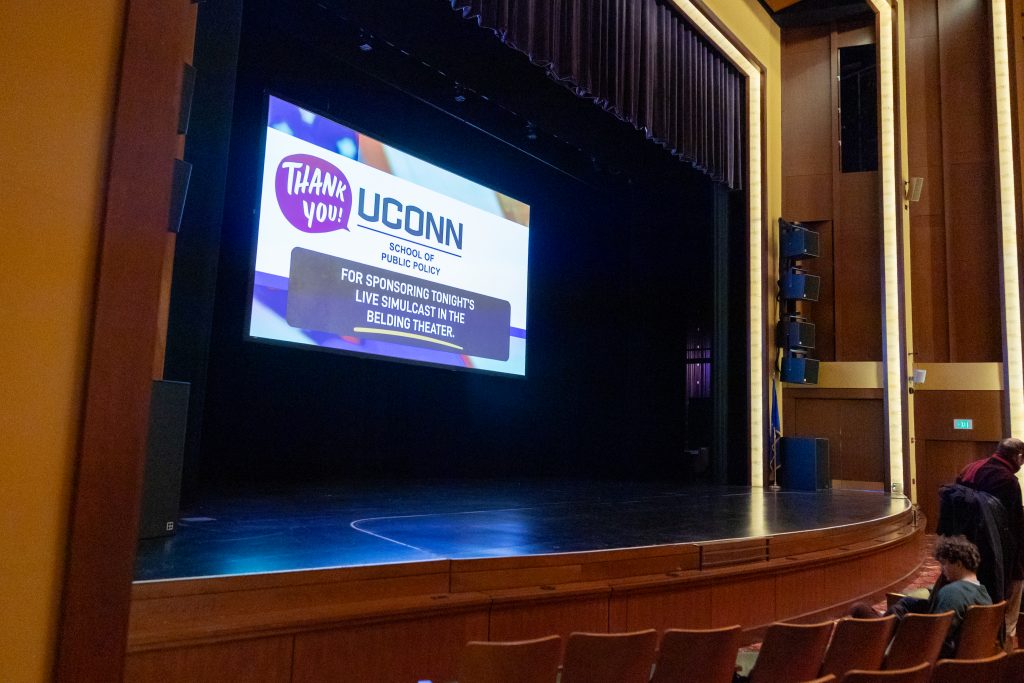
Even as Buttigieg declined to commit to another national campaign, the two-time South Bend, Indiana, mayor and former U.S. Navy Reservist, delighted not only the live audience in the Bushnell's Mortensen Hall but also an overflow crowd in the Belding Theater, where a simulcast of the event, sponsored by the UConn School of Public Policy, was being broadcast.
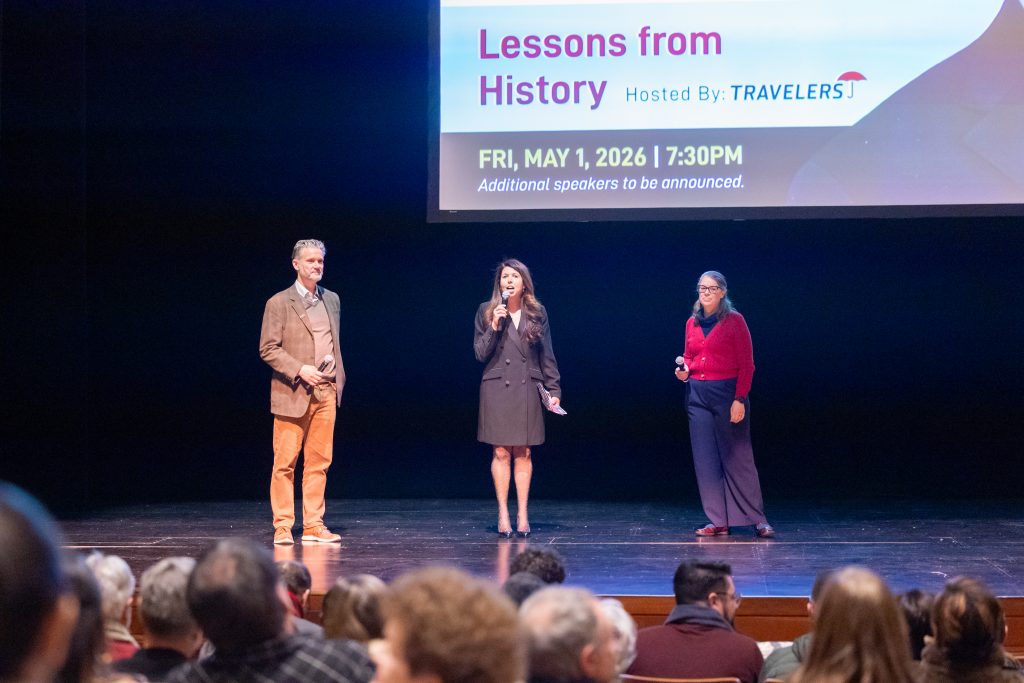
"We're really grateful for this opportunity," said Andrew Clark, director of the Institute for Municipal and Regional Policy in the School of Public Policy, as he and Angela Eikenberry, professor and director of the School, welcomed those in attendance, many of whom stood to be recognized as affiliates of the School.
Before Buttigieg took to the main stage next door for a nearly two-hour conversation with Goldberg "On Democracy and the Future of the Parties," he took a quick turn in the Belding, greeted by a rousing welcome.
As Goldberg – a self-described Regan Republican who started off by saying he is not a Trump supporter – and Democrat Buttigieg kicked off the conversation, both agreed the violence happening in Minneapolis, especially the recent ICE shooting deaths of Alex Jeffrey Pretti and Renee Good, are horrifying.
"It's a moment for national unity," Buttigieg said, later adding, "I would like to believe that there is a future where we can actually be negotiating between left and right."
Congress was founded to be the "supreme branch of government," Goldberg said, enumerating its powers including setting taxes and declaring war. "A huge amount of the problems we have today … (are) because the Founding Fathers were outright wrong" that 250 years later Congress would continue at the top.
It's not the U.S. Congress the Founding Fathers envisioned, Buttigieg agreed. With 435 seats in the House, only 1 in 10 races are competitive thanks to the way the districts are drawn and that's in a country nearly evenly divided among the parties. Congress isn't representative of the people anymore, he said.
The Founding Fathers also didn't imagine the amount of money that would influence politics and how that would shape Congress, Buttigieg said, disagreeing with Goldberg, who asserted the Citizens United decision was correctly decided.

Small, individual donors, Goldberg argued, are a bigger problem than large corporations because the latter have a longer vision and a more coherent understanding of the big picture. Small donors throw $15 to candidates who "monetize anger in the moment" and capitalize on a person's fury.
That ability to amass a significant campaign war chest through small donors gets elected outliers with radical ideas who then infiltrate a party and stack Congress with fringe beliefs, he said.
Buttigieg was thoughtful when Goldberg asked if there was something he believed about the Democratic Party in 2020 that he doesn't believe now after having been in Washington as transportation chief for four years.
"I always believed that ours was the party of and for working people and especially low-income people. Nothing should disturb Democrats more than the fact that we lost the vote of poor people in 2024," he said to applause from the audience. "If the majority of poor people don't think that we're here for them, what are we even doing as a party?"
Is that why Kamala Harris lost the election in 2024?
"She represented continuity at a deeply anti-incumbent moment," Buttigieg said.
And is that why Donald Trump won?
"There was a vote to burn the house down," Buttigieg said, elaborating that people wanted change, so even those who may not have liked Trump supported him because that's what he represented. They thought he was decisive, commanding, and that he would get things done.
Nonetheless, Buttigieg said, "How you voted doesn't make you a bad person, and how you voted doesn't make you a good person."
To which Goldberg surmised that many cast their votes in opposition to a candidate rather than in favor of the one they voted for - another problem of today's political system.
During a preshow talk as part of the Connecticut Forum's Youth PreView program, which drew about 45 students from the greater Hartford area and gave them the opportunity to personally query the panelists, Buttigieg admitted the heaviness of the question of how to maintain energy during trying times.
"We can generate hope through our actions," he said, pointing out that huge crowds of protesters have demonstrated in Minneapolis despite temperatures plummeting to 20 degrees below zero. "That matters. That will have an effect. … People should not underestimate their own power. … We've been through worse eras."
He restated that sentiment at the end of the main event, saying he once romanticized the 1960s with Woodstock, activism, and Jimi Hendrix and wished he could have belonged to it - until his parents reminded him of how violent the period was and how unsteady the country had become during Vietnam.
"This country has had moments of even greater despair and problems," Goldberg said, talking to an audience-question-asker who expressed despair. "Despair in Christian teaching is the greatest of sins. It literally means believing that you cannot be saved. It means that you are beyond God's grace. And the simple fact is in democracies you're never more than one generation away from things going off the rails."
Having the last word, Buttigieg responded that as a parent he can't be in despair and that his children one day likely will ask him about the 2020s.
"One way to think about our times is they are so fraught, so unstable, so unsteady, that if we handle them the right way they may one day be romanticized by a future generation," he said, referencing his own childhood. And, "a lot of these unprecedented things might be more precedented than we think."
He continued, "The wisest thing I ever heard said about hope is that hope is the consequence of action more than its cost. And, so, the question for all of us is what action do we take to generate that hope, so we can do right by the memory of these crazy 2020s."
The Connecticut Forum will sponsor a Forum Encore! Community Discussion at 11 a.m. on Tuesday, Feb. 3, at the Hartford Public Library, "From Campus to Capitol: the future of civic engagement in CT." Sponsored by the UConn School of Public Policy and Connecticut Public, it will feature Secretary of the State Stephanie Thomas and UConn student leader Ryan Engels '27 (CLAS), with additional speakers to be announced.