
In a trial on the effects of lower protein levels in the ration, milk production and feed intake were hardly affected by a moderate reduction in protein content. A further reduction, however, did lead to clear negative effects. These are the first results from research by Wageningen University & Research in collaboration with the Vereniging Diervoederonderzoek Nederland (VDN), LVVN, and the Melkveefonds.
Balancing protein, production, and the environment
The dairy sector is under pressure to reduce nitrogen emissions. One of the options is to lower the crude protein (CP) content in the ration of dairy cows. Protein-rich diets contribute to high nitrogen excretion through urine and manure. At the same time, protein is essential for milk production and animal health. Finding the right balance is therefore crucial for both the environment and dairy farmers.
The study, carried out at the Dairy Campus in Leeuwarden, followed 64 dairy cows over two full lactations. The animals received one of three rations with different protein levels, with realized average protein contents of 13.3, 14.3, and 15.4% CP for the low-, medium-, and high-protein groups, respectively. All cows received the same basal ration (12.4% CP), consisting of grass silage, maize silage, and rapeseed meal. This was supplemented with concentrate in different proportions to create the differences in protein content.
Data on feed intake (Figure 1) and milk production (Figure 2) from the first full lactation in the trial have now been analyzed. It is important to note that even the high-protein group, at 15.4% CP, was below the Dutch practical average of 16.1% (CBS, 2024). The results should therefore be viewed in the context of a relatively low protein level.
Results from the first lactation
Cows in the low-protein group ate less (21.7 kg dry matter (DM) per day) and produced less milk (on average 29.9 kg/day) than those in the medium-protein group (23.9 kg DM/day and 33.8 kg milk/day) and the high-protein group (23.9 kg DM/day and 34.4 kg milk/day). Fat- and protein-corrected milk production (FPCM) was also lower in the low-protein group (31.3 kg/day) than in the medium-protein group (35.8 kg/day) and the high-protein group (36.8 kg/day).
There were no significant differences in intake or production between the medium- and high-protein groups, although milk production in the high-protein group was on average slightly higher. The urea concentration in milk (Figure 3) was clearly related to the protein level in the feed: the lower the protein content, the lower the milk urea.
Reducing the crude protein level from 15.4 to 14.3% CP appears possible without significant loss of milk production or feed intake, offering prospects for nitrogen reduction in dairy farming. A further reduction to 13.3% CP, however, results in clearly lower feed intake and milk production, which is unfavorable for farm profitability.
The results provide dairy farmers and policymakers with starting points to find the balance between environmental gains and economic feasibility. It should be noted that the results from the second lactation and the analyses of effects on animal health are still to come, meaning that the long-term consequences will only become fully clear at a later stage.
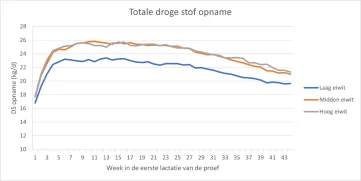
Figure 1: Dry matter intake of cows receiving rations with different protein levels (Low: 13.3%; Medium: 14.3%; High: 15.4%) during the first lactation (44 weeks) of the trial.
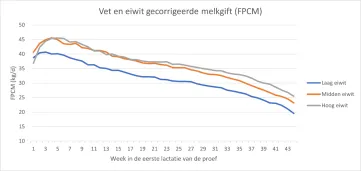
Figure 2: Fat- and protein-corrected milk yield (FPCM) of cows receiving rations with different protein levels (Low: 13.3%; Medium: 14.3%; High: 15.4%) during the first lactation (44 weeks) of the trial.
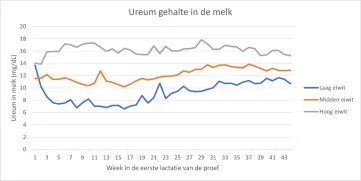
Figure 3: Milk urea concentration of cows receiving rations with different protein levels (Low: 13.3%; Medium: 14.3%; High: 15.4%) during the first lactation (44 weeks) of the trial.


