
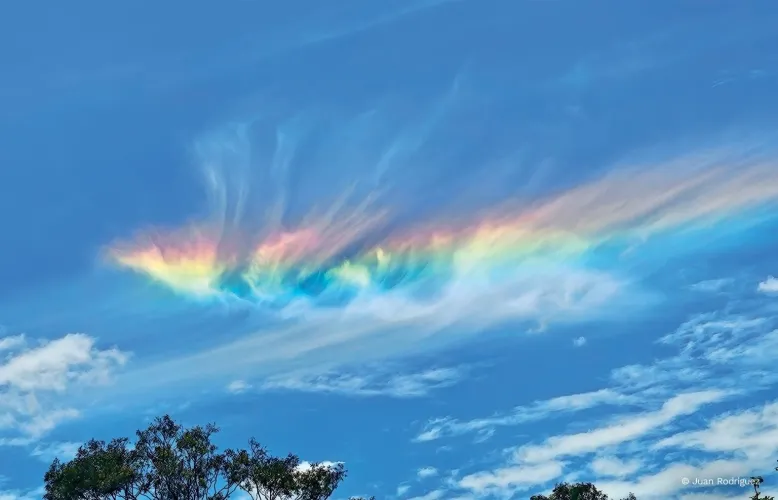
Rainbow cloud, Newport, Victoria. Credit: Juan Rodriguez.
A wisp of cloud shining with the bright colours of a rainbow dazzles in against a deep blue sky.
This image of rainbow cirrus clouds features as the January photo in the 2026 Australian Weather Calendar.
The iridescent rainbow cloud is a result of light being diffracted, or bent, around tiny ice crystals high up in the atmosphere.
Diffraction scatters light waves into rings or waves of colour that are randomly spread out.
Iridescence is more often visible in newly formed clouds, where the ice crystals are mostly the same size.
It also helps if the cloud is small or thin, so most rays of sunlight that pass through it are diffracted by a single icy droplet.
The colourful phenomenon was captured by Juan Rodriguez in Newport, Victoria.
Cirrus clouds, found at a height or 6 kilometres or higher in our atmosphere, are those pictured.
These are not the clouds responsible, however, for precipitation like showers, rain, drizzle and snow - this forms from clouds at lower levels of the atmosphere form such as middle level altocumulus, altostratus and nimbostratus clouds, and low-level stratocumulus, stratus and cumulus clouds.
The Bureau captures precipitation data using radars located across Australia, part of our comprehensive weather observation network made up of over 11,000 pieces of equipment.
Radars use radio waves to measure water in the atmosphere.
The information is converted into data that can be viewed on our website or the BOM Weather app.
Whether you're on a desktop computer, tablet or mobile, radar data can be viewed in one national mosaic image, or geolocated to a selected spot
The Bureau's 2027 Australian Weather Calendar national photo competition is currently open for submissions until March 31.
For the full terms and conditions of entry, and to submit a photo, visit: http://www.bom.gov.au/calendar/contest/


