
Key Points
Research based on fossil evidence has confirmed the theory that echidnas and platypuses descended from an aquatic ancestor with fossil evidence.
UNSW researchers analysed a fossilised upper arm bone of Kryoryctes cadburyi
Synchrotron CT and neutron tomography images revealed structural information about the species
Palaeontologists often use ANSTO's highly sensitive and penetrating but non-destructive synchrotron and neutron imaging techniques to reconstruct the evolution of species on our planet.
A paper led by researchers at the University of New South Wales (UNSW) published in the PNAS last year has confirmed the theory that echidnas and platypuses descended from an aquatic ancestor with fossil evidence.
Dr Joseph Bevitt, ANSTO's resident palaeontological imaging specialist, contributed to the work by undertaking synchrotron X-ray and neutron imaging scans of the fossilised bones of Kryoryctes cadburyi, a semi-aquatic ancestor of the echidna, on the Imaging and Medical beamline at the Australian Synchrotron and the Dingo neutron tomography instrument at the Australian Centre for Neutron Scattering.
Dr Bevitt explained that Kryoryctes is known from a single, isolated humerus or upper arm bone, lived approximately 106 million years ago, and was found at Dinosaur Cove in Victoria.
The bone is 46mm long and missing part of one end. The full length is approximately 50mm.
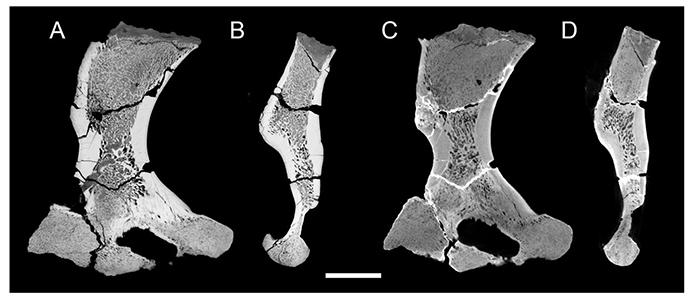
"We did extremely well to collect so much information from a single bone," commented Dr Bevitt.
"It is the largest mammal known from the Lower Cretaceous of Victoria and likely weighed around 2 kg. For comparison, long-beaked echidnas weigh between 5 - 10 kg, and platypuses are between 1.3 - 3.3 kg," he said.
"The humerus of Kryoryctes looks externally similar to the equivalent bone of land-dwelling, burrowing echidnas. Both the neutron CT, synchrotron and lab-based X-ray CT data revealed the same insight. The internal structure of the bone was, however, very different to that of echidna bones, which have thin walls and a hollow centre for efficient movement on land.
"Instead, the Kryoryctes humerus had a very thick outer wall bone and a small inner bone cavity. These features result in a high bone density as is seen many of today's semiaquatic animals, such as the sea otter and platypus, and in exclusively aquatic but slow, shallow-diving mammals, such as the dugong," said Dr Bevitt.
"Dense bones act as ballast, helping these animals stay underwater. This kind of bone specialisation is rarely seen in animals that are good at moving on land."
The compactness of the Kryoryctes humerus, and the width of its marrow cavity was statistically within the range of semiaquatic burrowing mammals (56.7%), such as the platypus and muskrat, with a lower probability of sitting within the range of burrowing nonaquatic mammals (32.8%), such as the sea otter.
This research was seriously impacted by the COVID lockdown.
To progress this research, Dr Bevitt coordinated handover of the specimen with Dr Thomas Rich, Senior Curator of Vertebrate Palaeontology at Museums Victoria, and Emeritus Professor Patricia Vickers-Rich AO of Monash University. Both headed the dig at Dinosaur Cove where the specimen was found by an unknown volunteer.
The day before Sydney went into hard lockdown, and state borders were closed, the pair drove the specimen from Melbourne to Wodonga, while Dr Bevitt drove from Sydney to Wodonga and back (1100 km) for safe transfer of the specimen for study.
"It was quite the adventure and worth it in the end."
Other collaborating institutions include the University of Salford (UK), Monash University, Museums Victoria, and the Museum of Natural History (France).
The research has been featured on the NIF facility website.
There is an amusing story as to why Kryoryctes cadburyi was named after the Cadbury chocolate company.
Dr Rich explained that he and Prof Vickers-Rich had been searching for any signs of mammal life from the time of the dinosaurs. During the dig at Dinosaur Cove, he jokingly promised that if anyone found a mammalian bone, he would shout them a cubic metre of chocolate.
The Cadbury factory in Tasmania learned of the promise and offered to make good on the bet. All volunteers of the dig were invited to the Cadbury Chocolate factory and were let loose in the board room full of chocolate bars, to take home as much chocolate as they each could carry. In recognition of the company's support for the dig, the species was named after the company.


