Regional and rural mental health services are under unprecedented strain, but a new Southern Cross University research partnership is working to ease that burden by co-designing practical workforce solutions with Northern New South Wales Local Health District.
Regional Services Under Pressure
In the wake of devastating floods, a global pandemic and a worsening housing and cost-of-living crisis, Northern New South Wales' mental health workforce has been stretched to its limits.
For some of the region's most experienced practitioners, the cumulative strain has led them to step away from frontline roles.
What remains is a workforce increasingly made up of early to mid-career mental health social workers – one part of the broader mental health workforce facing similar pressures – who are now being asked to step into leadership and mentoring roles sooner than expected.
That shift is one of the drivers behind new research led by Associate Professor Louise Whitaker at Southern Cross University (SCU), in partnership with Northern New South Wales Local Health District (NNSWLHD).
"If we're serious about retaining people in regional and rural services, then we have to work alongside the organisations and practitioners who are living this every day," Dr Whitaker said.
A National Problem with Local Consequences
Across Australia, the challenges are well documented. The National Mental Health Workforce Strategy 2022–2032 identifies workforce shortages, limited collaboration across disciplines and increasing service demand as major concerns. But statistics alone do not capture what it feels like on the ground.
Rather than approaching the issue from a distance, Dr Whitaker has co-designed the research with NNSWLHD Senior Mental Health Social Worker, Jessica Jeffreys. Their team is working in close collaboration with social workers themselves, including – in a full circle moment for Louise – some of her former students.
/prod01/channel_8/media/scu-dep/news/images/2026/Jessica-Jeffreys-Square.jpg)
Co-Design, Not Top-Down Solutions
Their co-design model means the research questions, methods and potential solutions are shaped by those directly affected. It also means the findings are more likely to translate into meaningful change. Meanwhile, the real-world insights are also informing Dr Whitaker's SCU curriculum design, ensuring its relevance.
Dr Whitaker believes a traditional 'top-down' research approach risks missing the nuance of these realities.
"We're building relationships, we're building trust, and something that is genuinely useful to the Local Health District," she said. "We're not just handing over a report at the end, we're working together from the start, so there's shared ownership of the outcomes."
Rethinking Burnout: It's Not What You Think
Importantly, early insights from participants challenge a common assumption about why social workers leave mental health roles.
There is often a perception that repeated exposure to other people's trauma inevitably leads to burnout. But Dr Whitaker said that is not what many participants are reporting.
"What we're hearing is that it's not necessarily the work with clients that wears people down," she explained. "In fact, many of the social workers talk about feeling energised by being able to respond. It gives them purpose and satisfaction."
Instead, the pressure points appear elsewhere – in stretched systems, unclear processes and insufficient time for reflection and peer support. By identifying these gaps, the research aims to develop practical retention strategies, such as improved peer networks and organisational supports.
Global Interest in Regional Innovation
Those early insights are already attracting international interest. Louise and Jessica have been invited to present their study at the 7th International Conference on Practice Research without Borders, to be held in July at the Singapore University of Social Sciences.
It's evidence that – while the context is Northern New South Wales – many regions globally are grappling with how to retain a skilled mental health workforce.
Collaboration in Action at SCU Symposium
The project's spirit of joint ownership was evident at the Southern Cross University Mental Health and Psychosocial Wellbeing Symposium, held on Friday, 27 February 2026 at the University's Gold Coast campus, where Jessica was part of a panel discussion on the impact of co-designed research.
The event brought together more than 70 representatives from health organisations, community groups and people with lived experience of mental health challenges.
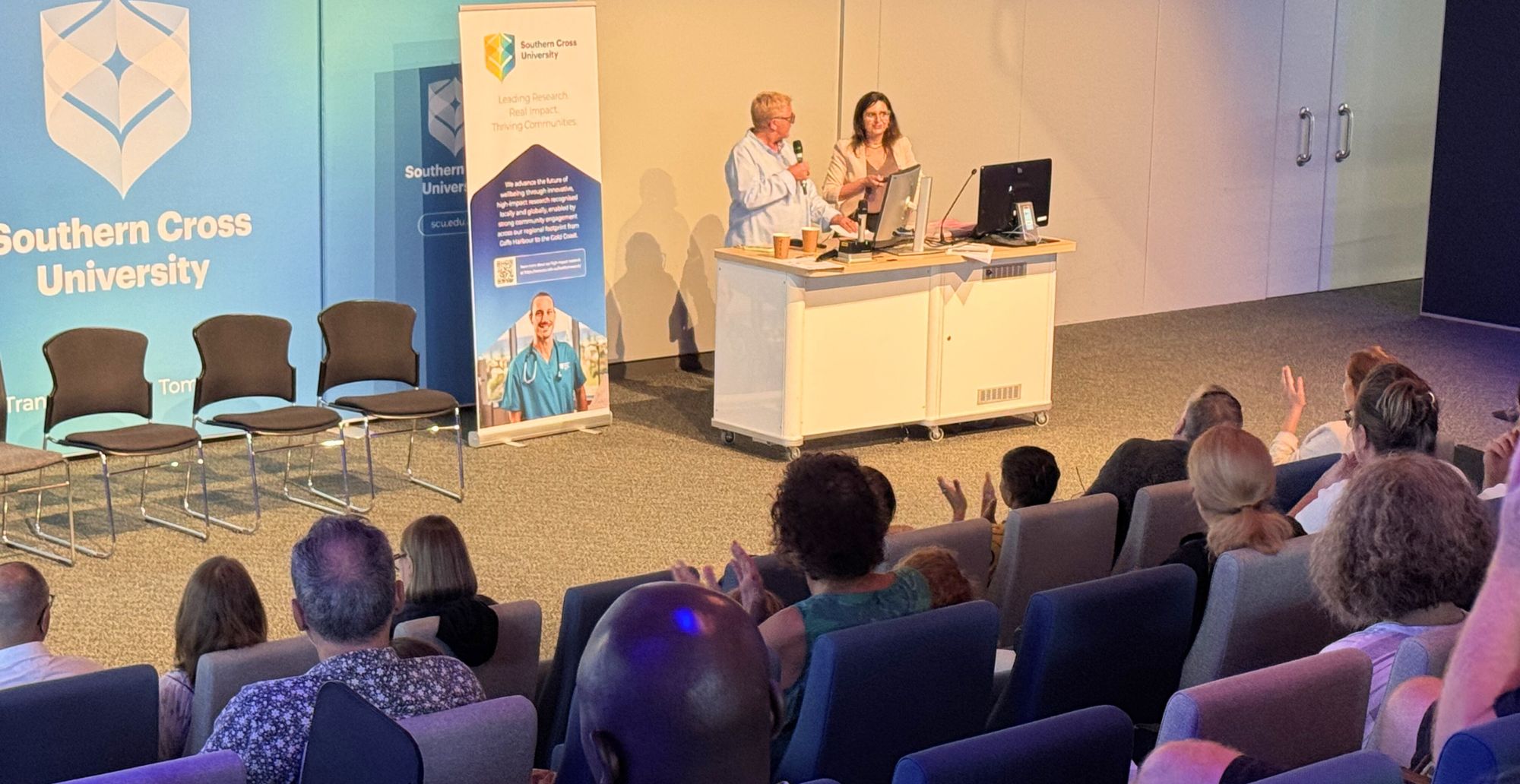 Gold Coast Health Professor Shanthi Sarma (right) and Advanced Peer Worker Titta Gigante at the SCU Mental Health & Psychosocial Wellbeing Symposium
Co-lead of the SCU Mental Health and Psychosocial Wellbeing research theme, Associate Professor Dr Eric Brymer said the symposium was abuzz with possibilities for impactful collaborations.
"It is very exciting to be able to tap in what's going on in the community because, I've found that, we often don't know what's going on," Dr Brymer said.
"Community organisations might have an issue, problem or challenge they want to resolve, and we may have the skills that will enable them to do that," he said.
"It's so important that communities and people with lived experience are involved in research. You can't overstate that benefit."
According to Dr Whitaker, "Limited connection and collaboration across mental health professions and disciplines is one of the challenges nationally, and events like this help bridge that."