What happens when tourists arrive at a popular destination only to discover it's off-limits?

Claire Hewitt (Te Arawa, Ngāti Rangitihi, Ngāti Tionga, Pākehā), a professional teaching fellow and marketing doctoral candidate at Waipapa Taumata Rau, University of Auckland Business School, is examining rāhui through the lens of responsible consumption. Her research explores how tourists perceive rāhui and how communication might influence their behaviour.
A rāhui is a traditional Māori mechanism that can be used to protect the environment by temporarily regulating access or activity around an area or resource. Rāhui can also be imposed following a death, preventing access to a particular location out of respect for the deceased and allowing time for the community to heal.
Rāhui may be marked by a pou rāhui, or post, while signage and other media are also used to communicate restrictions. A rāhui may be lifted after an agreed period or once the environment has recovered.
Claire's particularly interested in how communication can encourage respect for rāhui and support communities that rely on tourism.
The following is an edited excerpt of Claire's interview on 95bFM's Ready Steady Learn.
Q: What drew you to look at this topic in particular?
People from all over the world come to Aotearoa New Zealand to see our beautiful environment, and sometimes that comes at a cost to the ecology. At the same time, tourism has benefits for our communities and economy.
There have been instances where people come on this huge trip and find that, when they get here, there's a rāhui that prevents them from accessing the beach or having the experience they planned.
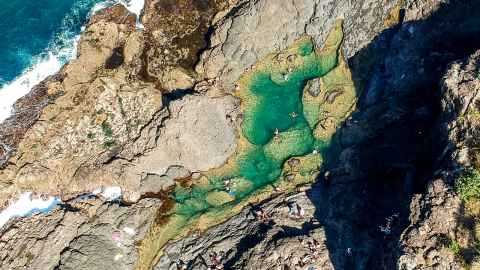
One example was up in Matapōuri at Te Wai o te Taniwha. These beautiful intertidal pools were getting really degraded by overtourism because the spot was marketed on social media sites like TripAdvisor.
So, the tangata whenua put a rāhui there. The first few busloads of tourists didn't really know that it was happening, but once they were told what it was about and that it was there to bring back balance, they were generally respectful.
So it's a really interesting thing to look at.
I've even come across rāhui on carrots, which I didn't expect.
Q: I guess often when we think about rāhui, it's coming from a cultural sensitivity angle or a sustainability angle. But it does have knock-on effects in terms of the consumption of nature from an economic standpoint. It must be interesting to look at how it all ties together?
Yeah, absolutely. And when we face these really big challenges around climate and the environment, on one hand, we need to do something different, but we also want methods that are proven and credible.
Rāhui fits into what we want. It has been studied by scientists and environmentalists, and we've seen really good results for the environment. But it hasn't really been looked at from where it intersects with consumers, tourists and the environment.
Q: Do you think that there's quite a lot of interesting work and research to be done in terms of integrating Indigenous knowledge into sustainability, particularly from a marketing perspective?
Oh yeah, and that's what's so fascinating. For a lot of people working in the space, including Iwi-owned organisations, there isn't much marketing theory that accounts for these different worldviews and paradigms.
So that's interesting as well, to look at these big, kind of mainstream marketing theories, which often see nature as something we're entitled to consume and assume we can just go for gold because we're human.
So it's quite nice to bring a different paradigm into that.
Q: I know it's early days for you in terms of your research, but have you figured out what sort of methodologies you might look at in terms of how you're going to go about the research?
We're using a kaupapa Māori-informed approach; we're talking to tangata whenua and having discussions about how they see rāhui and how they would like it to be researched.
The coolest part of that is that there are all these amazing stories that aren't really written down, and they often vary between different Iwi. So yeah, collecting those has just been such a pleasure and a privilege, and really interesting.
Q: It must be so cool when research looks like storytelling
Yeah, definitely. I've even come across rāhui on carrots, which I didn't expect.
Carrots take a lot of the nutrients out of the soil, so rāhui are used almost like crop rotation where you would grow carrots one year but then not the next year so that the soil can replenish.
Another cool thing I heard is that back in the day, when they wanted to let people know that there was a rāhui, if they didn't have a big pou, they would keep tūī because they're real mimics. So they would teach them all the curse words, and then when there was a rāhui, they would send them out into the bush.
So if you were out there walking around, you would hear all these strange-sounding voices cursing at you and think, 'Oh, we're not supposed to be here'.
It was probably a real kind of ethereal sort of feeling... 'Is that a person or not?' and it would get you out of there pretty quick.
Q: What are you hoping that the research will bring about for you, and what are you hoping to find out long term with it?
I'm hoping my research will help us understand how tourists view our natural environment and whether explaining the purpose of rāhui in a particular way will encourage people to respect them.
Ultimately, it's about finding ways to protect our environment while allowing tourism and the communities that depend on it to keep doing their thing.