
Using a new AI method, researchers from the University of Copenhagen have rediscovered 51 old pea varieties that are no longer used in agriculture but may prove promising for the production of plant-based foods. The method is a shortcut to finding new resources in the green treasure troves that gene banks' enormous seed collections represent.
The demand for plant-based foods is increasing worldwide. Peas in particular are a burgeoning source of high protein content as a substitute for meat. With their small climate footprint, peas are sustainable to grow and provide a high yield. However, the pea varieties we grow today require intensive industrial processing.
"Today, we use very few pea varieties in agriculture, which are primarily produced for their properties as pig feed, but are not intended as protein in a plant-based burger. Just as an apple is not just an apple, a pea is not just a pea, even though it may seem that way in the supermarket," says Associate Professor René Lametsch from the Department of Food Science.
In the quest to find suitable pea varieties, researchers from the Department of Food Science at the University of Copenhagen have developed a new AI method. They have unleashed it on the Nordic gene bank NordGen, which contains almost 2,000 different types of peas, in order to identify old pea varieties that are well suited as plant protein for humans.
"The gene banks contain an enormous variety that is largely untapped today. Our method makes it possible to utilise the plant resources in the gene bank and quickly find the most interesting types," says René Lametsch.
Smooth or wrinkled? 51 promising pea varieties found
Using the new AI method, the researchers have found 51 old pea varieties that are no longer used in agriculture but appear to have promising properties as plant food, including high starch and protein content.
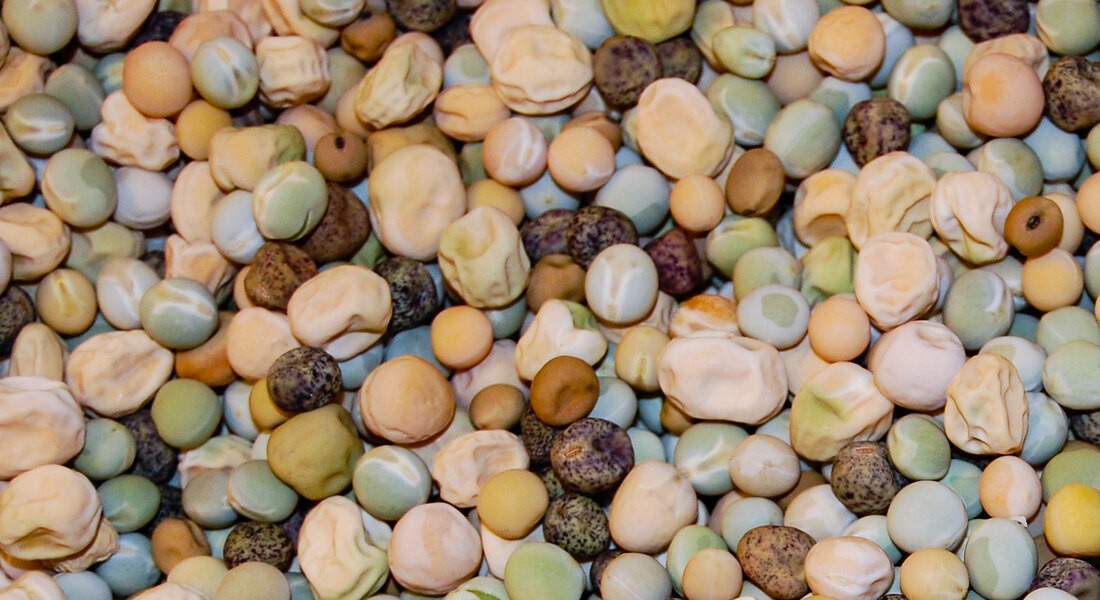
The method can automatically measure the shape, colour, size and surface of the seeds from ordinary photographs. The combination of image data and information about protein content makes it possible for the AI to select a small but
NordGen serves as the Nordic countries' joint gene bank for plants and as a knowledge centre for genetic resources. The gene bank contains over 33,000 seed samples from approximately 450 plant species and 95 potato varieties, which are preserved as living cuttings. NordGen's primary task is to ensure the conservation and promotion of the sustainable use of genetic resources in plants, livestock and forestry throughout the Nordic region (read more at www.nordgen.org).
representative sample of peas, which can then be analysed in depth.
"There are widely varying characteristics from variety to variety, especially in terms of starch and protein content, so it can make a lot of sense to revive some of the old varieties in our search for good ingredients for new types of plant-based foods," says René Lametsch.
The study shows that the appearance of the seeds is closely related to their chemical composition. One feature in particular - how smooth or wrinkled the seed is - is closely linked to the type of starch the pea contains. This means that, for the first time, researchers can partially predict chemical properties based on images alone.
"We see a surprisingly large variation in the balance between the two key proteins in peas, legumin and vicilin - far greater than in today's commercial varieties. This makes the gene bank's old peas an untapped gold mine for the development of future plant-based foods," concludes René Lametsch.
About the study
The study was published in Food Chemistry and was conducted in collaboration with NordGen and several research groups at the University of Copenhagen.
CRediT author contribution statement
Qinhui Xing: Authorship - original draft, visualization, validation, methodology, investigation, formal analysis.
Zhi Ye: Authorship - original draft, software, methodology.
Bo Yuan: Validation.
Xiaoxiao Liu: Validation, methodology.
Morten Arendt Rasmussen: Authorship - review and editing, software, methodology, formal analysis.
Jacob Judas Kain Kirkensgaard: Authorship - review and editing, resources, methodology.
Michael Lyngkjær: Authorship - review and editing, resources.
Ulrika Carlson-Nilsson: Authorship - review and editing, resources.
Cecilia Hammenhag: Authorship - review and editing, resources.
Rene Lametsch: Authorship - review and editing, supervision, project administration, methodology, fundraising, conceptualization.
Declaration of competing interests
The authors declare that they have no known competing financial interests or personal relationships that could influence the work reported in this article.
Funding
The project is supported by the Novo Nordisk Foundation (grant number: NNF220C0079385). Data were generated using research infrastructure at the University of Copenhagen, partly funded by FOODHAY (Food and Health Open Innovation Laboratory, Danish Roadmap for Research Infrastructure).


