
'There's something exhilarating about having a script out and watching the actors play and work with it. There have been times I've forgotten that I had anything to do with writing it'
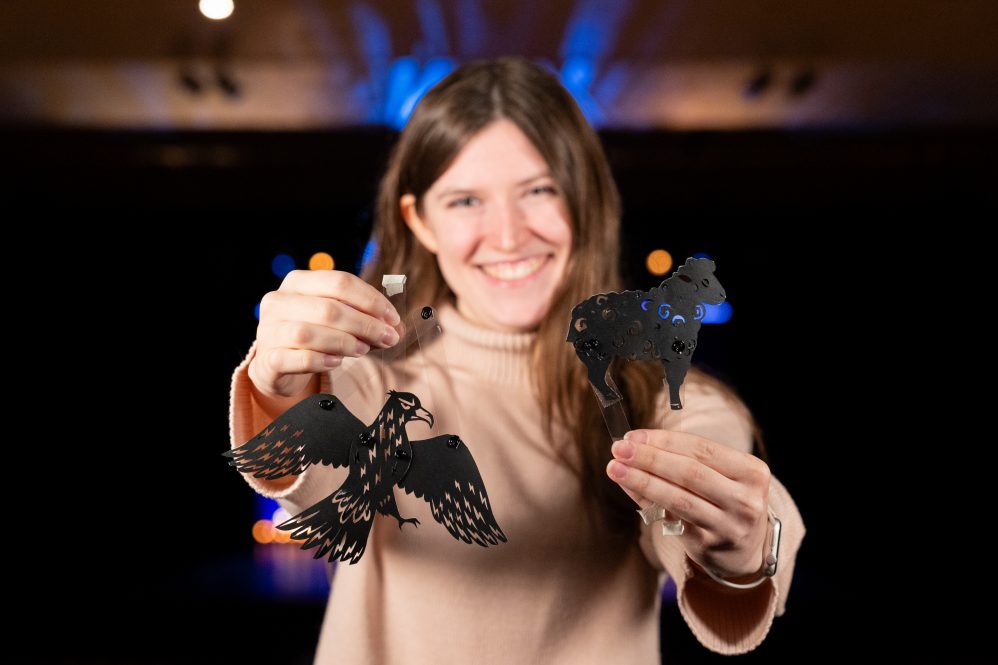
Emily Finch '26 (CLAS) poses for a photo with some of the puppets she will be using in upcoming productions of adaptations from the Aarne-Thompson-Uther Index in the Jorgensen Center for the Performing Arts on Monday, March 23, 2026. (Sydney Herdle/UConn Photo)
Some parents say their children walked only so they could run, but Emily Finch's mother tells people her daughter learned to read only so she could write.
"I guess that's pretty telling," Finch '26 (CLAS) says of the characterization. "I've been enamored with storytelling for so long, however I could get it. I certainly consider myself a big reader, but that can't exist for me without, also, creation."
 Finch says she carries creative projects in her head, throughout the day in spare moments ruminating on how a piece of dialog could run smoother, how a transition could bridge sturdier. As she tries to fall asleep, of course that's when puppets burst in, an imaginative spin on how a tale could be better told.
For the last two years, the Greek mythology of Eros and Psyche has consumed most open cerebral file space, along with a trio of folktales about a hedgehog, white bear, and venomous snake, as the English and individualized studies major looks to cap a University Scholar project on a grand scale.
"I keep going back and forth between the fear and joy of it," she says of an upcoming performance of two of her recent works. "There are moments when it's scary or even difficult to think about. Often with things that I've created, I don't want to look at them after they've left my body and are on the page. So, going back, over and over, looking at these scripts has been a learning experience to become comfortable with that process."
Having written a couple dozen plays, plus a couple dozen more, over the last five years, Finch can call herself a playwright, but after the April 10-11 performances of "Eros and Psyche" and "Hans My Hedgehog," she can call herself a playwright whose vision was performed on the Harriet S. Jorgensen stage.
Mythology Brought Her to Playwriting
Finch didn't know about the scholarly Aarne-Thompson-Uther Index system that groups similar folktales by narrative patterns and motifs when she was a Hamden first grader. That came much later.
Rather, she was the young student who on library-media center days gravitated to the Greek and Roman mythology section to check out books on Hades and Dionysus, Apollo and Diana, hardcovers and softcovers that hadn't been touched in years.

"Mythology is so different from much of the children's literature that I was seeing," she says. "These were stories where the stakes were always so high. I remember loving Perseus and his whole story. He slays Medusa and rescues the princess from the sea monster."
In high school, she played Tiresias, the blind prophet in the play "Antigone," and learned about an independent study the assistant director, someone in the grade above her, was doing with the school's drama teacher to learn about dramaturgy and directing.
She thought it would be fun for her senior year, a way to play while making a play before the rigors of college.
"I wrote probably 15 or 20 short plays over the course of this independent study, and then I sat down and started writing about women in Greek mythology, what I saw as the pitfalls they seemed doomed to fall into and repeat, and it turned into a full-length, two-act play," she says.
Her teacher was impressed - "You need to hear this out loud," she told Finch.
They organized a table reading, 25 friends in a circle giving voice to characters bemoaning the monsters they encountered, scapegoating they endured, and evil stepmothers in their midst.
Then her teacher chimed in – this show must be staged.
"Getting to spotlight so many of my friends who I had seen get passed over for roles and people who I'd never really met but shined at the audition, and then getting to see everyone grow in a way they might not have otherwise, that was the moment when I thought, 'Oh, this is something I could do,'" she says. "I always liked writing, and I'd always liked being in plays, but the idea of bringing the two together just did not occur to me or seemed out of reach."
Double Major: English and Individualized Studies
While Finch says she didn't know what she might do with an English degree from UConn, picking it as a major nonetheless was a natural choice. After a successful submission to a student-sponsored one-act play festival, she gave serious thought to adding a double major in theater studies.
The only catch: she didn't want to act, she wanted to write.
And without a defined track for aspiring playwrights at UConn, Finch says she discovered that the Individualized and Interdisciplinary Studies Program allowed her to create her own, in this case blending relevant classes in the School of Fine Arts and Neag School of Education, alongside those in the College of Liberal Arts and Sciences.
Her personalized program – creating and educating for the stage and screen – has included classes in film writing and acting for nonmajors, and seminars in dramaturgy and on the existing corpus of plays, among so much more.
Finch says the networking she did as part of her individualized major put the University Scholar Program in her grasp, along with the Office of Undergraduate Research's IDEA Grant, both of which supported her latest and biggest project.
"There's always the fear with something you've created that it won't make sense to anyone but you or that no one else will like it," she says. "But there's been such a community supporting me through this, which has been so lovely.
"And it's so wonderful to be in a rehearsal space again," she continues. "It's not something I've done a whole lot of in the past two years. There's something exhilarating about having a script out and watching the actors play and work with it. There have been times I've forgotten that I had anything to do with writing it."
Telling Stories with Puppets
The first weekend that Finch stayed overnight on campus, a welcoming committee, headed by a giant goose puppet on display at the Ballard Institute and Museum of Puppetry, assured the tender first-year that Storrs indeed was a good choice.
"I was raised in a family that loves the Muppets, so when I was 4 or 5, I saw the Muppet movie and just fell in love with it," she says. "Puppetry has always been an art form that has existed in my mind in a way that's maybe not the most common. At the Ballard, that enormous goose puppet that had been constructed for an opera, it was just mind-blowing, the craftsmanship of it."
When Finch started considering how she might stage "Eros and Psyche," puppets were obvious, of course, an idea conceived as she reclined trying to fall asleep one night.
This is a story of the Greek god Eros; his relationship with a young princess Psyche; his jealous mother, the goddess Aphrodite; and the life-or-death trials through which Psyche is put before being able to reunite with Eros and being made a goddess herself.
Shadow puppetry, Finch thought, would be an ideal way to stage a show, as they're in partial obscurity behind a screen and backlit with a light, an object of illumination that in the story both dooms and saves Psyche.
She connected with UConn's Puppet Arts Program in the Department of Dramatic Arts and commissioned about 20 shadow puppets for the show, visiting the program's home on the Depot Campus in what she describes as a "dream of Emily, age 5."
A second commission of foam and rod puppets for the show's second act - a performance of the folktale "Hans My Hedgehog" - rounds out the performance.
"Especially with folklore, I'm interested in bringing these stories back into oral tradition, which is where they emerged," Finch says. "It was people in a room together listening to someone tell the story. It's aurality, but also it's something you see in front of you. You can't not make facial expressions when you're telling one of these stories, especially if you're doing dialogue in your presentation of it. Oral traditions generally are a physical practice."
The scholarly Aarne-Thompson-Uther Index classifies "Eros and Psyche" and "Hans My Hedgehog," which originated in Germany, with "East of the Sun and West of the Moon" from Norway and "The Snake Prince" from India in its category 425, which has become colloquially known as the group, "The Search for the Lost Husband."
In each of these stories, the female lead withstands trials to reunite with her husband and save him, Finch explains, adding that the story "Beauty and the Beast" is indexed as 425C, similar to those in 425 although not exact.
While she's studied all four plays in category 425, Finch's upcoming show includes performances of only the first two – staged readings, she says, rather than full productions, though still with blocking, lighting, puppets, and some costuming and sets.
"I hope the audience sees how delightful this story is in both of these individual tellings from very different cultures. These were classed by scholars as the same and they likely were transmitted orally across time and geographical space, but they exist independently from one another, yet they are so similar," Finch says.
She adds, "These are human stories, even when they talk about Greek gods or a man that was cursed to look like a hedgehog. They're stories about people, and I hope the audience walks away seeing how important those similarities are and how similar humanity is."
And that's even if someone first walks to run, talks to sing, or reads to write.
"Eros and Psyche" and "Hans My Hedgehog" will be performed as a single show on Friday, April 10, at 7 p.m. and Saturday, April 11, at 2 p.m. in the Harriet S. Jorgensen Theatre. Admission is free.


